Renting an ATV in New Mexico
Renting an ATV in New Mexico can look simple until you have to choose a machine, understand what your booking includes and work out whether you can ride it on your planned route. The key is to settle those details before you pay. Use this guide to compare ATV and UTV rentals, check safety and permit questions, and avoid preventable surprises at pickup or on the trail.
Start with the ride you actually want
An ATV rental is a good fit when you want a compact machine for a solo ride or a route where the rental provider specifically allows an ATV. A UTV, also called a side-by-side, is generally the better category to consider when you need seats for passengers, a more enclosed riding position or space for gear. Neither choice automatically makes a route suitable: machine size, terrain, access rules and the rental agreement all matter.
Before comparing machines, decide what kind of outing you have in mind. Are you looking for a guided ride, a self-guided route, a brief introduction to off-road driving or a longer day away from town? Do you want to ride on a trail system, a forest road or a route that the rental company designates? A booking that sounds right in a headline may not include access to the terrain you pictured.
New Mexico defines an ATV as a motor vehicle fifty inches or less in width with an unladen dry weight of one thousand pounds or less, according to the Motor Vehicle Division NM. Rental listings may use “ATV,” “quad,” “four-wheeler,” “UTV” and “side-by-side” in ways that are meant for shoppers rather than legal classification. If the machine type affects your route or eligibility, ask the provider what vehicle you will receive and how it is classified.
| What you want from the ride | What to ask about | Why it matters |
|---|---|---|
| A solo, compact machine | Whether the booking is for an ATV and what kind of terrain the provider allows | A listing’s photos or wording may not fully explain the vehicle or permitted route |
| A ride with passengers | Whether a UTV is available, how many people it seats and who may operate it | Passenger seating and driver requirements depend on the specific machine and rental terms |
| A first off-road outing | Whether the route is guided or self-guided, and what instruction is included | A guided ride can provide route support; a self-guided ride puts more responsibility on you |
| A remote or demanding route | What communications, recovery help and route support are provided | Help may take time to reach a machine that is stuck, damaged or out of fuel |
| A road connection | Whether that specific road is authorized for the machine | A rental vehicle is not automatically street legal or allowed on every paved road |
If you are comparing a quad with a side-by-side, Renting a UTV in New Mexico can help you focus on the different questions involved. For the broader choice between paying for a rental and owning a machine, see New Mexico Rentals Versus Buying a Machine.
Choose a rental format and compare the real offer
Rental companies may offer guided rides, self-guided routes, shorter bookings and longer bookings. Those labels tell you something about the shape of the outing, but not everything you need to know. A “guided” experience can vary in group size, pace and amount of instruction. A “self-guided” booking can vary in how the route is delivered and whether the provider is available if you need help.
Ask the provider to describe the experience in practical terms. Where does the ride start? What route or riding area is included? Is the route fixed, or can you choose among approved options? Does the booking include a guide, a map or a GPS device? What happens if the group wants to turn back early? Does the company provide support if the machine develops a problem?
If you are new to off-highway riding, do not choose solely by the longest route or the most dramatic photographs. A route can be physically demanding even when the machine is easy to operate. Loose sand, rocks, steep slopes, narrow tracks and changing weather can all make a ride more challenging. Ask the provider to describe the terrain in ordinary language, including the parts that are most difficult. Tell them about your experience honestly; it helps them recommend a suitable ride and vehicle.
When comparing options, look beyond the advertised rental amount. Ask what is included and what could add to the bill: protective gear, fuel, taxes, a damage waiver, a deposit or credit-card hold, late return, cleaning, recovery or damage. The exact terms and amounts vary by provider, so check the written booking details rather than relying on a verbal summary.
A side-by-side rental may be more practical for a group, but added seats do not guarantee that everyone can ride every route. Confirm who is permitted to drive, whether the provider has age or licensing conditions, and what passengers need to wear. If a child is joining, ask the company what machine and protective equipment are appropriate, and review the legal requirements below before booking.
Online marketplaces and branded options can be useful starting points, but treat the listing as a lead, not a substitute for the operator’s rules. For example, if you find an option through Polaris Adventures or Viator, confirm directly with the local rental provider who supplies the machine, who conducts the ride and which written policies apply. Do not assume that two listings with similar names offer the same route, equipment or cancellation terms.
For local planning, Renting in Red River, New Mexico and New Mexico Rentals Near Taos are useful starting points for comparing location-specific options. A rental near a destination does not necessarily mean the machine can be driven from the shop to the trail. Ask whether the provider requires you to trailer it to the riding area.
Confirm registration, permits and where you may ride
Before booking, ask the rental company what documentation or permit applies to the machine and the route. New Mexico requires a user operating an off-highway vehicle on public land to have the vehicle registered or obtain a permit, according to the New Mexico Department of Wildlife. The same agency is responsible for the state’s OHV program, which supports off-highway recreation while balancing public safety and cultural, historic and resource values.
The practical point for a renter is to find out what covers the particular vehicle and where you plan to ride. Do not assume that the rental company’s paperwork automatically covers every rider, every route or every kind of public land. Ask the provider to explain whether the machine’s registration or permit is valid for the planned riding area, and what you need to carry. If the answer is unclear, ask for confirmation before you leave the counter.
New Mexico residents must register an OHV used on public lands, and resident registration is renewed every two years, according to the New Mexico Taxation and Revenue Department Motor Vehicle Division. Those resident registration rules do not by themselves tell a visitor what applies to a rented machine. If you are visiting, ask the provider which permit or registration applies to its vehicle and whether you need your own proof. Related background is available in New Mexico OHV Permits Explained and Riding New Mexico With an Out-of-State Registration.
Do not assume an ATV or UTV rental is street legal because it has a plate, lights or other road equipment. The Motor Vehicle Division NM says that vehicles manufactured for off-highway use cannot be registered as street legal. The rules for an allowed paved-road ride are different from ordinary off-road access, and a rental company may prohibit road use even where a specific road-use option exists.
New Mexico residents need additional registration for OHVs used on allowed paved roads, and those residents must have both a yellow and a green decal for valid paved-road use, according to the New Mexico Taxation and Revenue Department Motor Vehicle Division. A New Mexico Paved Road Permit costs $7, according to the New Mexico Department of Transportation. That permit or decal information does not mean a renter may use a particular road: confirm the route is allowed for the machine and authorized by the rental company. For more on the distinction, see New Mexico’s Paved Street Opt-In.
Route access also depends on who manages the land. A road or trail that appears open on a map may have restrictions, seasonal closures or separate permission requirements. Ask the operator which routes are approved, and follow signs and closures once you are out. The New Mexico Department of Wildlife says streams must be crossed where designated and at a 90-degree angle wherever possible. If your route approaches water, ask the provider how to recognize approved crossings and what conditions would make it safer to turn back.
A rental company should be able to explain the route it is selling. If it cannot say where you may ride, what paperwork applies or whether you can leave the designated area, do not treat that uncertainty as permission. A clear answer before pickup is much more useful than trying to resolve a boundary or access question from the trail.
Check age, training, gear and rider fit
Rental operators set their own eligibility requirements, so check the provider’s rules before making a booking, especially when a minor will ride or drive. State requirements also apply. According to the New Mexico Motor Vehicle Division, operators under eighteen must wear a DOT- or ECE-approved safety helmet and protective eyewear, carry an OHV safety permit from a certified course, and be visually supervised unless they hold a valid driver’s or motorcycle license. The same source says operators must use eye protection and be insured under the Mandatory Financial Responsibility Act.
The Motor Vehicle Division NM also says that people under eighteen may not operate or ride an OHV without eye protection and a securely fastened safety helmet. It prohibits an operator under eighteen from carrying a passenger while operating an off-highway motor vehicle. The New Mexico Department of Transportation says riders under six are prohibited from operating an ATV or ROV on public land, and that children under ten must ride an ATV that is an age-appropriate size-fit vehicle, according to the Motor Vehicle Division NM.
Because rules and rental policies can both affect a young rider, confirm eligibility with the provider before paying. Ask whether the child may ride as a passenger, whether they may operate the machine and whether the company supplies correctly fitting protective gear. A provider’s willingness to rent a machine does not replace a legal requirement, and a legal minimum does not require a company to accept a booking.
For adults, a good fit is more than being able to reach the controls. The rider should understand the throttle, brakes, gear selection and emergency shutoff, and be able to control the vehicle on the kind of terrain planned. Ask for an orientation before departure. If instructions feel rushed or a control is unfamiliar, ask the staff to explain it again while the machine is stationary.
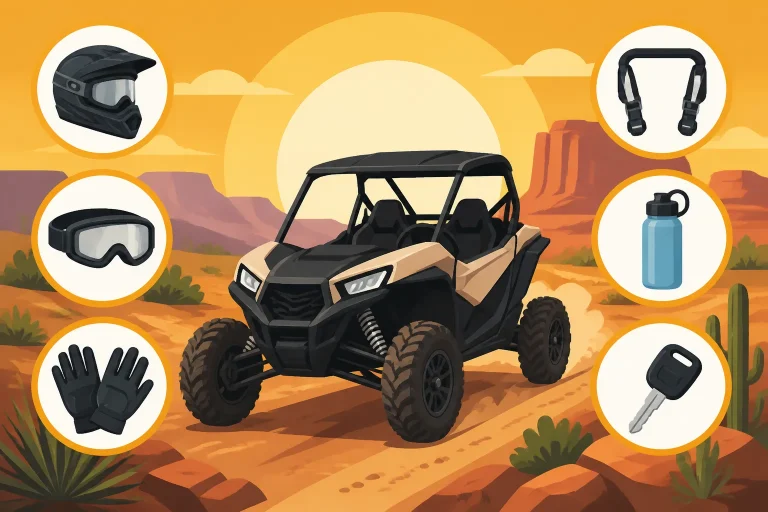
Ask which safety equipment is included, which equipment is mandatory for the ride and whether you may bring your own. Check the fit and condition of any helmet and eye protection before setting off. A helmet should be secure, not loose or damaged; eyewear should stay in place and provide a clear view. Do not leave the counter assuming the gear is included just because a listing shows riders wearing it. See New Mexico Rentals That Include Helmets for questions to ask about gear.
The New Mexico Department of Wildlife requires all OHVs to have a Forest Service-approved spark arrester. That is primarily a machine-equipment question for the rental provider, but it is reasonable to ask whether the rented vehicle is equipped for the public land route you are using. The same department says OHVs must not produce noise exceeding 96 decibels, according to the Motor Vehicle Division NM. Renters should not modify an exhaust or remove equipment; ask the operator to resolve any concern about the machine before departure.
Night and low-visibility riding also involve equipment requirements. The Motor Vehicle Division NM says that when visibility is limited to 500 feet or less due to darkness, OHVs must have headlights that can light objects at 150 feet. In low visibility, the same source requires at least one taillight showing a red or amber light visible at 200 feet. These are not a reason to plan a night ride without permission. Ask whether the rental agreement allows riding after dark and whether the route is appropriate for the conditions.
Understand insurance, damage terms and the total cost
A rental quote is not the full story until you understand what could be charged beyond the base booking. Ask for a clear explanation of the deposit or card hold, the damage policy, any optional waiver, fuel expectations, cleaning standards, late-return terms and recovery charges. Providers set their own prices and terms, so compare the written conditions rather than trying to infer coverage from a low advertised rate.
Most important, distinguish between a damage waiver and insurance. A waiver may change what the renter owes for specified damage under stated conditions; it does not automatically provide liability coverage for injuries or damage to someone else’s property. Ask the provider what is covered, what is excluded, whether a deductible or other responsibility remains, and whether the policy applies to every approved driver. If a term is unclear, get an explanation in writing before you sign.
The New Mexico Motor Vehicle Division says all operators must be insured under the Mandatory Financial Responsibility Act. Do not assume that a rental company’s insurance automatically satisfies every requirement for every operator, or that your personal auto policy covers an off-highway rental. Ask the rental provider how the required insurance applies to the machine and rider, and check with your insurer if you are relying on a personal policy. You can read more in New Mexico ATV Insurance Requirement.
Take time to read the rental agreement. Check who is allowed to operate the machine, whether passengers are allowed, where the vehicle may go, when it must be returned and what happens if weather or a closure interrupts the ride. Look for restrictions on paved roads, riding outside a route boundary, towing, alcohol, carrying extra fuel and taking the machine to a different riding area. The company’s rules can be stricter than the general access rules.
Before leaving, inspect the machine with the staff member. Note visible scratches, cracked plastic, tire damage, warning lights and other existing issues. Take clear photos or video if the provider permits it, and make sure any pre-existing damage is recorded on the check-out form. Ask how to report a problem during the ride and what to do if the machine becomes unsafe to operate. At return, ask for an inspection or confirmation that the vehicle has been checked in.
Fuel policies can affect both the final bill and the route you can reasonably ride. Ask whether the machine leaves full, whether it must be returned full, and what happens if it comes back with less fuel than required. Make sure the route’s distance and availability of fuel are consistent with the machine’s range, without assuming that a fuel station will be close to the trail. More detail is covered in New Mexico Rental Fuel Policy.
A damage waiver may be worthwhile for some renters and unnecessary for others; the answer depends on the actual exclusions, your tolerance for risk and any coverage you already have. Do not choose based only on the waiver’s name. Read the conditions for rollover, underbody damage, tires, misuse, unauthorized routes and recovery. For related questions, see New Mexico Rental Damage Waiver Cost and New Mexico Rental Damage Charges.
Plan the route, weather and support before departure
A scenic setting does not guarantee an easy ride. New Mexico routes can cross open desert, rocky ground, forest roads and changing elevations. Choose a ride that matches your ability and the group’s comfort, and ask the operator which sections typically challenge new riders. Be honest about whether you have driven an ATV or UTV before, and avoid committing to a route you do not understand simply because it is bundled with a rental.
Ask about weather and closures close to the ride date. Rain can change traction and make washes or stream crossings unsafe; wind and dust can reduce visibility; heat can make a long ride more demanding. Mountain weather can differ from conditions at the rental shop. Find out who makes the call if conditions change, whether the company will reroute or cancel, and what options you have if a closure affects the planned outing.
The New Mexico Department of Wildlife advises riders who encounter horses to pull off the trail on the low side, stop the engine, remove the helmet and speak to the rider. Riders must wait until all horses have passed 50 feet beyond their location before restarting the engine, according to that department. Treat this as a practical part of riding respectfully around other trail users, not as a reason to hurry past animals or crowd a narrow route.
Before setting out, clarify the support plan. Does the provider give you a phone number to call? Is there a check-in procedure? What should you do if you get separated from the group, have a mechanical issue or need to turn around? Ask whether the company offers recovery, and whether a recovery call may add a charge. On a self-guided ride, confirm how to follow the route if a phone loses service or a device runs out of power.
Pack for the ride, not just the forecast at the shop. Useful items may include water, layers, sun protection, gloves, sturdy footwear and a charged phone, subject to the operator’s packing rules and the available storage. Ask whether the vehicle has a secure place for personal items and whether loose objects need to be left behind. Carry only what you can secure; anything that shifts or catches can distract the driver.
Keep the route within the operator’s approval and obey land-use signs. Do not assume a track is open because tire marks are visible, or that an open road is approved for a rental machine. Stay on the designated route, avoid disturbing wildlife and livestock, and leave gates as instructed. If a route is closed or conditions look unsafe, turn back and contact the provider rather than trying an unapproved detour.
Book, collect and return the machine with fewer surprises
Before paying, ask for the complete booking terms and the provider’s cancellation policy. Find out whether the booking can be changed if weather, a land closure or a vehicle problem interrupts the plan, and whether any refund or rebooking option applies. Policies differ, so get the answer for your particular reservation in writing. For more on this, see New Mexico Rental Cancellation Policies.
Confirm the pickup location, arrival instructions and what each driver must bring. The company may require identification, a payment card, a signed waiver or other information, but requirements vary by provider. Do not assume the requirements from one rental shop apply at another. If anyone in your group is a minor, confirm in advance who must sign and what supervision the company requires.
At pickup, slow the process down enough to understand the machine. Ask the staff member to demonstrate the controls, explain the route and point out what to do if a warning light appears. Make sure each driver knows how to stop, reverse, park and shut down the vehicle. If a control or instruction is unclear, ask before moving off. A short orientation is not a substitute for experience on difficult terrain, so match the route to what you can safely handle.
Use a simple pre-ride checklist:
- Confirm the machine and seat arrangement match the booking.
- Check that the safety equipment fits and that you know how to use it.
- Make sure the staff member has explained the approved route and any restricted areas.
- Confirm what paperwork or permit applies to the machine and ride.
- Ask how to contact the provider and what to do in an emergency.
- Review the fuel, damage, return-time and recovery terms.
- Inspect the vehicle and record any visible damage before leaving.
Return the machine as instructed, on time and with the required fuel level. Tell the staff about any damage, warning light, unusual noise or mechanical issue, even if the machine still runs. Avoid trying to hide a problem; early reporting gives the operator a chance to assess it and helps clarify what happened. If there is a disagreement about damage or charges, ask for the relevant agreement term and inspection record.
Good planning is not just paperwork. It gives you a better chance of choosing a route that suits the group, understanding where you may ride and knowing whom to contact if things change. The rental company should be able to answer reasonable questions about its own equipment and policies. If it cannot explain an important term before you book, consider another provider rather than leaving the decision until you are at the counter.
Frequently Asked Questions
Do I need a permit to ride a rented ATV in New Mexico?
New Mexico requires a user on public land to have an OHV registration or permit, according to the New Mexico Department of Wildlife. Ask the rental provider what applies to its machine and your planned route, and confirm whether you need to carry anything yourself.
Can I ride a rental ATV on a paved road?
Do not assume so. The Motor Vehicle Division NM says vehicles manufactured for off-highway use cannot be registered as street legal. Ask the rental provider whether the specific machine and road are authorized; the rental company may prohibit road use even where a paved-road option exists.
Can a child ride or drive a rented ATV?
Age, supervision, training and equipment requirements apply, and rental companies may set additional conditions. The New Mexico Motor Vehicle Division says operators under eighteen must meet safety-permit, helmet, eye-protection and supervision requirements, subject to the stated license exception. Confirm the child’s eligibility with both the provider and the relevant rules before booking.
Does a rental include insurance and protective gear?
Not necessarily. Inclusions vary by provider, so ask exactly what is supplied and what coverage applies. The New Mexico Motor Vehicle Division says operators must be insured under the Mandatory Financial Responsibility Act and use eye protection. Confirm how insurance applies to the rental and each driver rather than assuming a waiver or gear package answers those questions.
What should I check before I sign the rental agreement?
Confirm the machine, permitted route, driver and passenger rules, insurance and damage terms, fuel policy, return deadline, cancellation conditions and recovery process. Inspect the vehicle and record existing damage before leaving.
Sources
- Motor Vehicle Division NM — Chapter 16 – Off-Highway Motor Vehicles | Motor Vehicle Division NM (checked November 3, 2026)
- New Mexico Department of Transportation — Laws & Rules | Ride New Mexico (checked November 3, 2026)
- New Mexico Taxation and Revenue Department Motor Vehicle Division — New Mexico Residents | Ride New Mexico (checked November 3, 2026)
- New Mexico Department of Wildlife — OHV Ethics | Ride New Mexico (checked November 3, 2026)
- New Mexico Department of Wildlife — Ride New Mexico | The Land of Enchantment (checked November 3, 2026)
Disclaimer
This article is for general informational purposes only and does not constitute professional advice. Laws, prices and regulations vary by location and change over time. Consult a qualified professional for guidance on your specific situation.