What a New Mexico UTV Rental Includes
A New Mexico UTV rental can mean very different things depending on the shop and the ride: a machine alone, a machine with helmets, or a guided outing with a route and support. The useful question is not just what is advertised, but what is included for your specific booking. Here’s what to check before you pay or arrive at the counter.
What a UTV rental usually includes
At a minimum, a rental booking reserves a machine for a stated period and gives you instructions for picking it up and returning it. Beyond that, inclusions vary. One company may supply helmets and a map; another may expect you to bring protective gear and follow a GPS route. A guided tour can include a guide and a set itinerary, but that does not mean every item you need is part of the package.
Think of an advertised rental as a starting point, not a complete packing list. Confirm the details with the company that will hand over the machine. If you book through a marketplace such as Viator, check both the listing and the local operator’s instructions; the operator is the one to ask about pickup, equipment, route access, and day-of requirements.
| Item | Common rental arrangement | What to confirm |
|---|---|---|
| UTV | Reserved for the selected rental period | Seating capacity, model class, pickup time, and whether the exact model is guaranteed |
| Safety gear | May be included, offered, or left to the renter | Helmets, sizes, goggles, and any required clothing |
| Fuel | May be supplied at pickup, billed separately, or subject to a return rule | Whether the tank starts full and how it should be returned |
| Route or map | May be a printed map, GPS route, or verbal directions | Whether the route is current and where the machine is allowed |
| Guide | Included only with certain tours or packages | Group size, pace, stops, and what happens if someone needs help |
| Permit or registration | Depends on where and how the machine will be used | Which permit applies, who obtains it, and what proof you must carry |
| Insurance or damage protection | Terms vary by operator and booking | What is covered, what remains your responsibility, and how damage is assessed |
| Recovery support | May be limited, conditional, or billed separately | Who to call, what help is available, and when a recovery charge may apply |
The word “included” can also have limits. A helmet might be supplied, but the shop may have a limited range of sizes. A route may be recommended, but not every road or trail may be open to rentals. A guide may lead the group, but you may still be responsible for operating the vehicle safely and following instructions.
When comparing options, look at the whole day rather than one headline feature. A lower-friction booking may include a clear route briefing and fitted safety gear; a more basic rental may suit experienced riders who already know where they are going and have their own equipment. Neither arrangement is automatically better. It depends on your group, your comfort level, and the area you plan to ride.
For an overview of the booking decision itself, see New Mexico UTV Rental Cost per Day and New Mexico Rentals That Include Safety Gear. Those topics can help you frame questions, but the operator’s current written terms are what matter for your reservation.
The machine, seats, and basic handover
Your first practical inclusion is the vehicle itself, but a booking description may not tell you everything needed to choose the right UTV. Ask whether you are reserving a particular model or a vehicle in a general category. If the exact model is not promised, confirm that the operator will provide a machine with the seating capacity and capability your group needs.
Count the riders who will actually be in the vehicle, including children. A four-seat UTV may sound suitable for a family, for instance, but you need to know whether the listed capacity refers to adults, whether there are individual seat belts, and what the operator allows for younger passengers. Do not assume a child can ride simply because a seat is available. Check the company’s age, passenger, and supervision requirements before booking. The related topic [New Mexico Rentals for Riders Under 18] can help you identify questions to ask.
A useful handover should establish how to operate the particular machine, not just point out the ignition. Ask the staff to show you:
- How to start, stop, and shift the vehicle, including any parking or emergency controls.
- Where the seat belts latch and how to adjust them.
- How to use the lights, horn, and any controls needed for the planned route.
- Where the basic safety equipment is kept.
- What to do if the machine overheats, gets stuck, develops a flat, or will not restart.
- Which contact number to use if you need assistance away from the shop.
A short demonstration is especially valuable if someone in your group has never driven a UTV. The passenger should also understand how to fasten the belt, remain seated, and follow the driver’s directions. Don’t let the driver’s familiarity with cars stand in for a vehicle briefing: off-road surfaces, slopes, rocks, and soft sand change how a machine responds.
Before leaving, inspect the UTV with the staff member. Make sure visible damage is recorded and that the vehicle’s condition matches the pickup paperwork. Check the tires, windshield or protective panels if fitted, seat belts, lights, and any supplied gear. Take clear photographs or video of existing marks, and report problems before you depart. This is a straightforward way to avoid a disagreement later about when damage occurred. For more detail, see Photographing a Machine at Pickup.
Ask what the shop considers a normal return condition. A dusty machine after a dry ride may be expected; heavy mud, wet sand, or debris may trigger cleaning terms. The rental agreement should explain how to report a mechanical issue and whether you should stop riding, attempt a simple fix, or wait for help. Do not continue operating a machine that seems unsafe just to avoid a late return or a call to the operator.
Match the vehicle to the people and terrain
Seating capacity is only one part of fit. Consider whether your group can get in and out comfortably, whether everyone has a properly fitting helmet, and whether the route suits the size and experience of the least confident driver. A broad UTV can be comfortable for passengers, but not every narrow trail is appropriate for every vehicle. Ask about route width and restrictions if you are considering a larger machine. New Mexico Trails for a Wide Side-by-Side is a useful related topic.
Also ask whether the vehicle has storage and what can safely be carried. A small compartment may fit personal items but not a large cooler or a full day’s supplies. Keep loose items secured; objects that shift around can distract the driver or become a hazard on rough ground.
Safety gear and what to wear
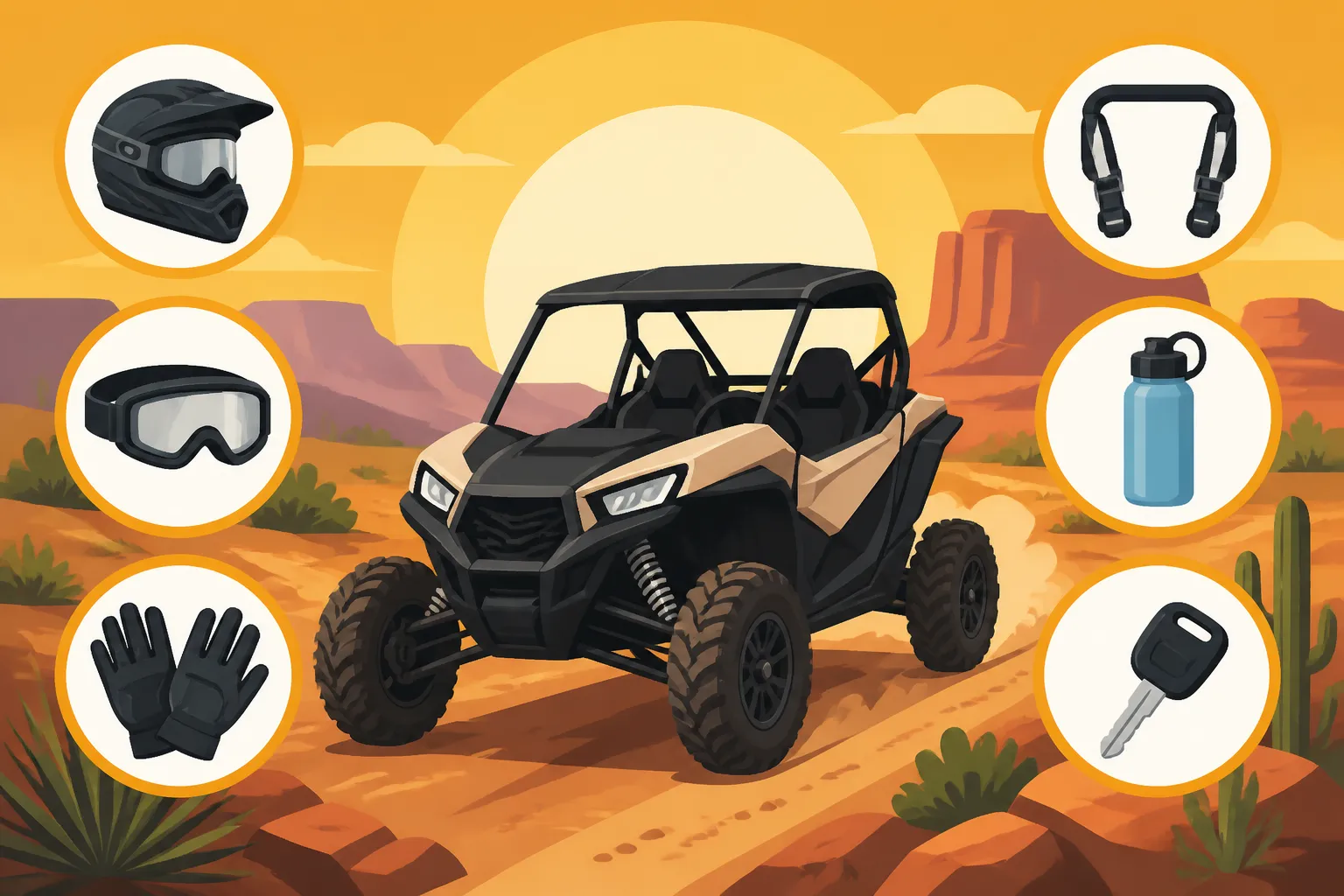
Helmets are one of the most important things to confirm. Some operators include them; others may make them available only by request or expect renters to bring their own. Ask whether helmets are provided for every rider, whether sizes are available for children, and whether you can inspect the fit before heading out. A helmet that is too loose or uncomfortable is not a good substitute for one that fits correctly.
Eye protection is another item to clarify. Depending on the vehicle and the conditions, dust can make goggles or other suitable eye protection useful even if a UTV has a windshield. Ask what the operator provides and what they recommend bringing. The listing may say “safety equipment included” without naming every item, so get a specific answer rather than guessing. Goggles Handed Over at the Counter and [Bringing Your Own Gear] cover the practical questions to sort out.
Choose clothing for the ride, not just the forecast at the shop. New Mexico can bring strong sun, dust, changing temperatures at elevation, and sudden weather shifts. Long sleeves, long pants, closed-toe footwear, and gloves can help reduce exposure to sun, dust, and scrapes. Bring layers if your route climbs into cooler country or begins early. Avoid clothing that can snag on controls or interfere with a seat belt.
If the operator supplies helmets or goggles, ask whether you need to reserve sizes ahead of time, especially for children or a large group. Confirm whether the gear is included in the booking or treated as an optional add-on. Do not rely on a listing photo to establish what you will receive. If you have a personal helmet that fits well, ask whether you may use it and whether it meets the operator’s requirements.
A rental package may also mention a safety briefing. Clarify whether that means a quick vehicle orientation, a full route briefing, or formal instruction. New riders may benefit from more than a few minutes at the counter. Ask whether there is time to practice basic controls in a safe staging area before joining a group or entering a trail.
Keep a small personal kit even when the company supplies core gear. Useful items can include water, sun protection, a charged phone, and any medication you may need. If your route is remote, ask what communications are available and whether phone coverage is expected. A rental company’s support number is not a guarantee that you can reach it from every point on the route.
Route, guide, and riding-area access
A rental may come with directions without granting permission to ride everywhere those directions pass. The operator should tell you where the vehicle is allowed, which routes are appropriate for that machine, and what areas are off limits. This matters in New Mexico, where land ownership, local rules, closures, and designated routes can change from one area to another.
Ask whether your booking is self-guided or guided. A self-guided rental generally leaves route-finding and pace decisions to your group, even if the shop provides a map or GPS track. A guided tour usually adds a person who leads the ride and explains the route, but you should still ask what the guide’s role includes. For example, find out whether the guide stays with the group, how stops work, and what happens if a rider wants to turn back.
Before departing, make sure the route instructions are understandable. A map without clear trail names or turn points may be hard to follow, especially in an area with intersecting tracks. If the company uses a phone-based route, ask whether the route can be downloaded or used offline. Check how your phone will be mounted and powered, and do not operate it while driving.
Do not assume that a tour or rental includes every permission or permit needed for the ride. Ask the operator which requirements apply to the planned route, whether the rental company handles them, and whether you need to carry proof. Different rules may apply depending on the land and whether the ride is guided, rented, or on a public route. See [New Mexico Rules for Riding a National Forest], New Mexico Rules for Riding BLM Land, and New Mexico Rules for Riding a Designated Route for related information. If your group includes visitors, Do Visitors Need a New Mexico OHV Permit? is another useful place to start.
Even when an operator provides a route, conditions can change. Fire restrictions, weather, maintenance, and closures may affect access. Ask how the company communicates a route change or cancellation, and whether it offers an alternate ride. Do not treat a saved GPS track or old map as proof that a route is open today. Follow signs and staff instructions, and turn around when a route is closed or conditions exceed your ability.
What a guided tour adds
A guided outing can reduce the burden of navigation, which is helpful if you are unfamiliar with the area. The guide may select a route suited to the group, explain local riding practices, and help keep the group together. Those details depend on the operator, so ask exactly what is included rather than assuming every tour has the same format.
A guide does not remove the need to listen, ride within your ability, or follow land-use rules. Ask how the operator handles different skill levels and whether the group can be split by pace. If you are booking a family or mixed-experience group, make sure the route is suitable for the least experienced driver, not only the most confident one.
A marketplace listing can help you compare schedules and tour descriptions, but review the local operator’s details too. If a booking is presented through Viator, confirm the meeting point, duration, included gear, and cancellation process in the reservation information and with the operator when needed. A platform description can summarize the offer; it may not answer every operational question.
Fuel, water, and other supplies
Fuel is an easy detail to miss because a listing may describe the vehicle and route without explaining how fuel is handled. Ask whether the UTV is supplied with fuel, whether you are expected to refill it, and what the return standard is. Clarify whether fuel is available at or near the pickup point and whether your route has a safe, realistic fuel plan. Never rely on an assumption that you can refuel on the trail.
The same goes for water. A rental may not include drinking water, even if the outing is described as a tour. Ask whether the operator supplies it, how much they recommend carrying, and whether there are stops where water is available. On a warm or exposed route, plan your own supply rather than counting on a shop or guide to provide it.
A machine may have storage, but space can be limited. Ask whether the rental includes a storage bag or other secure place for personal items. Bring only what you can secure without crowding passengers or interfering with visibility and controls. Keep valuables protected from dust, and avoid placing loose items where they could shift under braking or on uneven ground.
Before leaving, verify that the phone you intend to use for navigation is charged. If the operator’s route depends on a phone app, ask about offline access and power. A portable battery can be useful, but it should be stored safely and connected in a way that will not distract the driver.
For a longer ride, consider what happens if a group member becomes uncomfortable, tired, or unwell. Ask where the planned stops are and whether the group can return early. A tour description may give a duration, but it may not explain the pace or the amount of time spent driving versus stopping. A short ride in rough terrain can feel very different from the same amount of time on smoother roads.
Supplies to consider bringing, unless the operator confirms they are provided, include:
- Drinking water for each rider.
- Sun protection and weather-appropriate layers.
- A charged phone and any route information the operator recommends.
- Snacks for a longer outing, if allowed.
- Personal medication and a small first-aid item you know how to use.
- A secure place for keys, identification, and booking details.
Ask before packing bulky items. A cooler or large backpack may not fit securely, and the operator may restrict what can be carried. If you are unsure, describe what you want to bring and ask where it can go.
Costs, deposits, damage terms, and return rules
The rental price is only one part of the booking. A company may also require a deposit or card hold, offer a damage waiver, set rules for fuel and cleaning, or charge for certain kinds of damage or recovery. These terms differ by operator and booking. Do not rely on a general description of a rental package to determine what your own reservation will cost.
Read the agreement before signing and ask for unclear terms in writing. Make sure you understand:
- Whether a deposit or card hold is required and when it is released.
- What the damage waiver or protection option covers, if offered.
- What remains your responsibility after a waiver or protection option is selected.
- How the operator documents damage and handles a dispute.
- Whether tire damage, recovery, cleaning, late return, or fuel can be billed separately.
- Which use restrictions could affect coverage or create extra charges.
- What to do if you need to report damage or a breakdown during the ride.
A waiver is not the same as unlimited protection. It may have exclusions or conditions, and the operator’s contract controls. Ask about the difference between the booking price, a refundable hold, and any optional protection. If the terms are unclear, pause before signing rather than trying to resolve them after an incident. See New Mexico Rental Damage Waiver Cost, How Much a Rental Holds on Your Credit Card, and New Mexico Rental Recovery Charges for related questions.
Know the return time and location. A late return may affect the next reservation, and the contract may explain how lateness is handled. Ask what to do if traffic, weather, or a mechanical issue delays you. If you are expected to refill the tank or return the vehicle clean, establish what counts as meeting that requirement. The return instructions should be specific enough to follow without guesswork.
When returning the UTV, walk around it with staff if possible. Report any issue that happened during the rental, even if it seems minor. The operator may ask you to complete an incident report or provide details about when and where it occurred. Keep your copy of the agreement and any return documentation until the deposit or hold has been resolved.
For bookings made through a platform, check where changes, refund requests, or cancellation questions must be handled. The local operator may manage the vehicle and ride, while the booking platform may manage certain reservation details. Confirm which contact to use before the trip, not after plans change. Canceling a New Mexico Rental Booking offers more context.
How to confirm exactly what your booking includes
The simplest way to avoid surprises is to turn the listing into a checklist and get clear answers before arrival. Save the listing and confirmation, but treat them as a record of what was advertised, not a substitute for the signed rental terms.
Use this sequence:
- Identify the exact rental type. Confirm whether you booked a self-guided rental, a guided tour, or a vehicle bundled with another activity. Check the date, duration, pickup location, and number of riders.
- Confirm the vehicle. Ask about seating capacity, whether the specific model is guaranteed, and whether the route allows that vehicle size.
- List the included gear. Get a direct answer about helmets, goggles, and any other equipment. Confirm sizes, especially for children.
- Clarify route access. Ask where you may ride, whether the route is current, and which permits or proofs are your responsibility.
- Set expectations for fuel and supplies. Find out the fuel and return rules, whether water is supplied, and what you should bring.
- Review the agreement. Understand deposits, protection options, damage, cleaning, recovery, fuel, and late-return terms.
- Get the day-of contact details. Save the shop’s number, meeting point, and instructions for a delay, breakdown, or route change.
- Inspect the machine. Document existing damage and make sure the vehicle and gear fit the group before you depart.
If the operator cannot answer a basic question about the route, equipment, or return requirements, ask for clarification before you travel to the pickup point. A clear answer is more useful than a broad promise that “everything is included.”
For a direct booking, contact the rental business. For a tour booked through a marketplace, check the reservation information and then confirm operational details with the local operator. If a detail affects safety, access, or what you might be charged, do not leave it to interpretation.
Frequently Asked Questions
Does every New Mexico UTV rental include helmets?
No. Some operators provide helmets, while others may offer them separately or ask renters to bring their own. Confirm that every rider has access to a correctly fitting helmet and ask about goggles and child sizes.
Does a rental include fuel?
Not necessarily. Ask whether fuel is supplied, whether you must refill the UTV, and what condition the tank should be in at return. Confirm how fuel fits into the planned route.
Does the rental price include a guide?
Only if the booking is for a guided experience or explicitly says a guide is included. A self-guided rental may provide directions without a guide. Confirm the format, group pace, and what support is available during the ride.
Does the rental company handle permits and route access?
Sometimes the operator handles relevant requirements, but you should not assume that. Ask which permissions or permits apply to the route, who obtains them, and what proof you need to carry.
What should I check before signing the rental agreement?
Review the deposit or card hold, damage terms, any protection option, fuel and cleaning rules, recovery charges, return time, and the process for reporting a problem. Ask for clarification before you sign if anything is unclear.
Disclaimer
This article is for general informational purposes only and does not constitute professional advice. Laws, prices and regulations vary by location and change over time. Consult a qualified professional for guidance on your specific situation.