Tribal Land and Why Permission Differs
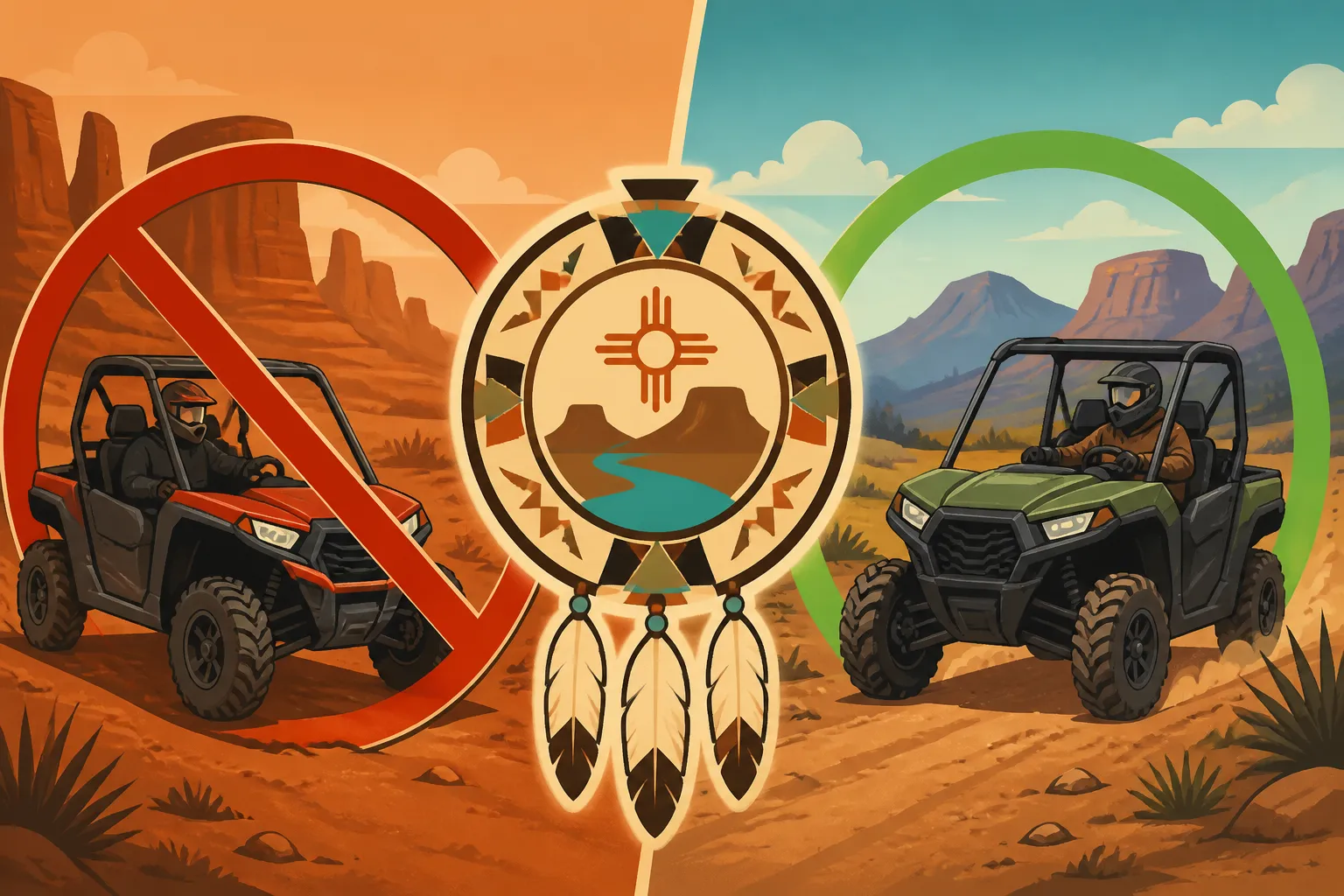
Tribal land in New Mexico is not simply another place to use a state OHV permit. A New Mexico permit, an out-of-state registration or a public-land map does not by itself establish permission to ride on tribal land. The practical first step is to identify who manages the land and ask that authority which routes, permits and conditions apply.
Why Tribal Permission Is Different
Tribal governments manage their lands under their own laws and access rules. Those rules are not automatically the same as New Mexico’s rules for state, county or federal land. A road or trail that appears on a map, passes near a public route or is open to local traffic is not necessarily open to outside OHV riders.
That difference matters even if your machine is properly registered or permitted for other places. New Mexico’s OHV permit system and reciprocity rules address state permit requirements; they do not grant permission from a tribal government to enter or ride tribal land. For the state permit side, see New Mexico OHV Reciprocity Rules and New Mexico’s Nonresident OHV Permit. Treat those as separate from a tribal access decision.
A useful way to think about it is that a permit answers only the question it was issued to answer. A state OHV permit may satisfy a state requirement where that requirement applies. It does not necessarily provide access to a particular parcel, road, trail, community or event. Likewise, an out-of-state registration that is accepted under New Mexico’s reciprocity rules should not be read as permission to ride wherever you can physically reach.
| What you have or see | What it may establish | What it does not establish by itself |
|---|---|---|
| New Mexico OHV permit | Compliance with applicable state permit requirements | Tribal permission to enter or ride |
| Out-of-state registration | Recognition under applicable New Mexico reciprocity rules | Access to a tribal road or trail |
| A road shown on a map | That a route is mapped or represented in some source | That the route is open to public OHV use |
| A route used by local traffic | That some traffic uses the route | That visitors may ride an OHV there |
| Permission for one place or event | Access within the permission’s stated scope | Permission for other land, dates or routes |
The details can differ from one tribal government, land area or activity to another. There is no safe assumption that one tribe’s process applies elsewhere, or that permission to travel on a road includes permission to ride off it. The relevant authority may set conditions on where visitors can go, when access is allowed, what type of machine is permitted, or whether a separate permit or escort is required.
The important distinction is not simply “tribal land versus public land.” It is whether the authority responsible for the specific place has opened that area to the activity you plan to do. Ask about the exact location and use, not just whether OHVs are generally permitted in the region.
How to Confirm Access Before You Ride
Start by pinning down the location. A nearby town, trailhead or highway is not enough to identify the land manager. Land boundaries can be close to one another, and a route may cross from one jurisdiction to another. If your intended route touches tribal land, confirm who manages each relevant segment and whether OHV access is authorized for visitors.
Then contact the appropriate tribal government or land office using its official channels. Ask which office handles visitor access, recreation, roads or permits. If you are not sure where to start, ask the tribal government to direct you to the department responsible for that specific area. Avoid relying only on a rental counter, social media post, forum comment or an old route description for current access rules.
When you ask, provide enough detail for the office to give a useful answer:
- Give the specific area, road, trail or destination you want to reach. If you have a map or route coordinates, use them to identify the location clearly.
- Explain that you plan to ride an ATV, UTV or other OHV, and say whether you are traveling through, using a designated route, attending an event or planning another activity.
- Ask whether nonmembers or other visitors may access the route and whether advance permission is required.
- Confirm whether a tribal permit, registration, fee, guide, escort or other condition applies.
- Ask whether the permission covers the full route and planned dates, including any return travel.
- Check whether there are restrictions on vehicle type, group size, operating hours, passengers, noise, camping or off-route travel.
- Ask what documents riders must carry and what to do if a gate, closure or sign conflicts with the route information you received.
Keep any written response, permit or reservation confirmation with you, and follow the conditions exactly. If permission is given only for a named road or destination, do not treat that as permission to explore nearby tracks. If the answer is unclear, ask a follow-up question before entering rather than trying to resolve the uncertainty at a gate or roadside stop.
| Question to ask | Why it matters |
|---|---|
| Is this exact route open to visiting OHV riders? | Access may be limited to particular roads or users. |
| Is prior permission or a permit required? | A state permit may not satisfy local access requirements. |
| Are there dates, hours or seasonal closures? | Permission may be limited in time or affected by closures. |
| Does the route allow my specific machine? | ATV, UTV and motorcycle access may not be treated identically. |
| May I leave the route to reach a viewpoint or campsite? | Route access does not automatically mean off-route access. |
| What proof should I carry? | Riders may need to show a permit, authorization or other documents. |
If no office can confirm that your route is open, choose a route with clearly established access instead. Do not assume that a lack of signs means the area is open, or that a gate left open is an invitation to enter. Tribal access rules can be specific to location and purpose, and the responsible authority is the best source for current instructions.
For further background on the distinction between state permits and land access, see New Mexico Rules for Riding Tribal Land. The same habit applies when planning routes across other kinds of land: verify the managing authority and the rules for the exact route, as described in New Mexico Rules for Riding a Designated Route and New Mexico Rules for Riding Private Land.
What to Check Alongside Tribal Authorization
Tribal authorization is one part of the plan, not a replacement for every other requirement. Confirm the rules that apply to your machine, rider and activity, too. Depending on the place and situation, you may need to consider state OHV requirements, vehicle registration, youth safety rules, equipment restrictions or event-specific conditions. Do not assume that one permission document covers all of them.
For example, a visitor’s New Mexico OHV permit may be required for certain riding outside tribal land, while the tribal authority may have its own separate access process for a route on tribal land. The opposite can also be true: having tribal authorization does not necessarily excuse a state requirement that applies to the rider or vehicle. Ask the relevant authorities what applies rather than treating the rules as substitutes.
This is especially important on a route that crosses multiple kinds of land. A journey might begin on a county road, continue onto federal land and approach tribal land. A route permitted on one segment may end at a boundary. The rules for national forest, BLM and state trust land are distinct as well; review [New Mexico Rules for Riding a National Forest], New Mexico Rules for Riding BLM Land and New Mexico Rules for Riding State Trust Land when those land types are part of the trip. Permission from one land manager does not automatically carry across a boundary.
Before setting out, check each route segment separately:
- Identify the land manager for the road, trail or parcel.
- Confirm that OHV use is allowed on that segment.
- Check whether a permit or advance approval is required.
- Verify that the route is open on the day you plan to ride.
- Confirm any machine, rider or equipment conditions.
- Carry the documents required for each jurisdiction.
- Have a legal alternate route if access is denied or a closure is in place.
Route-planning apps and maps are useful for orientation, but they are not proof of permission. A mapped line can represent a road without confirming that it is open to recreational riding. Similarly, a route shared by another rider may reflect an earlier rule, a different user’s access or a different section of road. Use maps to frame the question you ask the land manager, then rely on the authority responsible for access.
If you are riding with a rental machine or joining an organized trip, ask who is responsible for confirming access. A rental company or organizer may provide route guidance, but you still need to understand where the route goes and what documents you are expected to carry. Ask whether the route enters tribal land and whether authorization is arranged for the group. If the answer is vague, verify it with the relevant authority before departure. Related guidance on the state permit side is available in Riding a Rented Quad on New Mexico Public Land.
Common Mistakes and a Safer Planning Routine
The most common mistake is treating “registered,” “permitted” and “authorized” as interchangeable. They are not. Registration or a permit may relate to the machine or a state requirement. Authorization concerns access to a specific place or activity. A rider may need to address both, and the documents may come from different authorities.
Another mistake is using proximity as proof of access. A tribal boundary near a public road, a route that appears continuous on a screen or a trailhead close to a community does not establish that an OHV may enter. Stay on routes you have confirmed. Do not cross a boundary to investigate a road or shortcut.
Riders can also misunderstand the scope of permission. Approval to travel through one area may not authorize stopping, camping, hunting, filming, holding an event or riding off the designated road. If you plan anything beyond ordinary travel along the approved route, describe that activity when requesting permission. Separate activities can have separate rules.
A practical pre-ride routine is:
- Map the full route, not only the trailhead and destination.
- Mark any land boundaries or uncertain segments.
- Identify the authority responsible for each segment.
- Ask for current access conditions and required permits.
- Save the response and carry required proof.
- Recheck for closures before leaving, especially when plans depend on a particular road.
- Turn around if signs, gates or official instructions indicate that the route is closed or access is not allowed.
If you cannot reach the responsible office, do not use uncertainty as a reason to proceed. Choose a route whose access is confirmed, or postpone that part of the trip until you can get an answer. This may mean changing the destination, but it avoids treating tribal land as open by default and helps protect continued access for authorized visitors.
The safest rule is straightforward: meet the New Mexico requirements that apply to your rider and machine, then obtain separate permission from the tribal authority whenever the intended ride involves tribal land. Check the exact route, dates and activity, and stay within the permission granted.
Disclaimer
This article is for general informational purposes only and does not constitute professional advice. Laws, prices and regulations vary by location and change over time. Consult a qualified professional for guidance on your specific situation.