Riding With Your Safety Permit Left at Home
You arrive at a New Mexico trailhead and realize the young rider’s OHV safety permit is sitting at home. The key question is whether you can prove the rider is qualified to ride—not whether the ATV is registered. Here’s how to decide whether to ride, what not to assume about a phone photo, and how to prevent the same problem next time.
First determine whether the rider needs a safety permit
New Mexico’s OHV safety permit is a rider requirement, not a registration document for the machine. The rules generally concern riders under 18 using an off-highway vehicle on public land. An adult does not need this safety permit simply because they are riding an ATV or UTV, although other requirements can still apply.
The rider’s age and qualifications matter. Some riders may qualify for an exception based on a license or other credential, so do not assume that every rider under 18 has exactly the same requirement. Before deciding what to do, check the current rules for the rider’s age and situation in New Mexico OHV Safety Permit Requirements. The articles Can a 13-Year-Old With a Motorcycle License Ride? and Can a 15-Year-Old Driver Skip the Safety Permit? address two situations where a rider’s credentials may affect the answer.
If the rider does need the safety permit, having completed a course and having the issued permit available are two different practical questions. A completed course may establish that the rider qualified, but it does not necessarily mean you can demonstrate that fact during a roadside check without the required proof. The safest approach is to carry the issued permit as directed, rather than relying on memory of the course or an assumption that officials can confirm it for you.
The safety permit is also separate from New Mexico’s broader OHV permit and registration requirements. A valid registration decal does not replace a young rider’s safety permit. Likewise, a safety permit does not make an unregistered machine legal to ride where registration or another permit is required. If you are sorting out which documents apply to the machine as well as the rider, New Mexico OHV Permits Explained is a useful starting point.
| Situation | What to check | Safest next step |
|---|---|---|
| Rider is under 18 and may need a safety permit | Whether the rider’s age and qualifications create an exception | Confirm the rule and carry the issued permit if required |
| Rider is under 18 and the permit is at home | Whether you can retrieve the card or another form of proof is officially accepted | Pause the ride until you have acceptable proof |
| Rider is an adult | Whether any separate rule applies to the planned ride | Do not confuse the safety permit with registration or land-access requirements |
| Machine has a registration decal | Whether the rider separately needs a safety permit | Check both machine and rider requirements |
The practical takeaway is simple: first establish whether the rider is required to have a safety permit. If they are, treat the missing card as a problem to solve before riding on public land—not as a detail that the registration decal or another rider’s documents can cover.
What to do when the card is at home
If the rider needs a safety permit and the physical card is at home, the lowest-risk solution is to retrieve it before heading out. If that is not practical, postpone the ride, choose an activity that does not involve riding the OHV on public land, or have a qualified adult ride without the young person operating the machine. Do not assume that being at the trailhead, already having unloaded, or having traveled a long way changes the requirement.
A roadside check may involve more than looking at the machine. An officer may ask for information about the rider as well as registration or other required documents. A missing safety permit can therefore interrupt the ride even if the rider completed the course and the ATV or UTV has the correct registration. Depending on the circumstances, the rider may be unable to continue until the issue is resolved, and a violation may have consequences. For details about enforcement, see New Mexico Fines for No Safety Permit.
Before making a decision, take these steps:
- Confirm whether the rider is required to carry a safety permit. Check the rule that applies to the rider’s age and credentials. If an exception might apply, verify it rather than guessing.
- Try to retrieve the issued permit. If someone at home can bring it to the trailhead, that is more reliable than hoping another form of proof will be accepted.
- Ask the administering program what proof is acceptable. If you cannot retrieve the card, use an official contact channel to ask whether a digital copy, course record, or another document can serve as proof. Do not assume that any of these substitutes will be accepted.
- Do not let the young rider operate until you have a clear answer. If you cannot confirm an accepted alternative, the conservative choice is to stop the ride for that rider.
- Keep the rest of the group’s plans separate from the missing document. Other qualified riders may be able to continue where it is lawful and safe, but the young rider should not ride on the assumption that another person’s permit covers them.
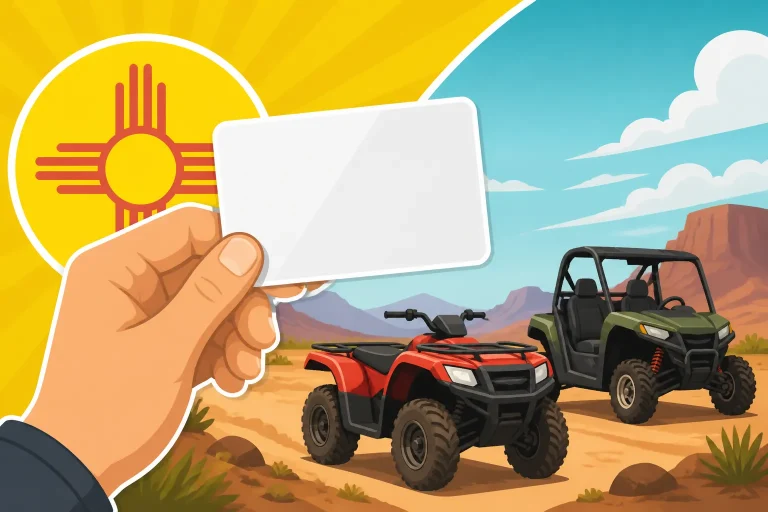
A photo of the card can be helpful as a backup record, but a photo is not automatically the same as the issued permit. Whether an electronic image is accepted depends on the applicable rules and the official’s ability to verify it. Keep a photo if you wish, but do not use it as your only plan unless the responsible authority confirms that it is acceptable.
The same caution applies to a screenshot of a course completion page, an email receipt, or a parent’s statement that the rider passed. Those records may help establish what happened, but they may not meet the requirement for carrying or presenting the permit. If the rider’s card is missing for good, follow the official replacement process described in Replacing a Lost Safety Permit. A card left at home is different from a lost card, but the replacement information can help you identify the correct program and avoid relying on an unofficial substitute.
If you are unsure who to contact, start with the official New Mexico program responsible for OHV safety education. Give the rider’s age, the type of vehicle, where you plan to ride, and the specific proof you have available. Ask a direct question: “Can this rider operate on this ride with this document, or must we retrieve the issued permit?” Keep the answer focused on the current rule; informal advice from another rider may be well meant but is not a dependable substitute.
Don’t confuse the safety permit with other OHV documents
A family can have several different papers or credentials connected with one ride. That makes it easy to pack one document and think it covers everything. It does not. New Mexico distinguishes between the rider’s safety qualification and requirements tied to the OHV, the rider’s access to public land, and—in some circumstances—using a paved road.
The rider safety permit relates to safety education for riders who fall within the applicable age rules. Registration or an OHV decal relates to the machine. Nonresident permits may apply to visitors depending on where the machine is registered and the relevant reciprocity rules. Road-use requirements are a separate issue again. A rider who has the safety card can still be missing a required machine document, and a registered machine does not prove that a young rider has the required safety credential.
| Document or requirement | Mainly relates to | Does it replace the under-18 safety permit? |
|---|---|---|
| OHV safety permit | The rider’s safety qualification | No; it is the rider’s own requirement |
| Registration or decal | The machine | No |
| Nonresident OHV permit, when required | A visitor’s authority to ride under applicable permit rules | No |
| Road-use documentation or equipment | A machine’s use on certain roads | No |
For a family ride, check the rider and machine separately before leaving. The documents a parent carries are not automatically transferable to a child, and the permit of one young rider does not cover a sibling. Each rider who is required to have a safety permit should have their own proof.
The distinction matters for borrowed and rental machines, too. A rental agreement, the rental company’s paperwork, or the machine’s registration does not by itself answer whether the young person operating it meets the safety-permit requirement. Confirm both the rider’s eligibility and the machine’s paperwork before setting out. For more on who needs to satisfy which requirement, see New Mexico’s Safety Permit for Under-18 Riders and New Mexico’s Nonresident OHV Permit.
Also keep the riding location in mind. A document that establishes one requirement does not grant permission to ride everywhere. Public-land access can depend on land-manager rules, open routes, and other permits or permissions. If the route includes a road or a change in land jurisdiction, check those rules separately rather than treating the safety card as an all-purpose pass.
Make forgetting the card less likely
The best time to solve a missing-card problem is before the trip. Choose one place for each rider’s documents and check it as part of loading. A brief pre-ride check is easier than trying to establish what a photograph or course record means while the group is waiting at a trailhead.
Use a simple routine:
- Keep each rider’s safety permit with that rider’s riding documents, not loose in a vehicle or stored with someone else’s paperwork.
- Before leaving, confirm that the card is physically present and readable.
- Check that the name and card belong to the rider who will be operating the OHV.
- Keep a backup photo or scan in a secure place, while treating it as a backup rather than a guaranteed substitute.
- If the rider changes jackets, bags, or vehicles, move the card deliberately instead of assuming it came along.
- Recheck the required documents when a different adult packs or leads the ride.
A small, waterproof card sleeve can help protect a permit from dust, sweat, and light rain. If you shop for one through Amazon, choose a size that fits the card without obscuring its identifying information. The sleeve is only for storage; it does not change which document is required or whether an electronic copy is accepted.
Parents and group leaders should also review the permit rules before the first ride of a season, when a child’s age or credentials may have changed. A rule that applied on a previous trip may not answer the question for a new rider, a different machine, or a different route. The Approved Courses for a New Mexico Permit information can help when a rider still needs to complete the course, while Carrying the Safety Permit on a New Mexico Ride covers the practical question of keeping proof with you.
If you discover the card is missing after arriving, make the decision calmly and early. Check the rider’s requirement, try to retrieve the issued permit, and seek confirmation from the official program if you believe another form of proof may work. If you cannot verify an acceptable alternative, do not have a rider who needs the permit continue on the assumption that nobody will ask. A missed ride is frustrating; a roadside dispute or an unsafe decision is a worse way to spend the day.
Disclaimer
This article is for general informational purposes only and does not constitute professional advice. Laws, prices and regulations vary by location and change over time. Consult a qualified professional for guidance on your specific situation.