Does a New Mexico Permit Count on BLM Land?
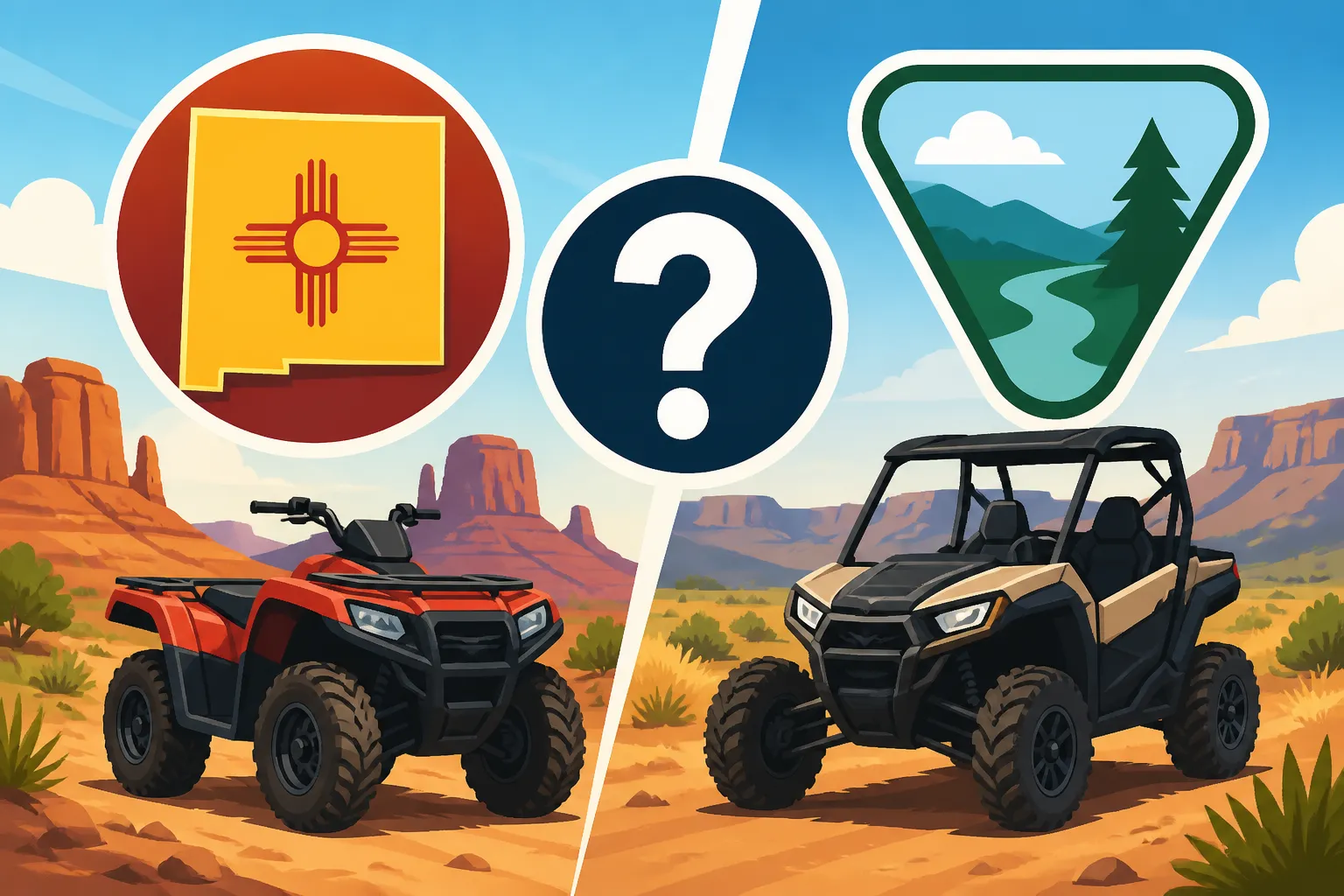
A New Mexico OHV permit can satisfy the state’s registration requirement when you ride on BLM land, but it does not grant access to every road or trail. The key is to separate the paperwork for your machine from the land manager’s route rules. Here’s how to check both before you unload and ride.
The short answer: the permit counts, but it is not an access pass
If your machine has the required New Mexico OHV registration or permit, that generally covers the state’s paperwork requirement for riding on BLM land in New Mexico. A visitor’s valid home-state OHV registration may also be accepted under New Mexico’s reciprocity rules. Riders whose home state does not have a qualifying OHV registration program may need to obtain a New Mexico nonresident permit instead.
That answers only the registration question. It does not mean that every route on BLM land is open to OHVs, or that your machine can be ridden anywhere you choose. The Bureau of Land Management manages access by area and route. A permitted machine must still stay on routes open to its use and comply with closures, vehicle restrictions, and other applicable rules.
Think of the two requirements as separate checks:
- State paperwork: Is the machine properly registered or covered by an accepted permit or out-of-state registration?
- Land access: Is the specific road, trail, or area open to this type of OHV right now?
Passing the first check does not automatically pass the second. A current sticker, card, or registration document cannot override a BLM closure, a route restriction, or a requirement to stay on designated routes.
This distinction matters whether you are bringing your own ATV, riding a side-by-side, or borrowing a machine. For a wider overview of visitor requirements, see New Mexico’s Nonresident OHV Permit and New Mexico OHV Reciprocity Rules. If you are unsure what your New Mexico paperwork covers, New Mexico Permits Explained can help clarify the different state requirements.
What a New Mexico permit does and does not cover on BLM land
A New Mexico registration or nonresident permit is about the machine’s legal status under state OHV requirements. On public land, that paperwork helps show that the vehicle is covered to be operated where state rules require registration or a permit.
It is not a substitute for BLM travel rules. The BLM determines which routes and areas are available for motorized use, and those designations can differ from one place to another. A route shown on an old map, a line visible on a phone app, or a track left by another rider is not proof that the route is open.
Designated routes still matter
Before riding, confirm the route designation for the specific BLM area you plan to visit. A travel management map or other current map from the relevant BLM office can help you identify open roads and trails, restrictions by vehicle type, and closed areas. Pay attention to signs at the trailhead and along the route as well.
Some routes may be open to motor vehicles generally, while others may have limits that affect particular types or sizes of machines. Some areas may restrict riding to designated routes, and temporary closures can be added because of fire, weather, maintenance, resource protection, or other management needs. Do not assume that a route is open just because it appears on a map or was open on a previous trip.
For help understanding how route designations work, see Designated Routes and Travel Management in New Mexico and Travel Management Maps on Federal Ground. These are especially useful when the route network is unfamiliar or the map contains several kinds of roads and trails.
The permit does not grant access to other land
A BLM route can pass near or connect with land managed by another agency, a private owner, a Pueblo or other tribal government, or the state. A New Mexico OHV permit does not give permission to cross land where access is restricted, nor does it replace any separate permit required by a different land manager.
State trust land is a common source of confusion. A route may appear to connect public roads but cross trust land that requires its own authorization. Tribal roads and private roads also have their own access rules. Check the land boundary and permission requirements before continuing beyond BLM ground. The permit is tied to the machine’s state OHV status, not to a general right to travel across all land.
Other operating requirements still apply
Registration is only one part of riding legally. Requirements can also apply to the rider, the machine, and the conditions of use. For example, New Mexico has separate safety permit rules for some riders under 18. Equipment requirements, noise limits, spark-arrester rules, and restrictions on riding closed routes may also be relevant on public land.
A machine that is registered can still be improperly equipped or operated in a prohibited way. Likewise, meeting BLM route rules does not excuse a rider from state requirements. Check both sets of rules rather than treating either one as a complete checklist. For further details, see [New Mexico Rules for Riding BLM Land] and [New Mexico OHV Safety Permit Requirements].
| Question | What the permit or registration answers | What you still need to check |
|---|---|---|
| Is the machine covered by New Mexico OHV paperwork? | Whether it has the required New Mexico registration or permit | Whether the registration is current and applies to that machine |
| Is an out-of-state registration enough? | Whether New Mexico recognizes the home-state registration under reciprocity rules | Whether your home state qualifies and the registration is valid |
| Can I ride a particular BLM road? | Nothing by itself | The current route designation, signs, closures, and vehicle restrictions |
| Can I cross land beyond the BLM route? | Nothing by itself | The owner or land manager’s access rules and any required permission |
| Can a young rider use the machine? | Nothing by itself | New Mexico’s age, supervision, and safety permit requirements |
Which permit or reciprocity rule applies to you
The right paperwork depends mainly on where the machine is registered and whether its home state has an OHV program that New Mexico recognizes. It is not enough to say that the machine has a plate or sticker from somewhere else; the type and status of the registration matter.
New Mexico residents
A New Mexico resident should make sure the OHV has the appropriate state registration before taking it onto public land. Keep the required decal or other proof with the machine as directed, and check that the registration remains current. Registration details can differ according to the vehicle and its intended use, so do not assume that a road-vehicle plate, a title, or a bill of sale alone replaces OHV registration.
If you are arranging paperwork for the first time, Registering an OHV in New Mexico explains the basic process. For the documents commonly involved, see New Mexico OHV Registration Paperwork. If the vehicle has been recently purchased or brought from elsewhere, resolve registration questions before planning a BLM ride.
Visitors with an out-of-state registration
A visitor with a valid OHV registration from another state may be able to ride in New Mexico without purchasing a separate New Mexico nonresident permit. That is the purpose of reciprocity: qualifying home-state registration can be honored for riding in New Mexico.
But reciprocity is not a blanket rule for every state or every kind of sticker. Some states do not have an OHV registration program that New Mexico recognizes. If your home state falls into that category, you may need a New Mexico nonresident permit. Confirm the current rule for your state rather than relying on a friend’s experience, a dealer’s guess, or a decal that may cover a different type of vehicle.
The state’s reciprocity information can help you sort out the distinction. Start with Any Valid OHV Registration Counts in New Mexico and The Sixteen States That Need a New Mexico Permit. If you are traveling from a neighboring state, the state-specific pages can also help, including Does New Mexico Honor Arizona OHV Registration?, Does New Mexico Honor Colorado OHV Registration?, and Does New Mexico Honor Texas Registration?.
A vehicle registration intended for ordinary road use is not necessarily the same as an OHV registration. Confirm that your document is specifically valid for the machine and activity in question. If your paperwork is expired, missing, or issued for another vehicle, do not assume that reciprocity will make it acceptable.
Visitors who need a New Mexico nonresident permit
If your home state does not have an OHV program that qualifies for reciprocity, the New Mexico nonresident permit may be the route to legal riding. The available permit options and purchase channels can change, so check the current official instructions before buying. Choose the option that covers the dates and type of use you actually need, and keep proof available while riding.
Buying the permit does not change BLM route access. A visitor with the right New Mexico permit must still use open routes, follow posted restrictions, and respect closures. The permit is not a day-use fee for a specific BLM recreation area and should not be treated as one.
If the machine is rented or borrowed, check whose paperwork applies and whether the machine itself is covered. A renter should not assume the permit on one vehicle covers a second vehicle, or that the rental company’s paperwork automatically resolves every rider’s requirements. Relevant information is available in Riding a Rented Quad on New Mexico Public Land and Whose Permit Counts on a Borrowed Machine.
A practical check before you ride
A little preparation can prevent a frustrating turn-around at the trailhead or a citation on a route that is not open. Use this sequence before leaving home and repeat the route check when you arrive.
- Identify the machine and its paperwork. Confirm whether it is registered in New Mexico or another state, and make sure the document is for that OHV rather than a different vehicle. Check the expiration status and keep the required proof accessible.
- Check reciprocity if the machine is registered elsewhere. Verify that New Mexico recognizes your home-state OHV registration. If it does not qualify, arrange the appropriate New Mexico nonresident permit before riding.
- Choose the BLM area and route, not just a destination name. A large recreation area can have different route designations in different parts. Use current information for the exact route you intend to ride.
- Look for current closures and restrictions. Check official BLM information for the area and pay attention to notices at the entrance or staging area. If a sign on the ground conflicts with an older map, do not ride past the sign.
- Confirm that the route suits your machine. Width, vehicle type, and other restrictions can matter. A route open to one category of OHV may not be appropriate or authorized for another.
- Check the rider requirements. If someone under 18 will ride, confirm whether a safety permit, supervision, or other age-related rule applies. Make sure required protective and safety equipment is available.
- Plan for land boundaries. If the route approaches private, tribal, or state trust land, verify access before crossing. A permit for the OHV is not permission to enter land managed by someone else.
- Carry proof and a usable map. Keep the registration or permit information available and have a map that helps you recognize route numbers, boundaries, and closures. Do not rely solely on a phone signal or an old saved track.
This process is worth doing even if you have ridden the same area before. A route can close, a restriction can change, or a road can cross onto land with different access rules. Planning around the current map and signs is more reliable than assuming last year’s ride is still legal.
Common mistakes to avoid
Treating the permit as a trail pass. A state permit or registration identifies the machine’s paperwork status. It does not open a closed route or let you ride off-route.
Assuming every out-of-state sticker is accepted. Reciprocity depends on the registration program and the paperwork, not just the state printed on a decal. Confirm that your home-state document qualifies.
Following tracks instead of route designations. Tracks made by other vehicles can lead onto closed routes, private land, or areas where motorized travel is restricted. Use authorized route information.
Relying on an old map. Paper maps and saved app data can be useful, but they may not reflect new closures or management changes. Check current information and on-site notices.
Confusing registration with a title. A title establishes ownership and is different from the registration or permit needed for OHV operation. Having one does not necessarily satisfy the other requirement. See Titling an Off-Highway Vehicle in New Mexico if ownership paperwork is part of your question.
Assuming a BLM boundary means all nearby ground is open. A route can cross or meet land with a different owner or manager. Check boundaries and permissions before continuing.
When the route status or permit requirement is unclear, pause and confirm it with the relevant official office before riding. The cost of checking is small compared with hauling a machine to a trailhead only to discover the route is closed or the paperwork is not accepted.
Frequently Asked Questions
Does a New Mexico OHV permit let me ride anywhere on BLM land?
No. It addresses state OHV paperwork, not route access. You must follow the BLM’s current route designations, vehicle restrictions, signs, and closures for the specific area.
Is my out-of-state registration enough on BLM land in New Mexico?
It may be, if New Mexico recognizes the registration under its reciprocity rules and the document is valid for your OHV. Riders from states without a qualifying program may need a New Mexico nonresident permit. Verify your state’s status before traveling.
Do I need both a New Mexico permit and a separate BLM permit?
A New Mexico OHV permit or registration is not automatically a recreation-area fee or federal access permit. Whether a particular area has an additional fee, reservation, or other condition is a separate question; check the BLM information for that location.
Does the permit cover a child riding on BLM land?
The machine’s permit does not replace rider-specific requirements. New Mexico has separate safety permit rules for some riders under 18, along with other age and supervision rules. Check the requirements that apply to the rider before heading out.
Disclaimer
This article is for general informational purposes only and does not constitute professional advice. Laws, prices and regulations vary by location and change over time. Consult a qualified professional for guidance on your specific situation.