Why Under-18 Riders Carry No Passenger
It's a common scene in New Mexico's stunning off-road country: you've got your ATV or UTV all ready to go, the sun is shining, and your younger sibling, child, or friend is practically bouncing with excitement, ready to hop on for the ride. But then that little voice in your head, or maybe a friendly reminder from a local outfitter, kicks in: "Wait, can I even carry a passenger if I'm under 18?" This question often brings a frustrating halt to plans, leaving many young riders confused about the rules. This guide is here to clear up that confusion, diving deep into New Mexico's specific laws regarding passengers for off-highway vehicle (OHV) operators under the age of 18, so you can ride safely and legally.
The Core Rule: Why Age Matters for Passengers
It might seem unfair or overly restrictive, especially when you feel perfectly capable of handling your machine. But New Mexico, like many states, has very specific reasons for its OHV laws, and they almost always circle back to safety. When it comes to carrying passengers, the age of the operator is a critical factor that directly impacts what's allowed.
The 'Operator' vs. 'Passenger' Distinction in OHV Law
First, let's nail down what the law considers an "operator" versus a "passenger." The operator is the person actively driving or controlling the off-highway vehicle. The passenger is anyone else riding on the machine who is not in control of it. This distinction might seem obvious, but it's crucial because the laws, especially those concerning age, apply differently to each role.
Think of it this way: the operator has the responsibility for safely navigating terrain, judging speed, and reacting to hazards. A passenger, while they should follow instructions, is essentially along for the ride and relies entirely on the operator's skill and judgment. The state's regulations are designed to ensure that the person at the controls possesses a certain level of maturity and experience to handle not just the machine, but also the added dynamic of another human being on board.
This legal framework is designed to prevent accidents where an inexperienced or underage operator might be overwhelmed by the dual task of controlling the vehicle and ensuring a passenger's safety. It's a fundamental aspect of OHV safety, acknowledging that these machines are not like cars where passengers simply sit passively. The balance, weight distribution, and maneuverability of an ATV or UTV are significantly altered by a passenger, requiring a higher degree of skill from the operator.
New Mexico's Age-Specific Restrictions for Operators
New Mexico has clear rules about who can operate an OHV on public land. Generally, operators under the age of 18 are required to hold a valid OHV Safety Permit. This permit signifies that they have undergone formal training and demonstrated a basic understanding of safe riding practices. You can learn more about these requirements in our guide on [New Mexico's Safety Permit Age Rules].
The core issue here is that the state places a higher burden of responsibility on an operator who is still in their formative years. It's not about questioning their personal skill, but rather acknowledging that cognitive development, risk assessment, and decision-making processes are still maturing during teenage years. Therefore, if you're under 18 and operating an OHV, the law implicitly states that you are still in a phase of learning and gaining experience. Adding a passenger, which inherently increases complexity and risk, is deemed too much additional responsibility for someone still developing these critical skills.
This restriction means that even if a 16-year-old feels like a seasoned rider, the state categorizes them as needing to focus solely on operating their machine safely, without the added distraction or responsibility of a passenger. It's a blanket rule designed to protect both the young operator and any potential passenger, simplifying enforcement and providing a clear standard for safety across the board.
Understanding the Safety Imperative Behind the Law
It's easy to view these laws as bureaucratic hurdles, but they are deeply rooted in the harsh realities of off-highway vehicle accidents. The data consistently shows that carrying passengers, especially with less experienced operators, significantly increases the risk of serious injury. New Mexico's laws are a proactive measure to mitigate these well-documented dangers.
The Unique Risks of Carrying Passengers on OHVs
Unlike a traditional car or truck, OHVs, especially ATVs, are designed to respond to shifts in the operator's body weight. This dynamic handling is part of what makes them so exhilarating to ride. However, it also means that the addition of a passenger dramatically alters the machine's center of gravity and overall balance. A sudden lean from a passenger, an unexpected bump, or a quick maneuver can easily throw off the equilibrium, making the machine much harder to control.
Imagine navigating a tricky, rocky uphill climb or a sharp turn on a dusty trail. With a passenger, braking distances increase, the machine might feel sluggish or unbalanced, and the risk of a rollover escalates significantly. For an operator who is still honing their skills, these changes can be overwhelming, leading to loss of control, tip-overs, or even ejections. These aren't just minor bumps and bruises; OHV accidents can result in severe injuries or worse. It’s why you’ll often hear experienced riders caution against carrying extra weight unless the machine is specifically designed for it and the operator is highly skilled. Even robust aftermarket accessories from companies like SuperATV, which enhance machine performance and durability, are designed with the machine's original carrying capacity in mind, not to override fundamental safety laws regarding passengers.
Why Minors Face Stricter Scrutiny
Minors, by definition, are still growing and developing. This isn't just about physical size or strength; it's about cognitive functions that are vital for safe OHV operation. Judgment, impulse control, reaction time, and the ability to anticipate hazards are all skills that mature over time. While a 16-year-old might have excellent reflexes, their ability to weigh risks and make critical decisions under pressure is generally not as developed as an adult's.
Adding a passenger compounds this challenge. A younger operator might be more prone to showing off, taking unnecessary risks to impress a friend, or simply misjudging their machine's capabilities with the added weight. The responsibility of another person's safety on board can also add a layer of stress that compromises their focus and performance. This is why New Mexico has specific [New Mexico OHV Safety Permit Requirements] for young riders – to ensure they understand the inherent dangers and responsibilities before hitting the trails. The law recognizes that asking a minor to manage these complex variables while operating a powerful machine is simply too great a risk.
What the Law Says for Young Riders and Passengers
Let's cut right to the chase with the specifics of New Mexico's law. This is where clarity is paramount, as misinterpretation can lead to citations or, worse, accidents.
Specific Passenger Age and Operator Age Combinations
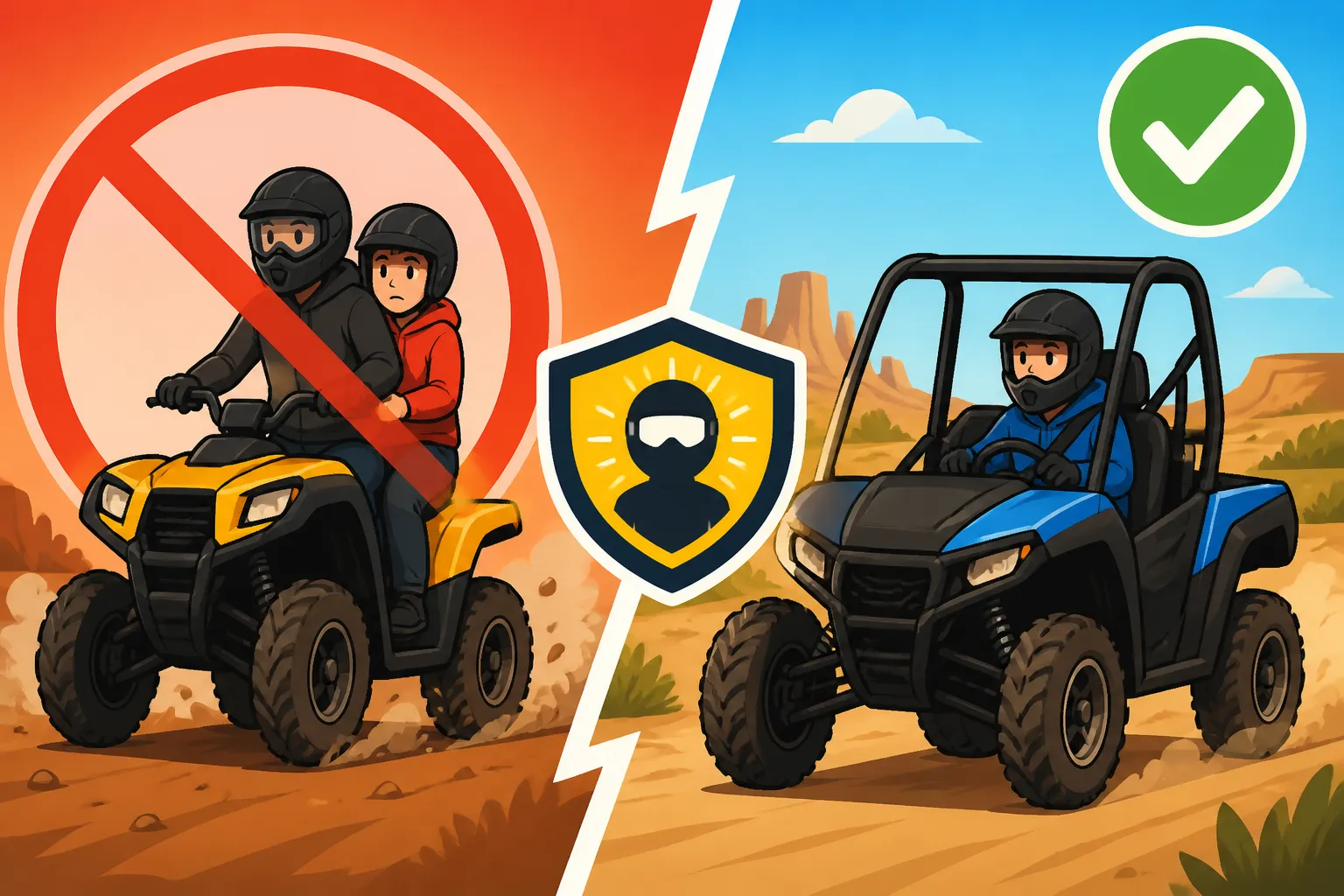
The rule is quite explicit and leaves little room for ambiguity: an operator of an off-highway vehicle who is under 18 years of age is prohibited from carrying a passenger. This applies regardless of the type of OHV, whether it's an ATV, dirt bike, or even a side-by-side, if the side-by-side is being operated by a minor. It also applies no matter how old the passenger is. A 17-year-old operator cannot carry their 15-year-old sibling, their 5-year-old cousin, or even their 80-year-old grandmother. The restriction is solely tied to the age of the person at the controls.
Consider these scenarios:
- Illegal: A 16-year-old on a two-up ATV (designed for two riders) with their younger sibling behind them.
- Illegal: A 15-year-old driving a side-by-side with a friend in the passenger seat, even if the side-by-side has seatbelts.
- Legal: A 17-year-old riding their own ATV solo.
- Legal: An adult (18 or older) driving a side-by-side with a 15-year-old passenger, provided the machine is designed for multiple passengers and the passenger is appropriately restrained and meeting other safety criteria (like helmet use).
The law is designed to be straightforward to ensure maximum safety. If the operator is a minor, they ride alone. Period. For comprehensive details on who can ride, explore [New Mexico Passenger Rules for Young Riders].
Exceptions and Nuances: When a Passenger Is Allowed (for adults)
While the rule for underage operators is strict, it's important to understand that passengers are generally allowed when the operator is an adult (18 years or older) and the machine is designed to carry more than one person. This distinction is critical.
Most ATVs are traditionally designed as single-rider machines. Even if they have a long seat, strapping on a second person to a machine not engineered for dual weight distribution is dangerous and often illegal. However, many newer utility terrain vehicles (UTVs) or side-by-sides are specifically manufactured with multiple seats, seatbelts, and roll cages, making them suitable for carrying passengers. For an adult, riding with a passenger in a machine designed for it, like a UTV, is perfectly acceptable, assuming the passenger meets any age or safety equipment requirements. For instance, [New Mexico Rules for Carrying a Passenger] outlines general guidelines, and remember, helmets are often mandatory, especially for minors, as highlighted in [New Mexico Helmet Law for ATV Riders].
So, while an adult can enjoy a scenic ride with their child or friend alongside them in a purpose-built UTV, a younger rider must exercise caution and adhere to the passenger prohibition. This emphasizes the state's focus on operator maturity and the machine's suitability for carrying multiple occupants.
Practical Implications for Families and Group Rides
Understanding the "why" behind the rule is one thing, but figuring out how to make it work for your family or group is another. It often requires careful planning, especially if you have multiple young riders eager to hit the trails.
Planning Rides with Multiple Youngsters
This rule can certainly throw a wrench into family outing plans, especially if you have several kids who all want to ride. The simplest answer is that if a minor is operating an OHV, they must ride solo. This means if you have three children, and two are old enough and have their safety permits to operate their own machines (say, ages 14 and 16), then each of those two will need their own OHV. The youngest child, if they can't operate their own machine due to age or size, would need to ride as a passenger with an adult operator on a machine designed for two.
Many families address this by having enough machines for each minor operator, or by ensuring an adult is always available to drive a multi-passenger UTV for the younger kids. For group rides where some operators are under 18, it's crucial to communicate these rules beforehand. Everyone needs to understand that the younger operators cannot double up. It’s also important to remember that general [New Mexico Supervision Rules for Young Riders] still apply, meaning adults must maintain visual supervision over minors at all times on public lands. This might mean spreading out your adult riders or having a designated "sweep" rider to keep an eye on the group.
Equipment Considerations and Aftermarket Solutions
When it comes to OHV equipment, especially anything that modifies passenger capacity, it's vital to stick to what's legal and safe. Adding aftermarket "buddy seats" or "rumble seats" to an ATV that was originally designed for a single operator can be extremely dangerous. These additions often compromise the machine's handling, stability, and the operator's ability to shift their weight effectively, which is crucial for ATV control. Even if such an accessory makes an ATV look like it could carry a passenger, New Mexico's law prohibiting minors from carrying passengers would still apply.
For those looking to enhance their UTVs for adult-operated group rides, companies like SuperATV offer a wide array of accessories designed to improve safety, utility, and comfort, such as roofs, windshields, or robust cargo solutions. These products are fantastic for customizing your machine for its intended use, but they don't alter the fundamental legal restrictions around who can carry a passenger, especially for underage operators. If you're considering a UTV for family rides where an adult will be the primary operator, opting for a model that comes from the factory with multiple seats is always the safest and most compliant choice. Resist the urge to convert a single-rider machine into a passenger carrier, particularly if a minor will be driving it.
Penalties for Non-Compliance and Enforcement
Ignoring these laws isn't just a matter of principle; it carries real-world consequences, including fines and potential legal issues. New Mexico law enforcement takes OHV safety seriously, and these rules are enforced to protect everyone on the trails.
The Consequences of Breaking Passenger Rules
If an officer spots an underage OHV operator carrying a passenger, you can expect a citation. The specific fines can vary, but generally, [New Mexico Fines for an OHV Violation] can range from moderate to significant. It's not just a slap on the wrist. Beyond the immediate financial penalty, there could be other repercussions. For instance, repeated violations could impact a minor's ability to obtain or maintain their OHV Safety Permit.
Crucially, parents or legal guardians often bear the brunt of these penalties. New Mexico law explicitly states that [New Mexico Penalties for a Parent] can be applied when a minor violates OHV regulations. This means that even if you weren't personally driving the machine, you could be held responsible for your child's non-compliance. This parental responsibility underscores the state's emphasis on adult supervision and guidance in OHV recreation. It's a heavy reminder that supervising young riders goes beyond just watching them; it includes ensuring they understand and follow all applicable laws.
Roadside Checks and Officer Discretion
It's common for law enforcement, including state police, county sheriffs, and land management rangers, to conduct roadside checks at popular trailheads, staging areas, or even out on the trails themselves. During these checks, officers will often verify registration, safety permits (especially for minors), and compliance with basic safety equipment and operational rules. [What a New Mexico Officer Checks Roadside] can include everything from helmet use to proper decal placement, and yes, they will definitely be looking for underage operators carrying passengers.
While officers might exercise some discretion depending on the situation, ignorance of the law is generally not considered a valid excuse. Their primary goal is public safety, and if they observe a violation that puts riders at risk, they are obligated to act. It's far better to be informed and compliant than to risk a fine or, worse, an accident due to a misunderstanding of the rules. Always assume that if you're riding on public land, an officer could be around the next bend, ensuring everyone is following the rules that keep New Mexico's trails safe and enjoyable for all.
To help visualize these important distinctions, here’s a quick overview of who can carry a passenger in New Mexico:
| Operator Age | Machine Type (Example) | Designed for Multiple Riders? | Can Carry Passenger? | Notes |
|---|---|---|---|---|
| Under 18 | ATV | No | No | Operator must ride solo. |
| Under 18 | UTV / Side-by-Side | Yes | No | Operator must ride solo, even if the machine has multiple seats. |
| 18 and Over | ATV | No | No (Generally) | Most ATVs are single-rider. Aftermarket passenger seats are often illegal/unsafe. |
| 18 and Over | Two-Up ATV | Yes | Yes | If the ATV is specifically designed by the manufacturer for two riders. |
| 18 and Over | UTV / Side-by-Side | Yes | Yes | If the machine has appropriate seats and restraints for passengers. |
Always remember that these rules are in place for safety. While it might feel restrictive at times, especially when you have a young, eager family member, adhering to them is crucial. Encourage young riders to develop their skills safely on their own machines, and save the shared rides for when an experienced adult is at the helm of a suitable vehicle. This way, everyone can enjoy the incredible off-roading opportunities New Mexico has to offer.
Disclaimer
This article is for general informational purposes only and does not constitute professional advice. Laws, prices and regulations vary by location and change over time. Consult a qualified professional for guidance on your specific situation.