Registering a Quad in New Mexico
It can feel a little overwhelming when you get a new quad or side-by-side, especially if you're new to New Mexico or just new to the world of off-highway vehicles (OHVs). You're excited to hit the trails, but then the questions start bubbling up: "Do I really need to register this thing?" "Where do I even go?" "What paperwork will they ask for?" This guide is here to cut through all that confusion and walk you through every step of registering your quad in the Land of Enchantment, so you can ride with confidence and stay on the right side of the law.
The Imperative to Register Your Quad in New Mexico
Let's be real, nobody enjoys dealing with bureaucracy, especially when all you want to do is go rip through some sand dunes or cruise a mountain trail. But when it comes to your quad, getting it properly registered in New Mexico isn't just a suggestion; it's a critical step that protects you, opens up riding opportunities, and keeps you from facing some pretty hefty fines. Think of it less as a hurdle and more as your official ticket to adventure.
Legal Mandates and Avoiding Penalties
First and foremost, New Mexico law is quite clear: if you plan to operate your off-highway vehicle on public lands, it absolutely must be registered. This isn't just a formality; it's a statewide requirement that helps fund trail maintenance, safety programs, and administrative oversight. Ignoring this mandate can lead to some unwelcome consequences. Imagine you're out enjoying a beautiful afternoon ride, and a Game and Fish officer or a local sheriff's deputy pulls you over for a routine check. If your quad isn't registered, you're looking at fines that can quickly add up, turning a fun day into a costly headache. These fines aren't just a slap on the wrist; they're designed to deter unregistered operation and can sometimes be accompanied by an order to cease riding until the issue is resolved. It’s far better to spend a little time at the Motor Vehicle Division (MVD) upfront than to gamble on getting caught later. The peace of mind alone is worth it.
Trail Access and Public Land Use
Beyond avoiding penalties, a registered quad unlocks a world of legal riding opportunities across New Mexico's diverse landscapes. Whether you're eyeing the vast open spaces of BLM land, the winding trails of a National Forest, or designated OHV areas like Red Sands or Glade Run, registration is your key. Public lands are managed, and part of that management includes ensuring that vehicles operating on them are accounted for and that their owners contribute to the upkeep of these precious resources. Without proper registration, you're essentially locked out of these incredible riding spots. Many of the most scenic and exhilarating trails in New Mexico are only accessible to legally registered machines. It's not just about a decal; it’s about being a responsible rider and contributing to the system that maintains the very trails you want to explore. Consider it your contribution to keeping New Mexico's OHV scene vibrant and accessible for everyone.
Navigating the New Mexico Quad Registration Process
Alright, so you understand why registration is important. Now let's talk about the how. The actual process for [Registering an OHV in New Mexico] is fairly straightforward, though like any bureaucratic process, it requires attention to detail. Knowing where to go and what to expect can make it a breeze.
Where to Go for Registration
In New Mexico, the Motor Vehicle Division (MVD) is your primary point of contact for registering your quad. You won't be dealing with the Department of Game and Fish for this initial step; it's all handled by the MVD. You have a few options for how you can tackle this:
- In-Person at an MVD Office: This is often the most common method, especially for first-time registrations or if you have any unusual circumstances. You can find MVD offices throughout the state. Visiting in person allows you to ask questions directly, have an agent review your paperwork on the spot, and often walk out with your registration and decals the same day. While it might involve a wait, knowing everything is handled correctly can be reassuring.
- Through an Authorized Dealer: Many OHV dealerships in New Mexico offer registration services as part of the sales process. If you're buying a brand-new quad or even a used one from a dealer, they can often handle all the MVD paperwork for you, sometimes even allowing you to leave the lot with your temporary registration in hand. This is incredibly convenient, as it means less hassle for you.
- Potentially Online (for renewals): While initial registration typically requires an in-person visit due to title and VIN verification, many renewals can be handled online. [Renewing a New Mexico OHV Registration] is usually a simpler process once your machine is already in the system. Always check the official New Mexico MVD website for the most current options.
The key is to always confirm the specific requirements with the MVD or your dealer, as procedures can occasionally change. For more details on the agency involved, check out [Why MVD Registers New Mexico OHVs].
The Core Steps: From Paperwork to Decals
Once you know where you're going, the actual process unfolds in a predictable sequence. It's mostly about gathering the right documents, presenting them, paying your fees, and then properly displaying your new registration.
- Gather Your Documents: This is arguably the most critical step. We'll dive into the specifics of what you need in the next section, but expect to show proof of ownership, personal identification, and proof of residency. Think of it as building your case for ownership and eligibility.
- Visit the MVD (or Dealer): Present your compiled documents to the MVD agent. They will review everything, verify your VIN (Vehicle Identification Number), and ensure all the paperwork is in order. This is when any questions you have can be answered directly.
- Pay the Fees: There are standard fees associated with registration. The [New Mexico OHV Registration Cost] is a biennial fee, meaning it covers two years of operation. Be prepared to pay this at the counter.
- Receive Your Registration and Decals: Once everything is processed and paid, you'll receive your official registration card and the all-important decals. These decals are physical proof that your quad is legally registered to operate in New Mexico.
- Affix Your Decals: This isn't just a suggestion; it's a legal requirement to display your decals correctly. The location varies slightly depending on the type of OHV, but for a quad, there are specific guidelines to follow. We'll cover this in more detail shortly.
By following these steps, you’ll transform your quad from an unregistered machine to a fully legal trail companion, ready for whatever adventures New Mexico throws your way.
Essential Documents for Your New Mexico Quad Registration
The phrase "paperwork" can send shivers down anyone's spine, but when it comes to registering your quad in New Mexico, it's really about proving who you are and that you legally own the machine. Having everything organized before you head to the MVD will save you a lot of time and frustration. This is where attention to detail truly pays off.
Proving Ownership: Title, MCO, or Bill of Sale
This is the cornerstone of your registration application. The MVD needs to verify that you are the rightful owner of the quad you're trying to register. Here's what they typically accept:
- Original Manufacturer's Certificate of Origin (MCO): If you're buying a brand-new quad straight from a dealer, the MCO is the document that establishes its first legal owner. It's essentially the birth certificate of your vehicle. Make sure it's properly signed over to you by the dealership.
- Certificate of Title: For used quads, a properly assigned New Mexico [Titling an Off-Highway Vehicle in New Mexico] is usually required. This document shows the history of ownership. The previous owner must sign over the title to you in the designated spots, and you'll typically need to apply for a new title in your name before or concurrently with registration. Always double-check that the VIN on the title matches the VIN on the quad exactly. If you're bringing a quad from another state, you'll generally need that state's title.
- Notarized Bill of Sale: In some cases, especially for older quads where a title might not have been issued (or was lost and can't be replaced), a detailed and notarized bill of sale can serve as proof of ownership. This document should include the buyer's and seller's names, addresses, the purchase price, the date of sale, and crucially, the quad's VIN, make, model, and year. It's highly recommended to have a robust bill of sale even if you have a title, as it provides an extra layer of protection for both parties. Resources like LawDepot offer templates for legally sound bills of sale, ensuring you include all the necessary information. For more on what this document needs, look up [New Mexico ATV Bill of Sale Requirements].
- Lien Release (if applicable): If you've paid off a loan on your quad, the lienholder (like a bank) needs to provide a release document. You cannot get a clear title or register the vehicle in your name until any outstanding liens are officially satisfied.
When you show up at the MVD, ensure you have the original documents, not just copies. They will need to verify signatures and details.
Identification and Residency Proof
Besides proving ownership of the quad, you also need to prove who you are and that you're a New Mexico resident (or are applying for a non-resident permit).
- Valid Photo Identification: Bring your current driver's license or state-issued ID card. This confirms your identity.
- Proof of New Mexico Residency: The MVD needs to ensure you actually live in the state. This could be your New Mexico driver's license, a utility bill with your name and New Mexico address, or a lease agreement. If you've recently moved, you might need a couple of different documents to establish your residency.
- Social Security Number: You'll typically need to provide your Social Security Number for MVD records.
It's a good practice to bring more than one form of identification or residency proof, just in case. MVD offices can sometimes be particular, and it's better to be over-prepared.
Fees and Payment Methods
There is a fee for registering your quad in New Mexico. This is a biennial fee, meaning it covers a two-year period. While I can't provide the exact current amount, you should expect to pay a set fee for your registration that lasts for two years. This fee helps fund the various programs related to OHV use in the state, including trail maintenance and enforcement. [What a New Mexico Renewal Costs] is generally the same as the initial registration fee, assuming no late penalties.
| Document Type | Purpose | Example Documents |
|---|---|---|
| Proof of Ownership | Establishes legal ownership of OHV | Original MCO, Signed-over Title, Notarized Bill of Sale (LawDepot provides templates) |
| Personal ID | Verifies applicant's identity | Valid New Mexico Driver's License or State ID |
| Proof of Residency | Confirms New Mexico address | NM Driver's License, Utility Bill, Lease Agreement |
| Additional (if any) | Specific circumstances | Lien release, customs documents (for imported machines) |
The MVD typically accepts various payment methods, including cash, checks, and major credit/debit cards. Always confirm accepted payment types when you visit or call ahead. Remember that the registration lasts for [How Long a New Mexico OHV Registration Lasts], which is two years, so budget accordingly.
Understanding New Mexico's OHV Decals and Their Display
Once you’ve successfully navigated the paperwork and paid your fees, the MVD will hand you your official New Mexico OHV registration and, crucially, your decals. These aren't just decorative stickers; they are proof positive that your quad is legally registered, and their correct display is mandatory. New Mexico actually uses two different colored decals, and understanding which one you need and where to put it is super important.
Yellow vs. Green: Which Decal Do You Need?
New Mexico offers two primary decals for OHVs, and the one you receive depends on how you plan to use your quad:
- The Yellow Decal: This is the standard off-highway decal. If your quad is strictly for off-road adventures – think designated trails, OHV parks, and unpaved county roads that are specifically opened – then the yellow decal is what you'll get. This decal signifies that your machine is registered for off-highway use only. It's the most common decal for recreational riders. For a deeper dive, check out [New Mexico's Yellow Off-Highway Decal].
- The Green Decal: This is the on-and-off highway decal. If you intend to operate your quad on certain paved public roads in New Mexico (where permitted by local ordinance) in addition to off-highway areas, you'll need this green decal. This essentially "opts in" your OHV for limited paved road use. Obtaining the green decal often comes with additional requirements, such as proving you have the minimum required liability insurance. It’s crucial to understand that even with a green decal, you can't just ride anywhere on pavement; specific city and county ordinances dictate where OHVs are allowed. This decal often comes with the requirement to also have a valid driver's license for paved road use. To understand more about the dual purpose, see [New Mexico's Green On and Off-Highway Decal].
It’s entirely possible to carry both if you want the flexibility, though the green decal usually covers all uses. The type of decal you receive will be clear on your registration document. Make sure it matches your intended use, and if you're ever unsure, ask the MVD agent. For a full explanation of the colors, refer to [New Mexico OHV Decal Colors Explained].
Correct Decal Placement on Your Quad
Proper placement of your decal isn't just a suggestion; it's a legal requirement that ensures law enforcement can easily verify your registration. For ATVs (which includes most quads), New Mexico has specific rules:
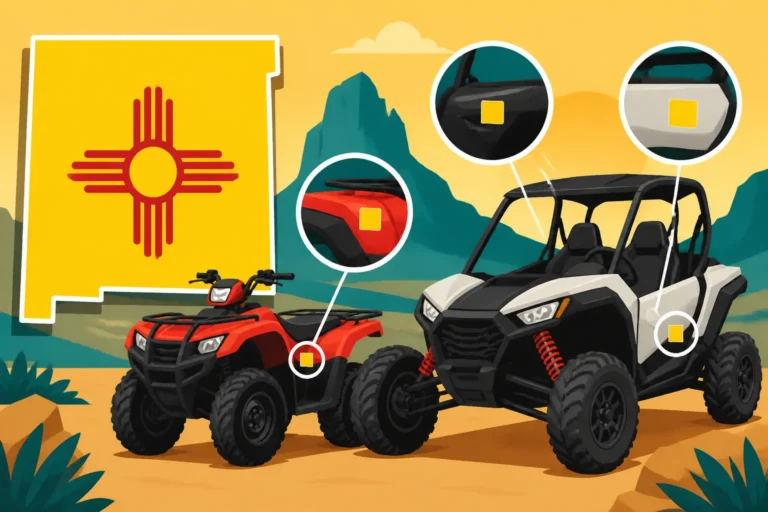
- Left Rear: Your OHV decal, whether yellow or green, must be affixed to the left rear of your quad.
- Visible Location: It needs to be in a place where it is clearly visible and not obscured by mud, equipment, or other accessories. The idea is that an officer should be able to spot it without difficulty.
- Clean Surface: Before applying the decal, make sure the surface is clean, dry, and free of grease or wax. This ensures the decal adheres properly and doesn't peel off easily, especially when exposed to the elements of New Mexico's diverse riding environments.
A common spot on many quads is on the left rear fender or a structural component on the left rear side of the machine. The exact location might vary slightly depending on your quad's design, but the key is "left rear and visible." Don't put it on a removable part that might fall off, and definitely don't keep it in your wallet; it needs to be on the machine itself. For specific guidance, you can check [Where the Decal Goes on an ATV's Left Rear]. If your decal gets damaged or becomes unreadable, you'll need to look into [Replacing a Lost New Mexico Decal] to avoid any issues.
Getting your quad registered in New Mexico really boils down to a few key steps: gathering the right documents, visiting the MVD, paying the fees, and correctly displaying your new decals. While it might seem like a bit of a chore, it's a fundamental part of being a responsible OHV owner and ensures you can enjoy all the incredible riding opportunities New Mexico has to offer without worry. By understanding these requirements, you're not just complying with the law; you're also contributing to the continued maintenance and accessibility of our beautiful trails.
Disclaimer
This article is for general informational purposes only and does not constitute professional advice. Laws, prices and regulations vary by location and change over time. Consult a qualified professional for guidance on your specific situation.