Plates Only for New Mexico Paved Road Use
It can be incredibly confusing trying to figure out where you can and cannot ride your ATV or UTV in New Mexico, especially when it comes to paved roads. The rules have shifted over the years, leaving many riders scratching their heads about what "street legal" really means in the Land of Enchantment. This guide is here to untangle the complexities of New Mexico's paved road regulations, explaining why a specific plate is now essential for any off-highway vehicle (OHV) venturing onto asphalt, and what that means for you.
Understanding New Mexico's Paved Road Philosophy
New Mexico, with its vast open spaces and incredible trails, is a dream for OHV enthusiasts. However, the legal framework differentiates sharply between off-road adventures and cruising down a paved street. This distinction isn't arbitrary; it's rooted in safety, traffic management, and the fundamental design differences between your average car and a rugged ATV or UTV.
Why Off-Highway Vehicles Face Special Rules on Pavement
Think about it: your typical ATV or UTV is built for dirt, rocks, and mud. It has knobby tires for traction in loose terrain, a suspension system designed to absorb massive bumps, and often lacks many of the safety features we take for granted in road-legal vehicles, like full enclosures, airbags, or even turn signals on older models. These machines handle differently on asphalt, brake differently, and are often less visible to other traffic. The state's approach, therefore, is to regulate their use on paved surfaces carefully to protect both OHV riders and other motorists. It's not about prohibiting fun, but about ensuring that when you do bring your machine onto a public road, you're doing so in a way that minimizes risk for everyone. This is a critical distinction that shapes all the rules we'll discuss.
Imagine pulling out of a trailhead parking lot directly onto a busy state highway on your side-by-side. Without proper lighting, mirrors, or even the right tires, you're not just a hazard to yourself, but to every car, truck, and motorcycle around you. New Mexico understands the need for riders to connect trails, access services, or even just get from their cabin to the nearest town, but it demands a certain level of equipment and preparation for that privilege.
The Core Purpose of the Paved Road Plate
The paved road plate is New Mexico's way of saying, "Okay, your OHV has met the necessary criteria to safely operate on certain public roads." It's not just a fancy piece of metal; it's a declaration that your machine has gone through the proper channels and has been outfitted with the basic safety features required for mingling with conventional traffic. Without this specific plate, any venture onto pavement, beyond designated crossings, can lead to fines and legal trouble.
This plate signifies that your machine is more than just registered for off-highway use; it's been registered for on-highway use, even if that use is limited. It's a key part of distinguishing a machine that's ready for a quick jaunt to the gas station from one that should stay strictly on the dirt. The plate also ties into the larger state framework for OHV management, helping ensure that revenue from these registrations contributes to trail maintenance and other rider services. It's an investment in both your safety and the longevity of the state's riding resources.
The Evolution of New Mexico's Paved Road OHV Rules
Like many aspects of life, the rules governing OHVs on paved roads in New Mexico haven't always been the same. They've changed and adapted over time, often in response to increasing OHV popularity, safety concerns, and the need for clearer regulations. Understanding this history helps contextualize why we have the current system today.
From Stickers to Plates: A Historical Look
Once upon a time, New Mexico had a system that involved stickers for paved road use. Riders would obtain a special sticker to signify their OHV was permitted on certain paved roads. It felt like a simpler time, maybe a bit more informal. However, this system had its quirks. Enforcing sticker visibility, distinguishing them from standard off-highway decals, and simply keeping track of them proved to be a challenge. There was a sense that the stickers, while well-intentioned, didn't provide the clear, easily identifiable indication that law enforcement needed to quickly determine an OHV's paved road legality. It was easy for confusion to reign, and riders might have unknowingly (or knowingly) bent the rules because the visual cues weren't strong enough. This is one of the primary reasons the state moved towards a more robust and universally recognized system: the license plate.
The move wasn't just about aesthetics; it was about bringing OHV road use into closer alignment with how traditional vehicles are identified and regulated. A standard license plate is instantly recognizable, making enforcement clearer and reducing ambiguity for both officers and riders.
What Changed with the 2017 Law
The year 2017 marked a significant turning point for OHV riders in New Mexico. Prior to this, the rules for riding on paved roads were often a patchwork of local ordinances and state statutes that could feel inconsistent. The 2017 law aimed to streamline these regulations and create a more uniform framework across the state, particularly regarding paved road access. One of the biggest changes was the formal establishment of a dedicated "paved road plate" program. This legislative shift acknowledged the growing demand for OHV road access and sought to create a safer, more organized way to allow it. It clarified which types of OHVs could qualify, what equipment was necessary, and how the registration process would work. [What the 2017 Law Changed for New Mexico Plates] goes into more detail about these specific legislative adjustments.
This law provided the foundation for the current system, moving away from temporary solutions or ambiguous interpretations and towards a clear, statewide standard for OHV road use. It was a recognition that OHVs were no longer just for remote trails but were becoming more integrated into the daily lives and recreational activities of many New Mexicans, necessitating a more comprehensive regulatory approach.
The End of the Paved Road Sticker Program
While the 2017 law laid the groundwork for the plate system, the actual end of the old paved road sticker program didn't happen overnight. It was a phased transition, designed to allow riders time to adapt and get their machines compliant with the new requirements. The state eventually set a hard deadline for the expiration of the sticker program, making it clear that after a certain point, those stickers would no longer be valid for paved road use. [Riding on a Sticker After the Program Ended] further explains the implications of this transition.
This transition was critical because it solidified the message: if you want to ride your OHV on paved roads in New Mexico, you need the official paved road plate. There was no longer any gray area or alternative. This final push to phase out the stickers ensured consistency and brought all paved road OHV use under the umbrella of the new, more stringent plate system, requiring updated equipment and a more thorough registration process.
Getting Your OHV Ready for Paved Roads: The Plate and Beyond
So, you're ready to take your OHV from the dirt track to the blacktop for a short connection between trails or a quick run to a local diner. That's awesome! But before you hit the pavement, there's more to it than just slapping on a plate. Your machine needs to meet specific equipment standards, and you need to understand the difference between the various decals and this special plate.
The Difference Between Decals and Plates
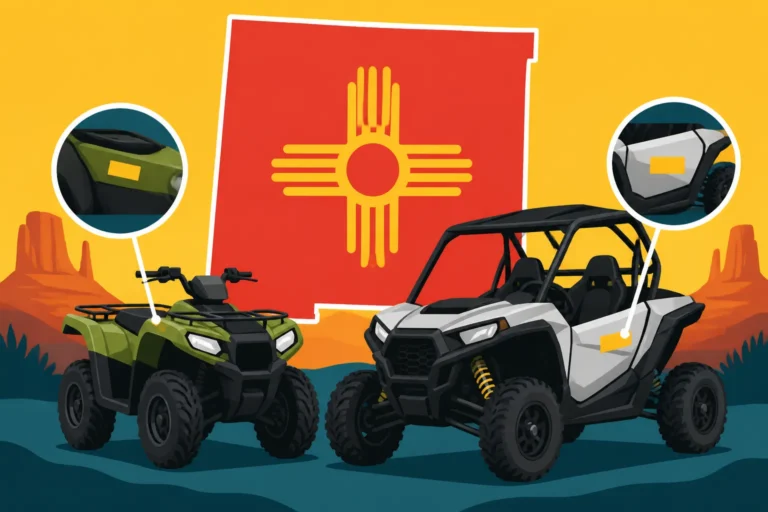
This is where a lot of confusion often arises. In New Mexico, you'll encounter a couple of different "decals" for your OHV, primarily the yellow and green ones. The standard yellow decal signifies that your OHV is registered for off-highway use only. It's essential for riding on public lands and designated trails, but it explicitly does not authorize you to ride on paved public roads. Then there's the green decal, which is for "on and off-highway" use, but even with this, a dedicated paved road plate is still the requirement for full compliance on paved streets. [Why New Mexico Wants Both Decals for Pavement] can help clarify this further.
The paved road plate, on the other hand, is a completely separate item. It's a physical metal plate, just like a car's license plate, and it's issued by the Motor Vehicle Division (MVD). This plate is the only official authorization for your OHV to operate on paved roads where permitted by state law and local ordinances. Decals confirm your off-highway registration; the plate confirms your paved road eligibility, assuming your machine meets all other equipment and operator requirements.
| Feature | Yellow Off-Highway Decal | Green On & Off-Highway Decal | Paved Road Plate |
|---|---|---|---|
| Purpose | Off-highway use only | On & Off-highway use | Paved road use |
| Issuing Body | MVD | MVD | MVD |
| Placement | Specific spots (e.g., left rear of ATV) | Specific spots | Rear of vehicle |
| Road Use | No paved road use | Restricted paved road use (needs plate too) | Essential for paved road use |
| Visibility | Sticker | Sticker | Metal Plate |
Essential Equipment for Paved Road Legality
Beyond just the plate, your OHV needs to be properly equipped to be considered legal for paved road use in New Mexico. This isn't just a recommendation; it's a legal requirement designed to enhance safety for you and others on the road. The list of necessary items usually includes:
- Headlights and Taillights: These must be functional and visible from specific distances. Generally, a headlight needs to illuminate 150 feet ahead, and a taillight must be visible from 200 feet to the rear.
- Brake Lights: These are crucial for signaling your deceleration to vehicles behind you.
- Turn Signals: While some older OHVs might have been exempt, modern requirements often lean towards having visible turn signals for clear communication on the road.
- Mirrors: You'll typically need at least one rearview mirror, and often two, to give you a clear view of traffic behind you.
- Horn: A working horn is essential for warning others of your presence.
- Muffler and Spark Arrestor: While critical for off-road use to prevent fires and manage noise, they are also relevant for road use to meet sound limits. New Mexico generally has a 96-decibel ceiling.
- Tires: Your tires must be suitable for street use, meaning they shouldn't be excessively aggressive or designed purely for off-road conditions if you're spending significant time on pavement.
It's wise to perform a thorough pre-ride inspection before heading out on any paved road. Check all your lights, test your brakes, and ensure your mirrors are clean and properly adjusted. If you're unsure about specific equipment requirements, a quick call to the MVD or reviewing the official state OHV guide can provide clarity. This attention to detail is paramount, not just for legal compliance, but for your safety and the safety of everyone sharing the road.
Navigating the MVD Process for Paved Road Plates
The journey to getting your OHV a paved road plate involves a few critical steps through the New Mexico Motor Vehicle Division (MVD). It's not always as straightforward as walking in and asking for one, especially if your machine isn't already titled. Understanding the sequence and requirements will save you a lot of headaches.
The Crucial Step of Titling Your Machine
Before you can even think about a paved road plate, your OHV must first be titled in New Mexico. This is a non-negotiable step. A title proves ownership and is the foundational document for almost all vehicle registrations, including OHVs that want paved road access. If you bought your machine new from a dealer, they likely handled the initial titling for you. If you bought it used, especially from a private seller, you'll need to ensure the title was properly transferred to your name. [Titling an Off-Highway Vehicle in New Mexico] provides a deep dive into this process.
If you don't have a title, or if it's not in your name, you'll need to get that sorted out first. This might involve obtaining a bill of sale, especially if the original title was lost, or if you're dealing with a very old machine where titles weren't as common. Websites like LawDepot offer templates for bills of sale and other legal documents that can be very helpful in ensuring you have all the necessary paperwork for proving ownership, which is crucial for the MVD. Having all your ducks in a row for the titling process will make applying for the paved road plate much smoother. [New Mexico OHV Title Requirements] further elaborates on the specific documents you'll need.
Applying for Your Paved Road Plate
Once your OHV is properly titled in New Mexico, you can proceed with applying for the paved road plate. This typically involves a visit to your local MVD office. You'll need to bring several key documents with you:
- Your OHV's Title: As mentioned, this is essential.
- Proof of New Mexico Residency: A driver's license or state ID will usually suffice.
- Proof of Insurance: For paved road use, specific liability insurance is mandatory, similar to what you'd have for a car. We'll discuss this more later.
- Vehicle Identification Number (VIN) Verification: Sometimes, the MVD may require a physical inspection of your OHV to verify the VIN, especially if it's an out-of-state machine or if there are any discrepancies in the paperwork.
- Application Forms: The MVD will have specific forms for OHV registration and for applying for the paved road plate. It's often a good idea to check their website beforehand to see if you can download and fill these out in advance to save time.
Be prepared for potential waiting times at the MVD, and ensure you have all original documents, not just copies. The staff there can guide you through any specific nuances, but coming prepared with everything outlined here will significantly streamline your experience.
Understanding the Associated Costs
Getting a paved road plate isn't free, and it's important to budget for the associated fees. These costs typically include:
- Initial Registration Fee: This covers the processing of your initial OHV registration.
- Paved Road Plate Fee: There's a specific fee for the issuance of the paved road plate itself. This fee is separate from your biennial OHV registration. [New Mexico OHV Paved Road Plate Cost] outlines the typical charges.
- Titling Fees: If you're also titling your machine at the same time, there will be fees associated with that process as well.
- Sales Tax: If you've just purchased the OHV, you'll likely pay sales tax based on the purchase price.
It's always best to check the current fee schedule directly with the New Mexico MVD or on their official website, as these figures can change. Remember, these fees contribute not only to the administrative costs of the MVD but also, in part, to programs that benefit OHV riders across the state, such as trail maintenance and safety education. So, while it's an expense, it's also an investment in the riding community.
Important Considerations for Paved Road Riding
Having your paved road plate and meeting all the equipment requirements is a fantastic start, but there's more to safe and legal paved road riding than just the machine itself. Your personal preparation, understanding of local rules, and awareness of specific limitations are equally vital.
Insurance and Driver's License Requirements
This is a big one. For any OHV operating on New Mexico's paved public roads, you absolutely must have proof of financial responsibility. This almost always means having an active liability insurance policy. Just like with a car, this insurance protects you financially in case you're at fault in an accident involving property damage or bodily injury. The state mandates minimum coverage amounts, so be sure your policy meets these requirements. You'll need to carry proof of this insurance with you whenever you're riding on pavement. [New Mexico ATV Insurance Requirement] will give you the full details.
Furthermore, if you're operating an OHV on a paved road, you must possess a valid driver's license. This isn't just a suggestion; it's a legal requirement. The logic is straightforward: if you're sharing the road with cars, trucks, and motorcycles, you need to be a licensed driver, demonstrating you have passed a driving test and understand traffic laws. This includes obeying all speed limits, traffic signals, and road signs. [New Mexico Driver's License Rules for OHVs] clarifies who needs a license and what type. These requirements are in place to ensure a baseline level of competency and accountability when OHVs enter the general traffic flow.
Local Ordinances and Where You Can Actually Ride
Here's where things can get tricky: while the state issues your paved road plate and sets general guidelines, individual counties and municipalities in New Mexico have the authority to create their own ordinances regarding OHV use on local paved roads. This means that even with your shiny new plate, you might not be able to ride everywhere. Some towns might open all their streets, some might open only specific ones, and others might prohibit OHVs on paved roads entirely.
For example, Red River has specific rules about OHV types and times for riding on its streets, while some counties like Sierra County have opened nearly all their county roads. It's your responsibility as a rider to know the local laws for wherever you plan to ride. Before you hit the road in a new area, it's always a good idea to check with the local police department, county sheriff's office, or town hall. You can often find this information on their websites. Ignoring local ordinances, even with a state-issued plate, can still result in fines or other penalties. [New Mexico Rules for Riding a County Road] and [New Mexico Rules for Riding a City Street] offer broader perspectives on this patchwork of regulations. Always remember to ride respectfully and within the designated areas to keep the trails (and roads) open for everyone.
Common Misconceptions and Troubleshooting
Despite the state's efforts to clarify rules, some misunderstandings persist among OHV riders in New Mexico. Let's tackle a couple of the most common ones and offer some troubleshooting advice.
Addressing Common Misunderstandings
One frequent misconception is that merely having a standard OHV registration (with a yellow or green decal) automatically grants you permission to ride on paved roads. As we've discussed, this is absolutely not the case. Those decals are primarily for off-highway registration. The dedicated paved road plate is the key for on-road legality. Another common misunderstanding is that all paved roads are fair game once you have the plate. This, too, is incorrect. State highways (like I-25, US 54, US 70, etc.) are generally off-limits to OHVs, even with a paved road plate. The plate primarily applies to county roads and designated city streets that local jurisdictions have specifically opened for OHV use. It's crucial to distinguish between a state highway and a county road; the former is almost universally forbidden for OHVs in New Mexico.
Some riders also mistakenly believe that a driver's license isn't necessary if they're just "crossing" a paved road. While New Mexico does have specific rules for perpendicular crossings of roadways, any sustained travel on a paved road requires a valid driver's license and the appropriate registration. It's always better to err on the side of caution and ensure you're fully compliant, both with your machine's documentation and your own licensing.
What to Do If You've Only Ever Had a Decal
If you've been riding your OHV for years with just a yellow or green decal and now realize you want (or need) that paved road plate, don't panic! It's a solvable situation. First, make sure your current OHV registration is up to date. Then, confirm that your OHV is properly titled in your name. If you've been riding on public land with a decal, it's likely your machine is already titled, but it's worth double-checking. If you don't have a title, you'll need to address that first, possibly using resources like LawDepot to help create a valid bill of sale if you're tracking down ownership for a previously untitled machine.
Next, conduct an honest assessment of your OHV's equipment. Does it have working headlights, taillights, brake lights, mirrors, and a horn? If not, you'll need to invest in upgrades to meet the street-legal requirements. These accessories are widely available from aftermarket suppliers. Once your machine is titled and properly equipped, gather all your documents (title, proof of insurance, driver's license) and head to the MVD to apply for the paved road plate. It's a process, but it's entirely doable, and it opens up new avenues for your riding adventures within the legal framework.
Disclaimer
This article is for general informational purposes only and does not constitute professional advice. Laws, prices and regulations vary by location and change over time. Consult a qualified professional for guidance on your specific situation.