New Mexico’s Paved Road Plate
Many riders in New Mexico yearn for the freedom to ride their off-highway vehicle (OHV) beyond designated trails, perhaps cruising a paved county road to reach a new riding area, picking up supplies in a small town, or simply extending their adventure onto the blacktop. However, navigating the legal landscape for street-legal ATV and UTV use in the Land of Enchantment can feel like trying to find your way through a maze without a map. This guide will demystify New Mexico's Paved Road Plate, explaining precisely what it entails, who needs one, and how to get your machine ready for legal paved road access.
Understanding New Mexico's OHV Road Rules
The open roads of New Mexico call to many OHV enthusiasts, but the call comes with a strong caveat: not all roads are created equal when it comes to riding your ATV or UTV. State law has specific provisions that differentiate between dirt roads, designated trails, and paved public thoroughfares. Understanding these distinctions is the first step toward responsibly enjoying your machine.
The Historical Context of Street Legalization
For a long time, the idea of an ATV or UTV on a paved public road in New Mexico was largely a no-go, outside of very limited, specific circumstances like crossing a highway. This created a real dilemma for riders who wanted to connect trails, access fuel, or simply enjoy a ride that incorporated both off-road and on-road elements without the hassle of constantly loading and unloading their machines. The laws just weren't quite caught up with the growing popularity and versatility of modern OHVs, leaving many riders feeling restricted and confused about what was permissible. It was a common frustration to see a perfect stretch of paved road connecting two fantastic dirt sections, only to know you couldn't legally ride it.
The legislative landscape has evolved to address these challenges, recognizing that responsible OHV use on certain paved roads could benefit communities, tourism, and rider experience. This evolution didn't happen overnight; it was a gradual process of understanding the needs of the riding community while also ensuring public safety. The creation of the Paved Road Plate was a significant milestone in this journey, offering a specific pathway for OHV owners to gain limited access to paved public roads. This plate fundamentally changed how many riders planned their trips, opening up new possibilities for multi-terrain adventures.
Differentiating Paved Roads from Off-Highway Trails
It’s crucial to understand that a "paved road" under New Mexico law is distinct from the unpaved county roads, forest service roads, or Bureau of Land Management (BLM) trails where OHVs typically roam. When we talk about paved roads, we're generally referring to asphalt or concrete surfaces that are part of the state, county, or municipal road system, not just any hard-packed surface that happens to be smooth. The rules for riding on these paved surfaces are much stricter and require specific compliance beyond what's needed for dirt trails.
Off-highway trails, on the other hand, are the lifeblood of OHV riding in New Mexico. These are typically unpaved routes designed or designated for off-road vehicles, often managed by federal or state agencies. While you need an [New Mexico's Yellow Off-Highway Decal] or a [New Mexico's Green On and Off-Highway Decal] to ride on these public lands, the requirements for the vehicle itself and the rider are generally less stringent than for paved road use. The Paved Road Plate specifically addresses the gap between these two worlds, allowing a bridge from the dirt to the asphalt, but only under strict conditions that mirror typical vehicle codes.
What Exactly is the New Mexico Paved Road Plate?
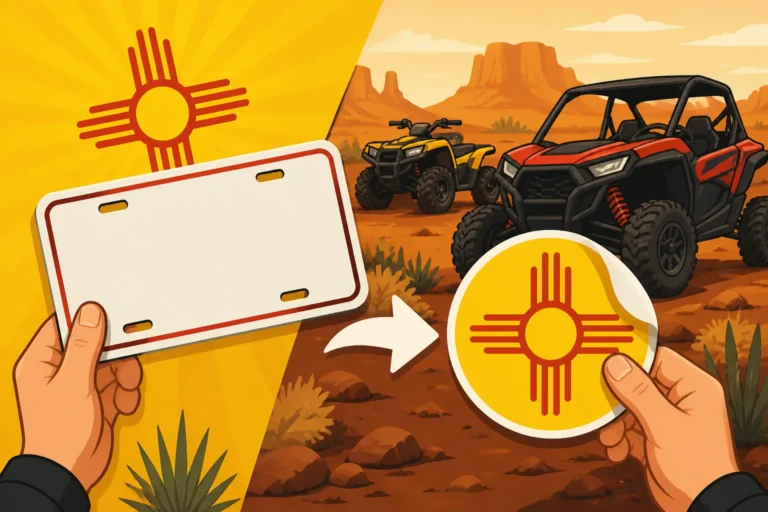
The New Mexico Paved Road Plate is precisely what it sounds like: a special license plate issued by the New Mexico Motor Vehicle Division (MVD) that, when properly displayed on your off-highway vehicle, grants you permission to operate on certain paved public roads. It's not just a fancy sticker; it’s a full-fledged license plate, much like what you'd see on a car or truck, but specifically for OHVs. This plate signifies that your machine has met the additional requirements necessary for paved road operation.
Purpose and Function of the Plate
The primary purpose of the Paved Road Plate is to provide a legal mechanism for OHV owners to access paved public roads that are not state highways. This means you can use it to travel between trailheads, access services in small towns, or connect segments of your ride that would otherwise require trailering. It’s an "opt-in" program, meaning you actively choose to get this plate to expand your riding opportunities. Without it, your OHV is generally restricted to unpaved roads and designated trails, with only very limited exceptions for crossing paved roads. The plate serves as visible proof to law enforcement that your vehicle is compliant with the additional regulations for street use.
This plate is a game-changer for many riders, transforming how they plan and execute their adventures. Imagine being able to ride directly from your campsite to a nearby diner for breakfast, or to a gas station for a quick fill-up, without having to load your side-by-side onto a trailer. This convenience significantly enhances the overall riding experience, making trips more seamless and enjoyable. It also encourages responsible OHV tourism in communities that have chosen to open their paved roads to these vehicles, boosting local economies.
Distinguishing the Plate from OHV Decals
It's easy to get confused between the various decals and plates New Mexico offers for OHVs, but the Paved Road Plate stands apart. You're likely familiar with the yellow and green decals. The [New Mexico's Yellow Off-Highway Decal] is for machines used exclusively off-highway, while the [New Mexico's Green On and Off-Highway Decal] allows limited on-highway use for residents to access trails within a reasonable distance, typically on unpaved county roads. Both are biennial renewals and critical for legal off-road operation.
The Paved Road Plate, however, is a separate and distinct item. It's not a substitute for your primary OHV registration decal, and in many cases, you'll need both. The decals primarily authorize off-highway use and basic identification, while the plate specifically permits paved road use, with all the additional requirements that entails. Think of it this way: the decals get you on the dirt, but the plate helps you legally cross or traverse the asphalt. You'll affix your green or yellow decal as required for your OHV, and the Paved Road Plate will be mounted separately, typically on the rear of your machine, ensuring both forms of authorization are clearly visible.
Who Needs a Paved Road Plate in New Mexico?
The question of whether you need a Paved Road Plate really boils down to how you intend to use your off-highway vehicle in New Mexico. If your riding adventures are exclusively confined to dirt trails, private land, or unpaved county roads, then the Paved Road Plate likely isn't necessary for you. However, if your vision for riding includes any significant travel on paved public roads, then this plate becomes essential.
Scenarios Requiring the Plate
Let's talk about real-life situations where the Paved Road Plate becomes a must-have. Perhaps you frequent an OHV area where a paved county road cuts right through the middle, and you want to ride from one section to another without having to trailer your machine. Or maybe your favorite trail system is a few miles down a paved route from your cabin, and you'd love to just hop on your side-by-side and drive there. These are prime examples.
Consider traveling to towns like Red River, where specific ordinances allow for OHV use on certain paved town streets, but only with proper street-legal equipment, which includes this plate. If you're using your OHV to access local businesses, campgrounds, or connect various segments of an extended tour that involves paved sections, then the Paved Road Plate is non-negotiable. Without it, you'd be breaking the law and risking significant fines for illegal road riding. It essentially unlocks a new dimension of riding possibilities, making your machine truly versatile for both wilderness and community access.
When the Plate is Not Required
It's equally important to understand when you don't need the Paved Road Plate. If your OHV never touches paved surfaces, except for perhaps very brief, perpendicular crossings of minor paved roads to get to another dirt trail, then you can likely skip it. These brief crossings are generally permitted as long as you yield to traffic, stop before entering the roadway, and proceed directly across.
Additionally, if you strictly use your machine on private land—your own ranch, for instance, or land where you have explicit permission—the Paved Road Plate isn't required because you're not operating on public roads. Similarly, if you trailer your OHV to every trailhead and only unload it once you're on designated off-highway routes, then the plate isn't needed. Your [New Mexico's Green On and Off-Highway Decal] covers your basic registration for trail riding, but it doesn't extend to general paved road use. Knowing these distinctions can save you time and money by ensuring you only pursue the necessary registrations for your specific riding style.
Requirements for Obtaining a New Mexico Paved Road Plate
Getting your Paved Road Plate isn't just a matter of walking into the MVD and asking for one. There are several specific prerequisites your off-highway vehicle must meet, as well as documentation you’ll need to provide. These requirements are in place to ensure that any OHV operating on paved roads is as safe and visible as possible, mirroring many of the standards for traditional motor vehicles.
Vehicle Equipment Standards
Before your OHV can even be considered for a Paved Road Plate, it must be equipped with certain safety features. These aren't optional extras; they are legal necessities for paved road operation. Expect to need:
- Headlights and Taillights: These must be functional and meet specific visibility requirements, ensuring you can see and be seen, especially during dawn, dusk, or adverse weather conditions.
- Brake Lights: Essential for signaling your braking intentions to other drivers on the road.
- Turn Signals: Required for clearly indicating your turns, just like a car.
- Mirrors: At least one rearview mirror is typically required, though many riders opt for two for better visibility.
- Horn: A working horn is necessary for alerting others to your presence.
- Muffler and Spark Arrester: While important for off-road use, your muffler must also meet specific noise limits for paved roads, and a spark arrester is often required on public lands anyway.
- DOT-Approved Tires: Your tires must be approved for highway use, not just off-road terrain. This is a critical safety component.
Each of these items plays a role in making your OHV compatible with the shared environment of paved roads. It's not enough for these components to simply be present; they must be fully functional and meet the [New Mexico Equipment Rules for Road Use]. It's a good idea to conduct a thorough pre-inspection of your machine to ensure everything is in working order before you head to the MVD.
Insurance and Driver's License Mandates
Operating any motor vehicle on a public paved road in New Mexico comes with responsibilities, and an OHV with a Paved Road Plate is no exception. This means two major requirements:
- Financial Responsibility (Insurance): You absolutely must carry proof of liability insurance. This isn't just a good idea; it's the law. New Mexico's Mandatory Financial Responsibility Act applies, meaning you'll need at least the state-mandated minimums for bodily injury and property damage coverage. This insurance protects you and others in the event of an accident. Without it, you risk significant fines and potential suspension of your driving privileges. Make sure your policy specifically covers OHV operation on public roads. [New Mexico ATV Insurance Requirement] is a fundamental aspect of paved road legality.
- Valid Driver's License: The operator of the OHV on a paved public road must possess a valid driver's license. This means you can't just be an experienced off-road rider; you need to be a licensed driver in New Mexico or another state that grants driving privileges. A permit or a learner's license typically won't suffice for unsupervised paved road operation. This ensures that anyone driving an OHV on public streets has demonstrated basic driving competency and knowledge of traffic laws. You can't just be a good driver off-road; you need to be a legal driver on-road. [New Mexico Driver's License Rules for OHVs] are strictly enforced on pavement.
Titling and Registration Prerequisites
Before you can even apply for the Paved Road Plate, your OHV needs to have a proper New Mexico title and current registration. This foundational step is critical, as the Paved Road Plate is an add-on to your existing legal vehicle status.
- Existing New Mexico Title: Your machine must already be titled in New Mexico. If you've just purchased a used OHV, or are moving from out of state, [Titling an Off-Highway Vehicle in New Mexico] is your first priority. The title proves legal ownership, which is paramount for any vehicle registration process. You'll need the original title, free of any liens unless properly acknowledged. If you're buying a used machine, ensure you get a proper bill of sale; resources like LawDepot can assist in creating a legally sound document for your purchase.
- Current OHV Registration Decal: Your off-highway vehicle must have a current New Mexico OHV registration decal, typically the yellow off-highway or green on-and-off-highway decal. This confirms your machine is registered for general use in the state. The Paved Road Plate doesn't replace this; it supplements it. The MVD needs to see that your vehicle is already recognized as a legal OHV within the state's system before granting it paved road privileges. Gathering all your [New Mexico OHV Registration Paperwork] beforehand will make this process much smoother.
The Process of Applying for Your Paved Road Plate
Once you've ensured your OHV meets all the equipment standards and you have your insurance and driver's license in order, you're ready to tackle the application process. While it might seem like a lot of steps, breaking it down makes it manageable.
Necessary Documentation for Application
When you head to the New Mexico MVD, whether it's an office or a certified third-party agent, be prepared with a complete set of documents. This preparation will save you immense frustration and potential extra trips. Here’s a checklist of what you’ll likely need:
- Your Valid Driver's License: As the applicant, you must prove you are a licensed driver.
- Original New Mexico Title for Your OHV: This confirms your ownership.
- Proof of Current New Mexico OHV Registration: Your current decal number will be on record, but having your registration certificate handy is always a good idea.
- Proof of Financial Responsibility (Insurance): Your insurance card or a certificate of insurance showing active liability coverage for your OHV.
- Completed [New Mexico OHV Plate Application] Form: This form will ask for details about you and your vehicle, certifying that it meets all necessary requirements for paved road use.
- Bill of Sale or Purchase Agreement (if recently acquired): Especially if you're titling and plating for the first time after a private sale. A detailed bill of sale, perhaps drafted using a service like LawDepot, can smooth this part of the process.
- Odometer Reading (if applicable): Some OHVs have odometers, and this might be required for the application.
- Payment for Fees: Be ready to cover the [New Mexico OHV Paved Road Plate Cost]. While I can't give you a specific number, understand that there will be a fee associated with the plate, separate from your regular OHV registration renewal. It's often a one-time or infrequent fee, but always check current rates with the MVD.
Having all these documents organized in a folder will make your visit significantly more efficient.
Step-by-Step Application Procedure
The actual application process at the MVD generally follows a straightforward path, but knowing what to expect can ease any anxiety.
- Gather Your Documents: As detailed above, ensure you have every piece of paperwork ready before you even leave your driveway.
- Visit an MVD Office or Third-Party Provider: You'll need to go in person. While New Mexico offers some online services, applying for a specialized plate like this often requires a physical inspection of documents and sometimes even the vehicle itself (though less common for the plate itself than for a VIN inspection).
- Present Your Documents and Application: Hand over your completed application form and all supporting documentation to the MVD agent. They will verify your identity, ownership, and current registration status.
- Vehicle Verification/Inspection (if required): While a full vehicle inspection isn't always standard for the Paved Road Plate application, MVD reserves the right to verify that your OHV has the required equipment. Be prepared to potentially show proof of your working headlights, taillights, horn, etc., or even bring your OHV for a quick visual check if specifically requested.
- Pay Applicable Fees: Once everything is verified, you'll pay the required fees for the plate. This fee contributes to the administrative costs of the program.
- Receive Your Plate and Registration: After successful processing, you will be issued your new New Mexico Paved Road Plate. You'll also receive an updated registration document reflecting the Paved Road Plate endorsement. Make sure to keep this document with you when riding on paved roads.
The entire process, from gathering documents to receiving your plate, is designed to ensure that only properly equipped and insured OHVs driven by licensed operators gain access to paved public roads.
Maintaining Your New Mexico Paved Road Plate
Getting your Paved Road Plate is just the beginning. Like any other vehicle registration, there are ongoing responsibilities to ensure you remain compliant with New Mexico law. This includes understanding renewal cycles, how to handle changes in ownership, and what to do if your plate is ever lost or damaged.
Renewal and Expiration
Unlike your biennial OHV registration decal, the Paved Road Plate itself doesn't typically have a recurring expiration date in the same way. The plate is usually issued as a permanent fixture for that specific OHV. However, the privilege of using it on paved roads is tied directly to your current OHV registration and proof of financial responsibility.
This means you still need to ensure your underlying [Renewing a New Mexico OHV Registration] is current every two years. If your regular OHV registration lapses, then your Paved Road Plate effectively becomes invalid for paved road use, even if the physical plate is still attached to your machine. Always keep your insurance current, as that is another critical ongoing requirement. Think of the plate as an endorsement that's only active if all other fundamental vehicle requirements are met. It’s similar to how a specialized driver's license endorsement is only valid if your base driver's license is current.
Transferring Ownership or Replacing a Lost Plate
What happens when you sell your OHV, or if your plate goes missing? These are common situations that require prompt attention to maintain compliance.
- Selling an OHV with a Paved Road Plate: When you sell an OHV that has a Paved Road Plate, the plate generally stays with the machine. The new owner will then need to go through their own process of [Titling an Off-Highway Vehicle in New Mexico] in their name and ensuring all their personal requirements (driver's license, insurance) are met to legally operate the OHV on paved roads. As the seller, you should provide the new owner with all the documentation you have, including proof of the Paved Road Plate. It's also wise to formalize the sale with a [New Mexico ATV Bill of Sale Requirements], which services like LawDepot can provide, explicitly noting the transfer of the OHV and its associated plate.
- Lost, Stolen, or Damaged Plate: If your Paved Road Plate is lost, stolen, or becomes damaged to the point of being unreadable, you must apply for a replacement immediately. This is similar to replacing a lost license plate for a car. You'll need to visit the MVD, present your identification and proof of ownership, and typically pay a replacement fee. Operating your OHV on paved roads without a properly displayed and legible Paved Road Plate can lead to [New Mexico Fines for an Unregistered OHV] or improperly registered vehicle. Don't delay in getting a new one; it's a visible sign of your legal compliance.
Limitations and Important Considerations for Paved Road Riding
While the New Mexico Paved Road Plate opens up new avenues for OHV use, it's crucial to understand that it does not grant unlimited access to all paved roads. There are significant limitations and rules you must abide by to ensure your safety and remain within the bounds of the law. Ignoring these can lead to fines, accidents, and a black eye for the OHV community.
Roads Where OHVs Are Still Prohibited
The biggest misconception about the Paved Road Plate is that it allows you to ride anywhere a car can go. This is simply not true.
- State Highways (Interstates, US Highways, State Routes): Generally, OHVs with a Paved Road Plate are still prohibited from operating on state highways, including interstates, U.S. highways (like US 54 or US 70), and most numbered state routes (like NM 38 outside of specific Red River sections). These are considered high-speed, high-traffic thoroughfares and are not suitable for OHV operation. The intent of the plate is primarily for access to county roads and municipal streets. [Why New Mexico State Highways Are Off Limits] to OHVs is a matter of safety and traffic flow.
- Limited Access Roads: Any road designated as limited access (like an interstate freeway or certain major arterial roads) is off-limits.
- Local Ordinances: While New Mexico law provides the framework, individual counties and municipalities have the authority to open or close their own paved roads to OHV traffic. A county might open most of its roads, but a town within that county might choose to keep its streets closed, or only open specific ones. Always check local ordinances before riding on paved roads in a particular area. A prime example is Red River, which has specific streets open to ROVs but bans ATVs. The Paved Road Plate facilitates compliance with these local opt-in rules.
Always assume a paved road is closed unless you can confirm it is explicitly open to OHVs with a Paved Road Plate.
Safe Riding Practices and Legal Obligations
Even with the plate, riding an OHV on paved roads requires extra vigilance and adherence to specific rules, many of which differ from off-road riding.
- Traffic Laws: When on a paved public road, your OHV is considered a motor vehicle, and you must obey all applicable traffic laws: speed limits, stop signs, traffic signals, yielding rules, and lane discipline. This includes stopping at all intersections and signaling turns appropriately.
- Helmet and Eye Protection: While not all adult riders are required to wear helmets off-road, [New Mexico Helmet Law for ATV Riders] dictates that riders under 18 must always wear a helmet. Furthermore, all riders on paved roads are encouraged, and often required, to wear eye protection, even if not wearing a helmet. It's simply safer.
- Passenger Rules: Be aware of [New Mexico Rules for Carrying a Passenger]. Many OHVs are designed for one rider, or specific numbers of passengers. Do not exceed the manufacturer's recommendations or state law regarding passenger capacity, especially with minors. [New Mexico Passenger Rules for Young Riders] are very specific.
- Right-of-Way: On paved roads, OHVs must yield to other motor vehicles, pedestrians, and bicycles. They are generally treated as slower-moving traffic.
- Equipment Functionality: All the required equipment—headlights, taillights, turn signals, horn, mirrors, brakes—must be fully functional at all times when operating on paved roads. A faulty brake light or a non-working turn signal could result in a citation.
- Carrying Documentation: Always carry your driver's license, proof of insurance, and OHV registration certificate (showing the Paved Road Plate endorsement) when riding on paved roads. Law enforcement can, and often will, ask for these documents during a roadside stop.
| Feature / Aspect | New Mexico Yellow Off-Highway Decal | New Mexico Green On & Off-Highway Decal | New Mexico Paved Road Plate |
|---|---|---|---|
| Primary Use | Exclusively off-highway trails & unpaved roads. | Off-highway + limited paved road access to trails. | Paved county roads & municipal streets (with local consent). |
| Legal Authority | Basic OHV registration for public lands. | Basic OHV registration with limited "on-highway" access. | Grants explicit privilege for general paved road use. |
| Paved Road Access | No general paved road access (only perpendicular crossings). | Limited, typically for trail access on unpaved/minor paved roads. | Broad access to permitted paved roads (not state highways). |
| Vehicle Equipment | Basic safety requirements for off-road. | Basic safety requirements for off-road. | Requires full street-legal equipment (lights, signals, mirrors, horn, DOT tires). |
| Insurance Req. | Not mandated by state for off-road (but recommended). | Not mandated by state for off-road (but recommended). | Mandatory liability insurance for paved road use. |
| Driver's License | Not mandated for off-road (age/safety permit rules apply). | Not mandated for off-road (age/safety permit rules apply). | Mandatory valid driver's license for operator. |
| Mounting | Sticker on vehicle (specific locations by type). | Sticker on vehicle (specific locations by type). | Metal license plate, typically on rear of vehicle. |
| Renewal Cycle | Biennial (every two years). | Biennial (every two years). | Permanent for vehicle, but tied to active OHV registration & insurance. |
Comparing the Paved Road Plate to Other New Mexico OHV Decals
The array of decals and plates can be confusing, but understanding their distinct roles is vital for legal OHV operation in New Mexico. The Paved Road Plate is not a replacement for your standard OHV registration decal, but rather a specialized addition.
Why the Paved Road Plate is Unique
The Paved Road Plate holds a unique position in New Mexico's OHV regulatory framework because it addresses a very specific need: sustained, general travel on paved county and municipal roads. While the green decal offers a limited "on-highway" privilege, it's typically understood to facilitate direct access to off-highway trails, not for cruising through town or extended paved journeys. The green decal allows you to bridge short gaps on pavement to get to dirt roads.
The Paved Road Plate, on the other hand, explicitly permits your OHV to integrate more fully into the paved road traffic system (excluding state highways and limited-access roads). It’s the highest level of paved road authorization for an OHV in New Mexico. This distinction is crucial because the plate demands a higher level of vehicle equipment, driver licensing, and insurance, reflecting the increased safety demands of operating alongside traditional vehicles on paved surfaces. Without the Paved Road Plate, even with a green decal, you could still be cited for illegal operation if you're using paved roads for general travel beyond what the green decal intends.
Navigating Dual Requirements (Plate and Decal)
For many riders who want to maximize their flexibility, carrying both a current OHV registration decal (yellow or green) and the Paved Road Plate will be the norm.
- OHV Decal for Off-Road Use: Your yellow or green decal is your fundamental permit for riding on designated off-highway trails and unpaved public roads managed by federal, state, or county agencies. This is what identifies your machine as legally registered for its primary purpose. You'll apply for and renew this every two years.
- Paved Road Plate for On-Road Use: This plate adds the layer of paved road access, conditional on your OHV meeting street-legal equipment standards and you holding valid insurance and a driver's license. It's an overlay of permission for a specific type of riding.
It's not about choosing one or the other if you want both types of access. It's about combining them to create a fully versatile machine. The decal shows you're registered to be an OHV, and the plate shows you're registered to be an OHV on paved roads. When an officer pulls you over on a paved road, they'll be looking for both: a current registration decal and the Paved Road Plate, along with your driver's license and proof of insurance. Understanding this dual requirement is key to avoiding penalties and enjoying all the diverse riding opportunities New Mexico has to offer.
Disclaimer
This article is for general informational purposes only and does not constitute professional advice. Laws, prices and regulations vary by location and change over time. Consult a qualified professional for guidance on your specific situation.