Gates on Grazing Allotments
A gate across a New Mexico trail can look like a small obstacle, but it may be doing an important job: keeping cattle where they belong, protecting a grazing rotation, or marking a boundary. This guide explains how ATV and UTV riders should approach gates on grazing allotments, what to check before riding through, and how to avoid turning a routine trail ride into a problem for ranchers or land managers.
What a gate on a grazing allotment means
An allotment is a working landscape
A grazing allotment is an area where livestock grazing is managed under an arrangement with a landowner or public-land agency. In New Mexico, allotments may cover large stretches of country, and their boundaries do not always line up with a fence or an obvious change in terrain. A gate can help manage cattle movement, separate pastures, or control access between sections of a ranch or public land.
For riders, the key point is that seeing a gate does not tell you by itself whether the route is public, private, open to motor vehicles, or closed. A gate might be on a public route, on a private road, or at a property boundary. Likewise, an open gate does not automatically mean that motorized travel is permitted.
This distinction matters in places where public and private parcels are interspersed. A route near a forest, BLM area, or rural community may pass close to grazing land without giving riders permission to cross private property. Before setting out, check the route and land status as well as any restrictions from the relevant land manager. For broader context, see [New Mexico Rules for Riding a Grazing Allotment] and [New Mexico Rules for Riding Private Land].
A gate is part of livestock management, not just a trail feature
Ranchers and land managers use gates to keep livestock in designated areas, move animals between pastures, and protect water or forage. A gate left open can allow cattle to wander onto a road, into a neighboring pasture, or away from water. A gate closed when it was meant to remain open can also disrupt a planned livestock movement.
That is why “always close every gate” is a useful habit, but not a complete rule for every situation. Some gates are meant to stay open temporarily, and some have signs or instructions explaining what to do. Follow posted directions first. If there are no instructions and you cannot tell what the expected position is, avoid guessing when the consequences could affect livestock. Stop, look for signs, and contact the land manager or property owner if you can.
A rider may encounter a gate on a quiet forest road, a BLM route, or a track beside a grazing allotment. The gate’s presence does not replace route rules. Confirm that the road or trail is open to motorized use before proceeding. [New Mexico Rules for Riding a National Forest] and [New Mexico Rules for Riding BLM Land] explain why the managing agency’s route information matters.
How to handle a gate safely on an ATV or UTV
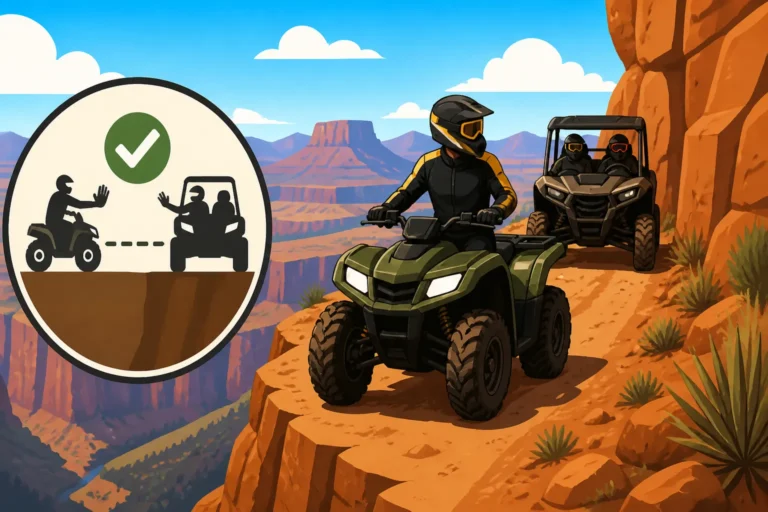
Stop before the gate and assess the situation
Approach slowly enough to stop without skidding or startling nearby animals. On a narrow trail, leave room for another vehicle to stop behind you. Before dismounting or opening anything, scan the area for cattle, calves, horses, people, dogs, loose wire, and uneven ground. In New Mexico’s dry country, cattle may be close to a water source or gathered in shade even when the trail looks empty.
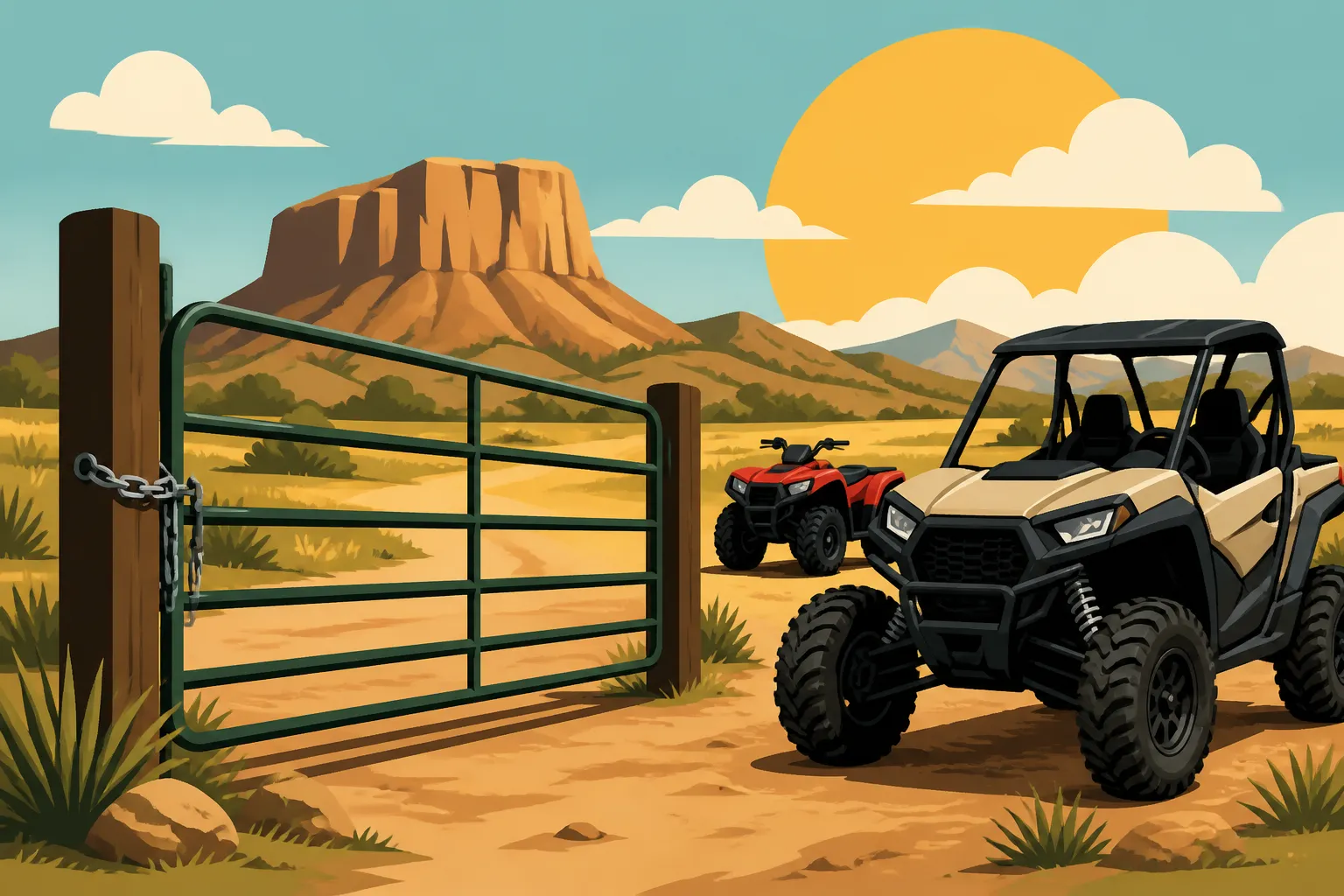
Look for a sign, marker, lock, chain, or posted instruction. Check whether the gate is damaged, whether a nearby fence is under tension, and whether there is a safe place to pull off without blocking the route. Do not climb over a fence, squeeze a machine around a gate, or make a new opening in the fence. Those shortcuts can damage property and create a livestock escape route.
If the gate is locked, marked closed, or clearly blocks a route that is not open to motorized use, do not treat it as an invitation to find another way through. Turn around and check the official route information. A gate can be a physical barrier, but it is also a useful signal to pause and confirm your access. [New Mexico Rules for Riding a Closed Road] covers the importance of respecting closures.
Open and close gates without putting livestock at risk
If you are authorized to use the route and the gate is meant to be opened, get off the machine when needed and handle the gate carefully. Keep your ATV or UTV clear of the gate’s swing, avoid revving close to livestock, and make sure passengers stay back. A gate can be heavy, spring-loaded, or awkward to control, particularly on uneven ground.
After passing through, follow the gate’s instructions. If it was closed when you arrived and there is no instruction to leave it open, close it securely behind you. Check that the latch has caught and that the gate is not resting against the fence in a way that leaves a gap. If a sign specifically directs riders to leave it open, follow that direction instead.
If livestock are crowding the opening, do not try to push through them. Stop, give the animals room, and wait for them to move away from the gate. Avoid honking, shouting, or accelerating to force a path. If the animals will not clear the opening safely, turn back rather than risk injuring an animal or getting your machine caught in the fence.
Keep the group and machine under control
Gate crossings take longer than ordinary trail riding, so make sure the entire group knows the plan. On a group ride, have one person handle the gate while others wait in a safe place. Do not let the next rider follow so closely that the gate is left open or a machine gets trapped between the gate and the fence.
For a side-by-side, consider the machine’s width and turning space before entering a tight opening. A UTV can snag a mirror, roof, cargo, or passenger’s arm on a post or wire even when the tires clear. Riders on ATVs should also watch handlebars and packs. Keep children and passengers away from moving gate hardware.
The table below gives a practical way to think through common gate situations.
| What you find | Safer response |
|---|---|
| A sign gives clear instructions | Follow the sign and any route restrictions |
| The gate is locked or marked closed | Do not bypass it; turn around and verify access |
| The gate is closed with no visible instructions | Confirm the route is open; if authorized, generally leave it as you found it unless the land manager says otherwise |
| The gate is open with no instructions | Do not assume the route is open or that the gate should stay open; check access and seek guidance if needed |
| Cattle are near or inside the opening | Stop, give them space, and wait; do not drive through the herd |
| The gate or fence is damaged | Avoid making repairs unless authorized; report the location to the responsible manager or owner |
Confirm route access before you ride
Check both land status and motorized route status
Planning a ride requires more than identifying public land on a map. You need to know whether the specific route is open to motorized travel and whether your ride crosses private land, a closed segment, or a restricted area. A grazing allotment may be on public land, but that does not mean every track across it is open to ATVs or UTVs.
Use the responsible agency’s current maps or route information when available, and pay attention to signs at the trailhead and along the route. A line on a general-purpose map may show a road without confirming that it is open to recreational motor vehicles. Local closures, seasonal restrictions, fire conditions, and travel-management rules can also affect access.
Mapping tools such as onX Offroad can help riders study routes and land ownership before leaving home, especially when a ride crosses a patchwork of public and private parcels. Treat the map as a planning aid, not permission to ride. Compare what it shows with official agency information and posted signs. If the route crosses private property, get permission from the owner rather than assuming that a nearby public route provides access.
Prepare for remote conditions and changing plans
In rural areas near Farmington, the Carson National Forest, or southern New Mexico’s open country, a ride can move quickly from a well-used road to a remote track with limited services. Download or carry maps before heading out, tell someone where you plan to ride, and have enough fuel, water, and basic recovery gear to turn around safely. Cell coverage may be unreliable, and a gate issue can become more complicated if the group is far from help.
Use onX Offroad or another mapping tool to review the route in advance, but confirm closures and access with the agency responsible for the land. If you find an unexpected gate, do not assume the route is still open just because it appeared on a map. Pause, assess the signs and conditions, and choose the conservative option if you cannot establish that passage is allowed.
When reporting a damaged gate, blocked route, or livestock concern, note the location as accurately as possible. A landmark, road name, route number, or map coordinate can help the owner or land manager find the issue. Avoid posting sensitive access details publicly if doing so could encourage unauthorized traffic onto private land.
Common mistakes riders can avoid
Treating an open gate as permission
An open gate may have been left that way for livestock movement, maintenance, or another temporary reason. It does not, by itself, establish public access. Riders should verify the route even if tire tracks suggest that other vehicles have passed through.
The reverse is also true: a closed gate is not always proof that a public route is permanently closed. It may be a working gate on an authorized route, with instructions for riders to pass through and close it afterward. That is why posted signs, agency maps, and permission from the landowner or manager matter more than assumptions based on the gate’s position.
If you are uncertain, do not force the decision by opening the gate and hoping it is fine. Check route information before the ride, contact the responsible manager when possible, or turn around and choose a route with clear access. [New Mexico Trespass Rules for Riders] is relevant when a route’s property status is unclear.
Leaving a gate unsecured or damaging the fence
A gate that looks closed may still have an unlatched gap large enough for livestock to push through. Take a moment to check the latch rather than riding away as soon as the gate swings shut. Do not drag the gate across rocks, let it slam, or use your vehicle to force a stuck latch.
Never cut wire, pull a fence post, or drive around the end of a fence to avoid the gate. A detour that appears harmless can cross private land, damage infrastructure, or create a new opening for cattle. If a gate is jammed or broken, do not improvise a repair unless you have permission and know how to do it safely. Report it instead.
Rushing past livestock or riding too close to a ranch operation
Cattle can react unpredictably to a loud engine, especially when calves are present. Slow down well before reaching animals, avoid sudden acceleration, and give them room to move away. If the route is narrow or the herd blocks the way, wait patiently or turn back. Do not separate a calf from its mother or drive between animals to reach the other side.
The same courtesy applies to ranch workers, trucks, trailers, and equipment. A gate may be part of an active operation, not an abandoned trail obstacle. Keep the route clear, follow instructions, and avoid creating extra work for the people managing the land. For more on responsible riding near livestock, see New Mexico Riding With Livestock Around and Why You Close Every Gate Behind You.
Disclaimer
This article is for general informational purposes only and does not constitute professional advice. Laws, prices and regulations vary by location and change over time. Consult a qualified professional for guidance on your specific situation.