Flash Flood Season in the Southeast
There’s nothing quite like hitting the trails in Southeast New Mexico on your ATV or UTV, especially when the desert blossoms after a rare rain. But that very rain, particularly during what we affectionately call monsoon season, brings with it a serious and often underestimated danger: flash floods. These aren't just puddles; they're incredibly swift, powerful walls of water that can turn a beautiful ride into a terrifying struggle for survival. This guide will walk you through understanding, preparing for, and reacting to flash flood threats so you can keep your adventures safe and enjoyable.
The Looming Threat: Understanding Monsoon Season and Flash Floods in Southeast New Mexico
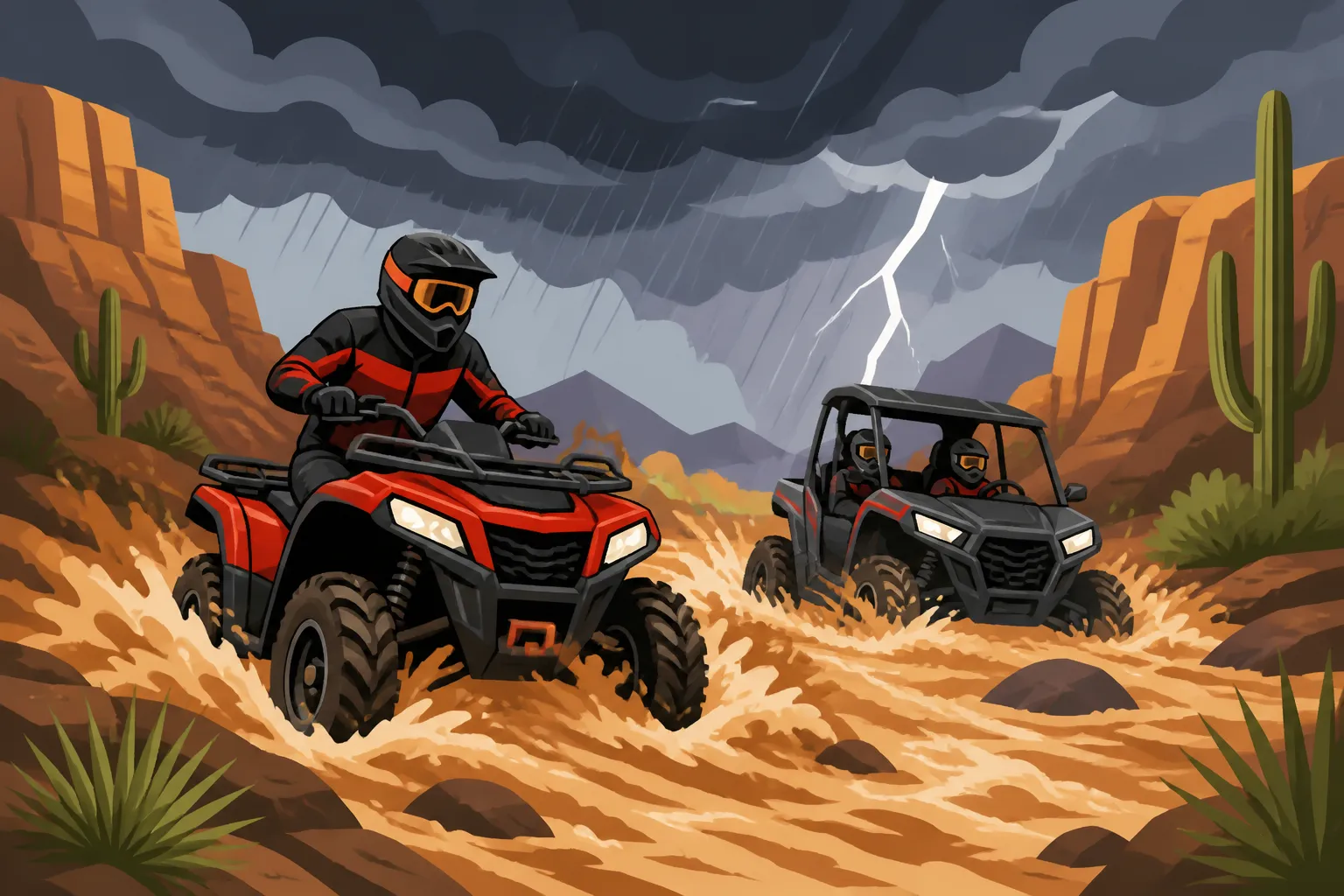
For those of us who love exploring the vast, rugged landscapes of Southeast New Mexico, the summer monsoon season brings a unique blend of beauty and peril. From roughly June through September, the region experiences a shift in weather patterns, pulling moisture up from the Gulf of Mexico and the Pacific Ocean. This isn't your gentle, all-day drizzle; it's often characterized by intense, localized thunderstorms that can dump an incredible amount of rain in a very short period. One minute, you're enjoying blue skies, and the next, a towering cumulonimbus cloud forms overhead, unleashing a deluge.
The real danger here isn't just the rain itself, but how the arid desert terrain responds to it. Unlike lush, vegetated areas that can absorb rainfall more slowly, much of Southeast New Mexico is hard-packed earth, rock, and sandy washes. When heavy rain hits, it has nowhere to go but to rush across the surface, carving out gullies and turning dry streambeds, known as arroyos or washes, into raging torrents in mere minutes. What looks like a harmless, sandy path on your map can become a deadly river without warning. It's a cruel trick of nature, luring riders into what seems like stable ground, only to unleash its fury.
The problem is exacerbated by the often remote nature of our riding areas. Places like Red Sands OHV Area or the various BLM lands near towns like Artesia, Carlsbad, or Roswell are crisscrossed with these dry washes. When you're out there, far from paved roads or immediate assistance, a flash flood isn't just an inconvenience; it's a critical emergency. The water can carry rocks, trees, and other debris, making it incredibly destructive. The power of these floods is difficult to comprehend until you witness it firsthand, but trust me, it's not something you want to experience from the seat of your UTV. Understanding this phenomenon is the first step in ensuring your safety. [New Mexico Riding in Summer Monsoon] provides more context on what to expect during this time of year.
Spotting the Danger: Recognizing Flash Flood Warning Signs on the Trail
Being prepared for a flash flood isn't just about having the right gear; it's fundamentally about understanding and observing your environment. Nature gives us clues, but we have to be vigilant enough to pick up on them. Many riders, eager to get out and enjoy the trails, sometimes overlook these subtle (or not-so-subtle) signs, which is a mistake that can have dire consequences.
Observing Weather Patterns
The most obvious signs often come from the sky. Before you even leave home, check the weather forecast for the specific area you plan to ride. Pay attention to percentages of rain, but more importantly, look for terms like "isolated thunderstorms" or "scattered showers," especially if they include "heavy rain possible." While out riding, constantly scan the horizon. Dark, ominous clouds, particularly those that are tall and anvil-shaped, are a major red flag. Listen for distant thunder, even if the sky directly above you seems clear. Thunder means lightning, and lightning means active thunderstorms that could be upstream, dumping water into the very washes you're about to cross. Even a clear sky directly overhead doesn't guarantee safety if a storm is raging miles away in the watershed that feeds into your current location. This is especially true for arroyos; the water can travel many miles before it reaches your position.
Changes in Water and Terrain
Perhaps the most critical warning signs come directly from the water or the absence of it. If you're near a stream or river, notice any changes in its appearance or behavior. Water that suddenly becomes muddy, silty, or carries an unusual amount of debris (twigs, leaves, trash) is a huge indicator that heavy rain is falling upstream. A sudden, unexplained rise in water level, even if slight, means water is being added to the system rapidly. If you hear a distant roar that sounds like a freight train, but there's no train track nearby, it's often the sound of a wall of water approaching down a dry wash. This sound can be deceptively close, and the water can hit with surprising speed. Never attempt to cross a wash that shows any signs of recent water flow, let alone active flow. [Riding an Arroyo in New Mexico] is a good resource for understanding these unique geological features.
Local Alerts and Preparedness
Modern technology can be a lifesaver. Ensure your cell phone is charged and check for any emergency weather alerts for the county you're in. Many riding apps or GPS devices also offer weather overlays. However, cell service can be spotty in remote parts of Southeast New Mexico, so don't rely solely on your phone. Beyond technology, keep an eye out for official warnings at trailheads or ranger stations if you start from an established staging area. If other riders are turning back or warning you about conditions, take their advice seriously. Ignoring these warnings is not being tough; it's being foolish. [New Mexico Trail Closures to Check First] should always be on your pre-ride checklist.
Pre-Ride Preparedness: Gearing Up Your Machine and Mind for Wet Weather
Facing the possibility of flash floods requires more than just knowing what to look for; it demands proactive preparation. This involves both getting your ATV or UTV ready and cultivating a safety-first mindset. When you're in the backcountry, especially in an unpredictable environment like the New Mexico desert during monsoon season, your preparedness is your greatest asset.
Essential Vehicle Checks and Upgrades
Before every ride, especially during flash flood season, perform thorough pre-ride checks. This means inspecting your tires for proper inflation and tread, ensuring your brakes are functioning perfectly, and checking all your lights – headlights, taillights, and brake lights – are operational. Visibility can drop dramatically during a sudden storm, and working lights are crucial for being seen and seeing obstacles. For those who frequently ride in areas with water crossings or where recovery might be needed, investing in a good winch is highly recommended. Companies like SuperATV offer robust winch systems that can be invaluable for self-recovery or assisting a stranded fellow rider. Ensure it's properly mounted and regularly tested. While not directly for riding through floodwaters (which you should never do), a snorkel kit can protect your engine and CVT system from water ingress if you encounter unexpected deep puddles or very minor, slow-moving water crossings you cannot avoid. Again, this is for prevention, not permission to drive into a flood.
Safety Gear and Communication
Your personal safety gear should always include a helmet and eye protection, but for flash flood season, expand your kit. Carry a waterproof backpack with essential supplies: plenty of water, high-energy snacks, a comprehensive first-aid kit, a reliable map (even if you have GPS, a paper map is unaffected by battery loss or signal), and a fully charged power bank for your phone. A satellite messenger device, such as those from Garmin inReach or Zoleo, is perhaps the most crucial piece of communication gear. Cell service often vanishes in remote areas, leaving you isolated. A satellite messenger allows you to send text messages and, more importantly, trigger an SOS call to emergency services, regardless of cell signal. Make sure it's charged and that your subscription is active. Also, pack a high-quality, bright flashlight or headlamp – conditions can darken quickly. [New Mexico Riding in July] means you're definitely in monsoon season, so this gear is non-negotiable.
Strategic Route Planning
Planning your route meticulously is paramount. Use detailed topographical maps or GPS apps that show elevation changes and identify all potential washes or arroyos. Prioritize routes that minimize crossings of these flood-prone areas. If a route requires multiple crossings, have alternative plans for higher ground or completely different trails. Always inform someone reliable of your exact route and your estimated return time. Tell them what to do if you don't check in. Consider riding with a buddy or in a group during this season; there's safety in numbers. If you're exploring new territory, err on the side of caution. Don't push your luck. What might seem like a small risk can quickly escalate into a life-threatening situation when mother nature decides to unleash a torrent.
When Disaster Strikes: Safe Actions During a Flash Flood Encounter
Despite all the planning and vigilance, sometimes you find yourself in a situation where a flash flood is imminent or actively happening. Your immediate actions in these moments can be the difference between a close call and a true disaster. This is where the mental preparedness cultivated earlier truly comes into play. Panic is your enemy; clear, decisive action is your friend.
The "Turn Around, Don't Drown" Principle
This isn't just a catchy slogan; it's the golden rule for flash floods. Never, under any circumstances, attempt to drive your ATV or UTV through floodwaters. It might look shallow, but even six inches of fast-moving water can sweep a vehicle away, and twelve inches can float a car. You cannot gauge the depth, the speed of the current, or what debris might be hidden beneath the surface. Many fatalities occur when people underestimate the power of floodwaters. If you see water beginning to flow into a wash you were about to cross, or if you encounter water over a road or trail, stop immediately. Do not proceed. Turn your machine around and seek higher ground. Your ride can be replaced; your life cannot. [Crossing a Highway on an ATV in New Mexico] only applies to paved roads, and floodwaters are a completely different hazard.
Seeking Higher Ground and Evacuation
If you realize you're in a low-lying area and floodwaters are rising around you, your priority is to get to higher ground as quickly and safely as possible. Look for elevated ridges, hillsides, or any natural high points. If your machine is still operational and it's safe to do so, drive to the nearest high ground. If the water is rising too fast, or if driving becomes unsafe, you may need to abandon your vehicle and proceed on foot. This is a difficult decision, as no one wants to leave their expensive machine behind, but your life is worth more than any ATV or UTV. If you must abandon your machine, try to do it in a way that minimizes risk to others and yourself – don't leave it in the direct path of moving water if you can help it, as it could become a dangerous piece of debris.
After the Flood: Assessing and Recovering
Once you are safely on high ground and the immediate danger has passed, do not rush back into the flooded area. Flash floods can recede as quickly as they appear, but the landscape they leave behind can be treacherous. Roads and trails may be washed out, new obstacles might be present, and the ground may be unstable. Wait until the water has fully receded and the area has been deemed safe by authorities or appears clearly stable. If you had to abandon your machine, wait for safe conditions before attempting recovery. You might need professional assistance, especially if your vehicle was submerged or carried away. This is where a company like SuperATV might be able to help with recovery gear or advice on post-flood inspection of your machine. Document everything with photos for insurance purposes. And remember, the experience, though harrowing, provides invaluable lessons that can keep you safer on future rides.
Here's a quick summary of warning signs and actions:
| Flash Flood Warning Sign | Immediate Rider Action |
|---|---|
| Dark, towering clouds; distant thunder | Seek shelter, consider turning back, avoid low-lying areas |
| Muddy or debris-filled water in washes | Do NOT enter or cross; find higher ground immediately |
| Rapidly rising water level in streams | Evacuate to higher ground, move away from water's edge |
| Roaring sound from a dry wash (freight train) | Drop everything, run to the highest point nearby |
| Weather alerts on phone/radio | Heed warnings, adjust route, communicate with group |
| Other riders turning back/warning | Take warnings seriously, turn back yourself |
Disclaimer
This article is for general informational purposes only and does not constitute professional advice. Laws, prices and regulations vary by location and change over time. Consult a qualified professional for guidance on your specific situation.