Which Freeways You May Not Even Cross
It's incredibly frustrating when you're trying to navigate New Mexico's diverse landscapes on your ATV or UTV, only to find yourself confused about where you can and cannot go, especially when it comes to paved roads and major thoroughfares. Many riders hit a wall of uncertainty when considering crossing a busy highway or freeway, wondering if a quick dash across the asphalt is permissible or a surefire way to encounter trouble. This guide is here to cut through that confusion, clearly outlining which freeways and high-speed roads in New Mexico are absolutely off-limits for your off-highway vehicle, even for the briefest crossing.
The Absolute Ban: Why Freeways Are Off-Limits for OHVs in New Mexico
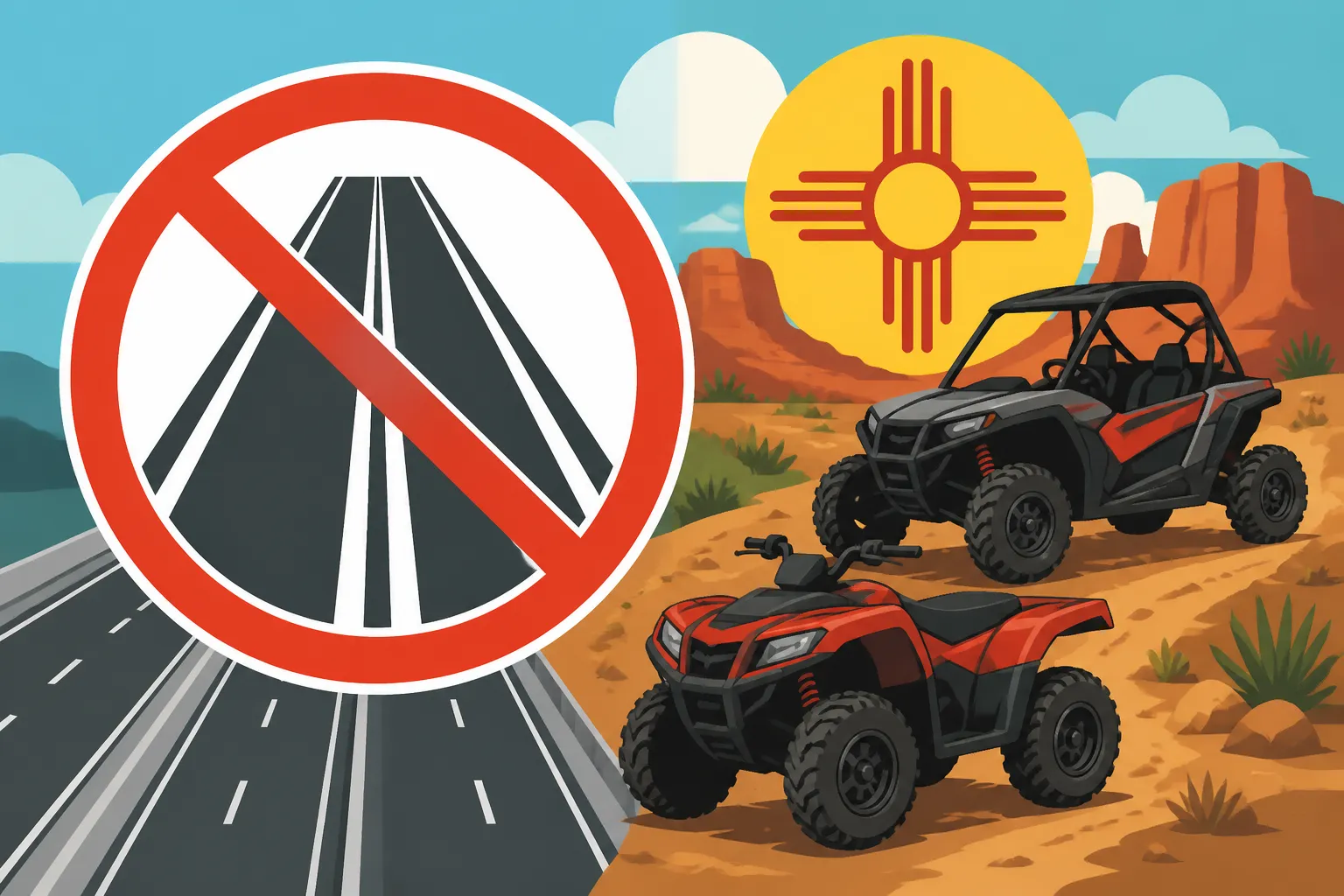
Let's get straight to the point: riding an off-highway vehicle on a New Mexico freeway or interstate highway is unequivocally prohibited. This isn't just a suggestion; it's a legal mandate rooted in safety and the fundamental design differences between your ATV or UTV and a highway vehicle. These roads are engineered for high-speed traffic, offering limited access and multiple lanes that pose significant hazards to slower-moving, less protected OHVs. It's a common misconception that if a county road allows you to cross a state highway, the same logic applies to a freeway. Unfortunately, it does not. The dangers are simply too great, not only for you but for other motorists traveling at freeway speeds.
The rules around street legal ATVs and UTVs in New Mexico often lead to this kind of confusion. While New Mexico has an "opt-in" provision for counties and municipalities to open certain paved roads to OHV use, this provision specifically excludes state highways and interstates. So, even if you're riding in a county that has opened all its two-lane paved roads, that privilege ends abruptly when you encounter a major freeway. The intention behind the law is to keep OHVs on roads where their speed, size, and rider protection levels are more appropriate, ensuring a safer environment for everyone. You might want to brush up on [New Mexico's Paved Street Opt-In] to understand its precise scope.
Understanding the "Freeway" Designation
When we talk about "freeways" or "interstate highways" in New Mexico, we're referring to roads characterized by specific design features that set them apart from your typical city street or county road. These are routes designed for continuous flow of traffic at high speeds, typically 65 mph or higher. Key indicators include:
- Limited Access: Freeways have controlled entry and exit points, usually through on-ramps and off-ramps, rather than intersections with stop signs or traffic lights. You can't just drive onto or off a freeway from any point along its path.
- Multiple Lanes: Often featuring two or more lanes in each direction, separated by a median or barrier.
- No Cross-Traffic: There are no cross streets at grade; all crossings are handled by overpasses or underpasses. This means there's no opportunity for a perpendicular crossing at an intersection in the way you might cross a smaller road.
These design elements, while efficient for cars and trucks, make freeways inherently unsafe for OHVs. The expectation for drivers on these roads is that all vehicles will be traveling at high speeds, capable of keeping up with traffic. An ATV or UTV, even one accessorized with durable parts from SuperATV designed for rugged off-road performance, simply isn't built for that environment. Attempting to enter or cross one of these roads puts you in a highly vulnerable position.
Safety Concerns and Vehicle Capabilities
The primary reason for the ban on OHVs on freeways boils down to safety. Your typical ATV or UTV, while robust and capable off-road, is a different beast entirely when placed in a high-speed traffic environment.
- Speed Disparity: OHVs generally have a much lower top speed than cars and trucks on a freeway. This speed differential creates a dangerous situation, as faster vehicles may not anticipate or see a much slower vehicle, leading to potential rear-end collisions.
- Protection Levels: OHVs offer minimal crash protection compared to enclosed vehicles. In the event of a collision at freeway speeds, the risk of serious injury or fatality to the OHV rider and passenger is extremely high.
- Visibility: While you might deck out your machine with extra lights, the smaller profile of an OHV can make it less visible to drivers of larger vehicles, especially during dawn, dusk, or in adverse weather conditions.
- Handling Characteristics: OHVs are designed for off-road terrain, where agility at lower speeds and traction are paramount. Their suspension, steering, and braking systems are not optimized for sustained high-speed pavement travel, making them less stable and predictable on a freeway. This is why even on approved county roads, [New Mexico's Paved Road Plate] was once necessary, requiring machines to meet certain safety equipment standards, though that program has since changed.
Considering these factors, the prohibition on freeways for OHVs is not just about rules; it's about protecting lives. It's crucial for every rider to understand that no matter how brief the intended freeway interaction, the risks are immense and universally deemed unacceptable by New Mexico law.
Specific No-Go Zones: Identifying New Mexico's Major Freeways
New Mexico has a network of major interstate highways that serve as critical arteries for cross-state and regional travel. For OHV riders, these roads represent absolute exclusion zones. It's not just about avoiding riding on them, but also understanding that typical road-crossing rules for OHVs do not apply here. Even if you're on a legal OHV route, you'll need to find an alternative to traverse these major corridors. Knowing these specific arteries is key to planning safe and legal rides.
The state's landscape is crisscrossed by these high-speed routes, and misjudging where you can and cannot go can lead to significant penalties and, more importantly, dangerous situations. A quick glance at a map might make a direct crossing seem feasible, but the legal and physical realities make it a non-starter.
The Interstates: I-10, I-25, I-40
These three interstates are the backbone of New Mexico's highway system and are the clearest examples of roads where OHVs are strictly forbidden.
- Interstate 10 (I-10): Running east-west across the southern part of the state, I-10 connects major cities like Las Cruces and Deming. It's a high-volume, multi-lane freeway designed for rapid transit. There are absolutely no provisions for OHV crossings or riding on any part of I-10. If your route plan requires crossing where I-10 lies, you must seek out a designated OHV underpass or overpass, or find a legal alternative route that does not involve the interstate itself.
- Interstate 25 (I-25): Stretching north-south from Colorado to Texas, I-25 traverses the heart of New Mexico, passing through population centers like Albuquerque, Santa Fe, and Las Cruces. Similar to I-10, I-25 is a multi-lane, limited-access freeway. OHVs are strictly prohibited from riding on or crossing I-25. This means no quick dashes across on-ramps or intersections. You'll need to plan your route to utilize local roads, bridges, or tunnels that run parallel to or safely over/under I-25, without ever touching the interstate itself.
- Interstate 40 (I-40): This east-west interstate crosses the northern half of New Mexico, connecting Gallup, Albuquerque, and Tucumcari. I-40 is another high-speed, multi-lane freeway with limited access points. Again, OHVs are not permitted on or across I-40. For riders near areas like the Cibola National Forest or other popular riding spots adjacent to I-40, careful route planning is essential to avoid any interaction with this major interstate. Often, forest roads or BLM routes will provide alternatives, but they will not connect directly across an interstate.
It’s important to remember that these interstates typically feature fencing, concrete barriers, and limited access points that physically prevent a casual crossing. Even if you somehow managed to get onto an interstate, the immediate danger and certainty of a citation from law enforcement would be high. Familiarize yourself with [New Mexico Fines for Illegal Road Riding] to understand the potential consequences.
Key State Routes and Expressways
Beyond the primary interstates, New Mexico also has several state routes and expressways that, in certain sections, function with freeway-like characteristics. While not always officially designated as "interstates," their design, speed limits, and traffic volumes make them equally unsuitable and often illegal for OHV use.
These can include:
- Portions of US-70: Especially around urban areas like Las Cruces or Alamogordo, sections of US-70 can become multi-lane, limited-access expressways.
- Portions of US-285 and US-54: In areas where these routes are upgraded for higher traffic flow, they might adopt freeway-like features, making them no-go zones for OHVs.
- Bypass or Loop Roads around cities: Some cities have developed bypass or loop roads that mimic freeway design to divert traffic. These, too, would fall under the same prohibition.
The key takeaway is to look beyond the road number. If a road has multiple lanes, limited access, high speed limits, and no at-grade intersections, it's safer to assume it's off-limits for your OHV. Always prioritize safety and legal compliance. If you're unsure, find a different route. A robust GPS system with accurate, up-to-date mapping for OHV trails can be a lifesaver in these situations, helping you stick to routes that are legal and safe, and keeping you from accidentally venturing onto restricted pavement. Equipping your UTV with a reliable winch or durable tires from SuperATV won't help you on a freeway, but it will certainly prepare you for the actual off-road challenges that New Mexico's trails offer, making the freeways irrelevant to your adventure.
Crossing vs. Riding: The Crucial Distinction
In New Mexico, the rules for OHVs on paved roads can sometimes feel like a tangled mess, especially when you consider the difference between riding on a road and merely crossing it. While certain paved county or city roads might allow for OHV use or crossing, this flexibility absolutely does not extend to freeways or interstates. This is a critical distinction that riders often misunderstand, leading to dangerous situations and significant legal repercussions.
The state's regulations, particularly those that define [New Mexico's Perpendicular Crossing Rule], are designed for specific types of roads – typically two-lane paved roads with at-grade intersections. Freeways, by their very nature, lack these at-grade intersections. They are built for continuous, high-speed travel, with all cross-traffic handled by bridges or underpasses. This means there's rarely a legal or safe point to attempt a "perpendicular crossing" of a freeway.
Think of it this way: on a county road, you might stop at a stop sign, check for traffic, and then proceed directly across to another legal OHV route. On a freeway, there are no stop signs at the main thoroughfare, no direct intersections for crossing, and traffic is moving at speeds that make any brief entry incredibly hazardous. This fundamental difference means that the limited permissions granted for crossing smaller paved roads are irrelevant when dealing with a freeway.
The Perpendicular Crossing Rule and Its Limits
New Mexico's perpendicular crossing rule is a valuable provision for OHV riders, allowing them to traverse certain paved roads to access another section of trail or a different OHV-friendly route. However, it comes with strict conditions and, most importantly, specific limitations on the types of roads it applies to.
- Specific Road Types: This rule is almost exclusively intended for two-lane, lower-speed paved roads, typically county roads or certain city streets, that have at-grade intersections. These are places where vehicular traffic is expected to stop or slow down, and where a rider can visually assess oncoming traffic and make a quick, direct crossing.
- No Freeways: Crucially, this rule does not apply to interstate highways or freeways. The design and traffic characteristics of freeways — high speeds, multiple lanes, limited access, and lack of at-grade intersections — make a perpendicular crossing unsafe and illegal. You cannot simply stop on a freeway shoulder and attempt to cross multiple lanes of 75 mph traffic. It's a recipe for disaster.
- Purpose: The intent of the rule is to facilitate access between trail systems without forcing riders onto long stretches of pavement where they might be less safe. It's not a loophole to bypass major highway prohibitions.
Therefore, while knowing [New Mexico Rules for Crossing a Highway] is important, it’s equally vital to understand that those rules have boundaries, and freeways are firmly outside those boundaries. If you find yourself needing to cross an interstate, your only legal and safe options are to use an existing bridge (which will carry a road that itself must be legal for OHV use, or which is part of a designated trail overpass) or a tunnel. You cannot simply take your OHV onto the interstate to get from one side to the other.
Consequences of Illegal Freeway Operations
Attempting to ride on or cross a prohibited freeway in New Mexico carries severe consequences, encompassing both legal penalties and extremely high safety risks. It's simply not worth it.
Safety Risks:
- High-Speed Collisions: As discussed, the speed differential between an OHV and freeway traffic makes a collision highly probable and catastrophic.
- Limited Evasion: OHVs lack the rapid acceleration and braking capabilities of highway vehicles at those speeds, making evasive maneuvers incredibly difficult.
- Low Visibility: Being a smaller vehicle, an OHV is less visible to drivers of large trucks and cars, especially in conditions with glare or low light.
- Risk to Others: Beyond the rider, attempting an illegal freeway operation endangers other motorists who might swerve to avoid you or be involved in a chain reaction accident.
Legal Penalties:
- Significant Fines: You'll face hefty fines for operating an OHV on a prohibited roadway. These can be considerably higher than those for minor off-road violations.
- Vehicle Impoundment: Law enforcement has the authority to impound your OHV, leaving you stranded and incurring additional towing and storage fees.
- Criminal Charges: Depending on the specifics of the incident, such as reckless endangerment or causing a disturbance, you could face more severe criminal charges, not just a traffic citation.
- Insurance Issues: Any accident occurring during an illegal operation on a freeway would likely void your insurance coverage, leaving you personally liable for all damages and injuries. This highlights the importance of understanding [New Mexico OHV Registration and Liability Insurance] requirements and how they apply.
The combination of extreme danger and serious legal repercussions makes it abundantly clear: freeways are no-go zones for OHVs in New Mexico, even for quick crossings. Planning your route carefully to avoid these roads is not just good practice; it's essential for your safety and legal standing.
Planning Your Routes to Avoid Freeway Encounters
Navigating New Mexico's vast and varied terrain on your ATV or UTV is an incredible experience, but it requires careful planning, especially when it comes to avoiding freeways and other prohibited roads. The best defense against an accidental run-in with an interstate is a well-thought-out route that relies on legal OHV trails, county roads, and designated crossing points. Don't leave it to chance or rely solely on instinct; proactive planning is key to a safe and enjoyable ride.
The reality is that New Mexico offers an incredible network of trails on public lands, including BLM and National Forest lands. Focusing your adventures on these designated routes and understanding how to connect them via legal paved roads is the smart way to ride. Products from SuperATV, like their robust skid plates and heavy-duty axles, are built for the challenging, legal trails you should be riding, not for the smooth, high-speed asphalt of an interstate.
Utilizing OHV-Friendly Maps and Resources
Modern technology and traditional mapping tools are your best friends when it comes to route planning. There are numerous resources available that can help you identify legal OHV routes and steer clear of forbidden freeways.
- Specialized OHV Maps: Many state agencies and private organizations publish maps specifically for OHV riders. These maps often highlight designated trails, staging areas, and permissible road crossings. Look for maps from the Bureau of Land Management (BLM) and the U.S. Forest Service for specific areas like the Carson National Forest or the Glade Run Recreation Area. These maps are invaluable for understanding [New Mexico Rules for Riding a Forest Road] or BLM land.
- GPS Devices and Apps: Dedicated GPS units for off-road use, or smartphone apps with robust mapping capabilities, can be incredibly helpful. Many of these offer layers that show public land boundaries, OHV trails, and roads. Some advanced apps can even filter for "OHV legal" roads, helping you avoid restricted areas. Always download maps for offline use, as cell signal can be spotty in remote parts of New Mexico.
- Online Resources: State government websites (like the New Mexico Department of Game and Fish or MVD) often provide information on OHV regulations and sometimes link to interactive maps. Online forums and riding communities can also be a great source for shared GPX tracks and local knowledge.
- Physical Maps: Never underestimate the value of a good old-fashioned paper map, especially as a backup. Maps from entities like Benchmark Road & Recreation Atlases or National Geographic Trails Illustrated series can provide a comprehensive overview of terrain and road networks, helping you visualize potential routes. While these might not specifically highlight OHV legality, they can help you identify major freeways to avoid and potential alternative routes.
Here's a quick comparison of mapping tools:
| Feature | Paper Maps | GPS Devices (Garmin InReach, etc.) | Smartphone Apps (Gaia GPS, OnX Offroad) |
|---|---|---|---|
| Availability | Always available (no battery needed) | Dedicated purchase | Requires smartphone and subscription |
| Detail | Excellent for topographic and broad overview | Specific trail data, waypoints | Dynamic, detailed, often community-sourced |
| Real-time Position | No | Yes | Yes |
| Offline Access | Always | Yes | Yes (if downloaded) |
| OHV-Specific Layers | Limited/None | Varies by device/map | Often excellent with subscriptions |
| Durability | Can be damaged by weather | Designed for rugged use | Depends on phone case and environment |
Before every ride, take the time to study your route, identify any potential freeway crossings, and plan detours. Even if it adds a few miles, taking a legal and safe route is always the best choice.
Local Knowledge and Community Groups
While maps and technology are fantastic tools, nothing beats the wisdom of local riders and community groups. These individuals often have up-to-the-minute information on trail conditions, temporary closures, and, crucially, nuances of local road ordinances that maps might not capture.
- Join Riding Clubs: Many communities in New Mexico have local ATV/UTV clubs. These groups organize rides, share information, and advocate for rider access. Becoming a member is a fantastic way to tap into a wealth of knowledge about legal routes and how to avoid restricted areas, including freeways.
- Visit Local Dealerships or Outfitters: Businesses that cater to OHV enthusiasts – like dealerships selling new machines or aftermarket parts from SuperATV, or rental companies – are often staffed by knowledgeable locals. They can offer advice on popular trails, local regulations, and safe ways to connect different riding areas. If you're looking for replacement parts or accessories, remember that SuperATV offers robust solutions designed for the actual trails, keeping your focus where it should be: off-road.
- Online Forums and Social Media Groups: Many online platforms host discussions and groups dedicated to New Mexico OHV riding. These can be great places to ask specific questions about routes, potential crossing points, and areas to avoid. Just be sure to verify information, as not everything online is accurate or up-to-date.
- Talk to Land Managers: If you're planning a ride in a specific area, especially on BLM or Forest Service land, don't hesitate to contact the local field office or ranger district. They can provide current information on trail status, fire restrictions, and any specific rules regarding road crossings. They can also clarify [What a New Mexico Officer Checks Roadside] if you have questions about what documentation to carry.
Combining digital planning with local insight ensures you have the most comprehensive and accurate information for your ride. This proactive approach not only helps you avoid freeways but also enhances your overall riding experience by leading you to the best, safest, and most legal trails New Mexico has to offer.
Disclaimer
This article is for general informational purposes only and does not constitute professional advice. Laws, prices and regulations vary by location and change over time. Consult a qualified professional for guidance on your specific situation.