New Mexico Rules for Riding an Interstate Crossing
Navigating New Mexico's diverse terrain on an ATV or UTV is an absolute thrill, but hitting the open road, especially near those big, intimidating interstates, can quickly turn exciting plans into a confusing maze of rules and regulations. It's frustrating to be out enjoying the incredible landscapes only to hit a wall of uncertainty about what's legal and what's not, particularly when it comes to something as central as an interstate highway. This guide is here to untangle the specific rules around off-highway vehicles (OHVs) and interstate crossings in New Mexico, helping you understand where you can and cannot go, and how to stay on the right side of the law.
The Absolute Ban: Why OHVs Can't Ride New Mexico Interstates
Let's be crystal clear right from the start: you cannot ride your ATV or UTV along an interstate highway in New Mexico. This isn't just a suggestion; it's a fundamental rule that protects both OHV riders and the countless other motorists sharing those fast-paced roadways. Many riders, especially those new to the state or coming from areas with different regulations, might wonder why such a strict ban is in place, particularly when their machines feel perfectly capable. However, the reasoning behind this rule is deeply rooted in safety, engineering, and legal classifications.
Speed, Safety, and Vehicle Classifications
Interstate highways are designed for high-speed travel, typically with minimum speeds of 45 mph and maximums often reaching 75 mph. Off-highway vehicles, by their very nature, are not built to safely operate at these sustained speeds. While some UTVs can certainly hit impressive speeds on a flat surface, their chassis, braking systems, tires, and overall handling characteristics are optimized for varied, often rough, off-road conditions, not the smooth, high-friction asphalt of an interstate. Imagine trying to keep pace with an eighteen-wheeler or a fast-moving sedan while your machine, which excels at climbing rocky trails, is trying to maintain 70 mph for miles on end. The speed differential alone creates an enormous safety hazard.
Beyond speed, there's the critical issue of vehicle classification. In New Mexico, like most states, OHVs are generally not considered "street legal" vehicles in the same vein as cars, trucks, or motorcycles for general road use. They lack many of the mandatory safety features required for highway travel, such as specific lighting configurations, turn signals, specialized tires, and often, adequate mirrors for comprehensive visibility in high-traffic environments. When an OHV attempts to operate on an interstate, it not only creates a hazard due to its inherent design limitations but also operates outside of its legal classification, making it an unregistered or unapproved vehicle for that specific roadway. This is a huge reason why [Why New Mexico State Highways Are Off Limits] to OHVs.
Understanding New Mexico's Highway Design
New Mexico's interstates are engineered marvels, designed for efficient, high-volume traffic flow. They feature multiple lanes, often with minimal shoulders, and long stretches between exits. These design elements, while excellent for cars and trucks, present significant dangers for OHVs. The shoulders, if they exist, are typically for emergency use only, not for slower-moving vehicles to travel upon. Furthermore, the limited access points and high barriers often found along interstates mean that if an OHV rider encounters a problem, getting off the highway safely can be incredibly difficult, if not impossible, for miles.
The entry and exit ramps themselves are designed to merge traffic at high speeds. An OHV trying to merge onto an interstate from an on-ramp or exit onto an off-ramp would struggle to match the speed of merging traffic, creating dangerous situations for all vehicles involved. The very curvature and grading of these ramps are optimized for passenger vehicles, not for the often higher center of gravity and different handling dynamics of an ATV or UTV. The bottom line is that these roads are simply not built for us, and trying to force our machines onto them is a recipe for disaster.
The Perpendicular Crossing Exception: Your Only Legal Pass
While you absolutely cannot ride along an interstate, New Mexico law does provide a very specific, limited exception: the perpendicular crossing. This rule is a lifeline for riders whose preferred trails or destinations are bisected by an interstate, allowing them to connect two legal riding areas without breaking the law. However, this isn't a free pass to dart across wherever you please. It's a precise maneuver with strict requirements, and misunderstanding it can lead to serious trouble.
Defining a Perpendicular Crossing
A "perpendicular crossing" means exactly what it sounds like: you must cross the interstate roadway as directly and straight as possible, at a 90-degree angle to the flow of traffic. Think of it like drawing a perfectly straight line across the highway. This isn't about veering diagonally, attempting to make a U-turn, or traversing any more distance than absolutely necessary. The intent is to minimize the time an OHV spends on the active lanes of traffic.
This type of crossing is typically only permissible at designated intersections or at specific points where a county or local road directly intersects with the interstate, creating a controlled crossing point. You can't just pick a random spot in the median and decide to cross. Often, these are older intersections that predate some interstate sections, or areas where local traffic patterns necessitated a direct link. You must identify a legitimate, established intersection to attempt this. Remember, [New Mexico's Perpendicular Crossing Rule] is about crossing, not traveling.
Essential Safety Protocols During a Crossing
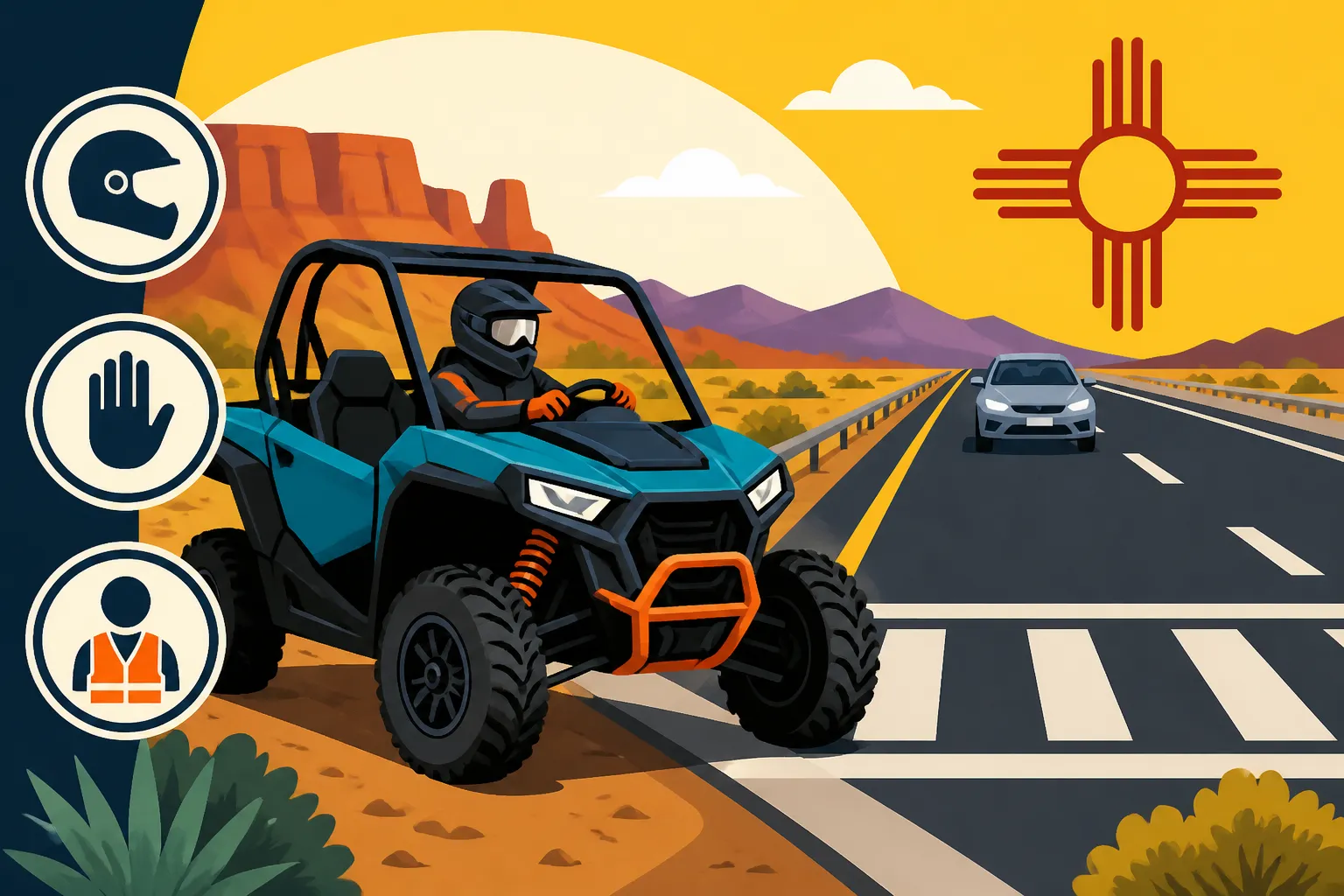
Executing a perpendicular crossing safely requires extreme caution and adherence to all traffic laws. Before you even think about entering the roadway, you must come to a complete stop. This isn't a rolling stop; it's a full, momentary pause where your wheels cease movement. From this stopped position, you must yield to all oncoming traffic. An interstate highway is a fast-moving environment, and you need ample time and space to cross safely. Do not assume drivers will see you or slow down for you.
Once you have a clear opening, accelerate smoothly and cross the highway as quickly and directly as possible. Do not dawdle, change lanes, or make any unnecessary maneuvers. Your goal is to get from one side to the other in the most efficient and predictable manner. As you approach the other side, be prepared to immediately exit the interstate onto another legal road or trail. Never, under any circumstances, should you use the shoulder to stage your crossing or to continue travel after you've crossed. This strict protocol is outlined in rules like [Stopping Before You Enter a New Mexico Roadway].
If you're riding a machine that's equipped with lights, make sure they're all functional, even if it's daytime. Extra visibility can be crucial in these high-stakes moments. For machines like UTVs, ensuring your mirrors are clean and properly adjusted can give you that critical extra second to spot approaching vehicles.
When a Crossing Isn't an Option
There are many sections of interstate where a perpendicular crossing is simply not an option because no legal intersection exists, or the roadway is designed with barriers or overpasses that make a direct crossing impossible. For example, [Freeways New Mexico Riders May Not Cross] include those without direct intersections. In these cases, you absolutely cannot attempt to cross. Trying to jump curbs, go over medians, or cut across undeveloped areas flanking the interstate is illegal, extremely dangerous, and will likely result in severe penalties.
If your route requires you to get from one side of an interstate to the other and no legal perpendicular crossing is available, you must find an alternative. This almost always means trailering your machine to the other side, or rerouting entirely to use a legal overpass, underpass, or a different public road that is approved for OHV use. Sometimes, the safest and only legal option is to simply load up your rig and drive it around the obstacle. It's an inconvenience, but far better than a citation or, worse, an accident.
Beyond the Interstate: Frontage Roads and Alternative Routes
While the interstate itself is largely off-limits, the surrounding infrastructure, like frontage roads, sometimes offers an opportunity for OHV travel, provided it's explicitly allowed by local ordinances. It's crucial to understand that even these adjacent roads aren't universally open to OHVs. The rules vary significantly, making local research indispensable.
The Role of Frontage Roads
Frontage roads, sometimes called service roads or access roads, run parallel to interstates and highways, often providing access to businesses, residences, or agricultural land. They can seem like a convenient way to bypass the main highway, and in some areas, they might indeed be open to OHV use. However, this is not a given across the entire state. The legality of riding on a frontage road depends entirely on the specific county, city, or tribal land where that road is located.
Some counties have passed ordinances that permit OHV use on certain county roads, and a frontage road might fall under such an ordinance. For example, if you're looking into [New Mexico Rules for Riding a Frontage Road], you'll quickly discover that you need to check the local jurisdiction's rules. Just because one county allows it doesn't mean the next one over does. Always assume it's prohibited unless you can definitively prove otherwise. Before planning a route that includes any frontage road, consult the local county sheriff's office or city hall for current ordinances. Ignorance of the law is never an excuse, and a quick phone call can save you a lot of trouble.
Seeking Local Road Alternatives
When interstates block your path, and frontage roads are a no-go, the next best option is to look for alternative public roads that are explicitly open to OHVs. New Mexico has a growing number of counties and municipalities that are opening up their paved or unpaved roads to off-highway vehicles, often as a way to connect trail systems or provide access to businesses. These can be lifesavers for continuing your ride.
For instance, [New Mexico Rules for Riding a County Road] vary widely. Some counties, like Sierra County, have opened nearly all their county roads to OHVs, provided the vehicle is registered and, if paved, equipped for street legal operation (like having mirrors, lights, and insurance). Other counties might have only specific designated routes. This means you need to do your homework for every specific area you plan to ride. Don't rely on word-of-mouth; seek out official maps or ordinances from local government offices or the New Mexico Department of Game and Fish. Sometimes, designated routes are clearly marked, but you can't always count on that.
Equipment Considerations for Public Road Use
If you do find a legal road, whether it's a frontage road or an opened county road, remember that your OHV must meet specific equipment requirements for public road use, especially if it's a paved surface. These requirements are in place to ensure your safety and the safety of other motorists. For example, if you plan to utilize any paved public road, even for a short stretch, your OHV must be properly registered with the MVD, carry the correct decal (often the green on-and-off highway decal), and you must have proof of liability insurance.
Beyond registration, your machine will need functional headlights, taillights visible from a certain distance, brake lights, and at least one rearview mirror. Some riders opt for aftermarket upgrades from companies like SuperATV to ensure their machines meet these requirements. Things like proper turn signals, a horn, and even a windshield can become critical for safe and legal operation on public roads. Even if a road is open, failing to have the proper equipment can lead to fines. Ensure your machine is truly road-ready before you venture onto any paved surface.
| Feature | Interstate Travel (Riding ON) | Interstate Crossing (Perpendicular) | Frontage/County Road (Where Allowed) |
|---|---|---|---|
| Legality | Strictly Prohibited | Limited & Conditional | Varies by local ordinance |
| Speed | Unsafe, Illegal | Quick, Direct acceleration | Match posted speed limit |
| Lane Use | N/A | Must cross directly (90 degrees) | Stay to right, follow traffic laws |
| Traffic | Extreme Danger | Extreme Caution, Yield to ALL | Follow all road rules |
| Safety Gear | N/A | Mandatory (Helmet, Eye Protection) | Mandatory (Helmet, Eye Protection) |
| Vehicle Prep | N/A | Lights functional, quick response | Lights, mirrors, horn, registration, insurance |
| Consequences | Severe Fines, Impoundment | Severe Fines, Impoundment | Fines, warnings if non-compliant |
Avoiding Penalties: The Consequences of Illegal Interstate Access
The rules regarding OHVs and interstates in New Mexico aren't just polite suggestions; they are enforceable laws with real, and often expensive, consequences. Disregarding these regulations can quickly turn a fun day of riding into a major headache, involving hefty fines, potential vehicle impoundment, and even more serious legal ramifications if an accident occurs. It's simply not worth the risk.
Fines, Impoundment, and Legal Ramifications
If you are caught riding your OHV on an interstate highway in New Mexico, you can expect a significant fine. [New Mexico Fines for Illegal Road Riding] are substantial and are designed to deter such dangerous behavior. These fines can escalate quickly, especially if you're cited for multiple violations, such as operating an unregistered vehicle or lacking required safety equipment. Beyond the financial hit, law enforcement has the authority to impound your off-highway vehicle. This means your machine will be towed away, and you'll be responsible for towing fees, storage fees, and any administrative costs incurred to retrieve it. This can add up to hundreds, if not thousands, of dollars, far outweighing any perceived convenience of illegally using the interstate.
More critically, if your illegal interstate presence leads to an accident, even if you weren't directly at fault for the collision itself, your legal standing could be severely compromised. Operating a vehicle illegally on a highway can negate your insurance coverage, leaving you personally liable for damages to other vehicles, property, and injuries sustained by anyone involved. This could lead to civil lawsuits that cost far more than any fine or impoundment fee. It's a risk that no responsible rider should ever consider taking. Furthermore, repeated violations or reckless behavior can even lead to suspension of your riding privileges or other legal action. An officer checking [What a New Mexico Officer Checks Roadside] will quickly identify an illegally operated machine.
Protecting Yourself and Your Riding Privileges
The best way to protect yourself, your finances, and your ability to enjoy OHV riding in New Mexico is to always adhere strictly to the rules. This means understanding exactly where you can and cannot ride, especially concerning major roadways like interstates. Before any ride, especially if you're exploring a new area, take the time to research local ordinances and maps. Websites for the New Mexico Department of Game and Fish, BLM field offices, and Forest Service districts are excellent resources.
Always ensure your OHV is properly registered and carries the correct decals, and that you have proof of insurance on hand if you plan to use any public roads. If you're under the age of 18, make sure you have your [New Mexico OHV Safety Permit Requirements] fulfilled and carry it with you. For adults, carrying proof of your driver's license, if you possess one, is always a good idea when interacting with law enforcement, especially on public roads.
If you encounter an interstate or any other prohibited roadway that blocks your intended route, turn around. Find an alternative. Load your machine onto a trailer if necessary. It might be inconvenient, but it is always safer and more cost-effective than attempting to break the law. Riding legally and responsibly ensures that the beautiful landscapes of New Mexico remain open and enjoyable for all OHV enthusiasts for years to come.
Disclaimer
This article is for general informational purposes only and does not constitute professional advice. Laws, prices and regulations vary by location and change over time. Consult a qualified professional for guidance on your specific situation.