New Mexico Paved Road Plate Requirements
Figuring out the ins and outs of New Mexico's OHV laws can sometimes feel like trying to navigate a thorny arroyo after a monsoon – confusing, a bit treacherous, and you're not always sure where you're allowed to go. One of the biggest head-scratchers for many riders is what it takes to legally take their ATV or UTV onto paved roads. This guide is here to clear up all the confusion surrounding New Mexico's paved road plate requirements, ensuring you have all the information you need to ride legally and safely.
Understanding New Mexico's Paved Road Plate System
For a long time, the idea of taking your ATV or UTV on a paved road in New Mexico felt like a pipe dream for most of us. There was a lot of gray area, and then came the changes. It's easy to get frustrated when the rules shift, especially when you just want to enjoy your machine without constantly worrying about getting pulled over. But the good news is, New Mexico has made strides to provide a clearer path for off-highway vehicles to access certain paved roads, and the paved road plate is a crucial part of that system.
The Shift from Stickers to Plates
You might remember a time when New Mexico had a "paved road sticker" program. That was the old way of doing things, and it certainly had its quirks and limitations. For a while, riders could apply for a sticker that permitted limited paved road use. However, laws change, and sometimes, those changes are aimed at creating a more robust and unified system. The sticker program has been phased out, and in its place, we now have the paved road plate. This transition was designed to bring more clarity and better enforcement, integrating paved road access more seamlessly with the existing MVD (Motor Vehicle Division) registration system. It might have felt like another hoop to jump through, but ultimately, it's about making sure everyone on the road, whether in a car or a UTV, has appropriate identification and is operating within established guidelines.
Who Needs a Paved Road Plate?
This is where many riders get hung up. Not every ATV or UTV in New Mexico needs a paved road plate. If your machine is strictly used for off-roading, whether it's on dedicated trails, private land, or designated OHV areas, then you generally won't need this specific plate. Your regular yellow or green OHV decal is sufficient for those activities. However, if you have aspirations of cruising through a town that has opened its streets to OHVs, or you need to connect between trails by using a short stretch of paved county road, then the paved road plate becomes a necessity. This applies to your ATVs, UTVs, side-by-sides, and quads that you intend to operate on paved public roads. It's really about your intent to use the pavement. If you're staying entirely off the blacktop, you're likely fine without it. But if even a small portion of your ride involves a publicly accessible paved surface, then you'll fall into the category of riders who need this plate. [Which Riders Actually Need a Paved Road Plate]
What the Paved Road Plate Allows You to Do
Let's be crystal clear: having a New Mexico paved road plate does not make your ATV or UTV "street legal" in the same way a car or motorcycle is. You won't be zipping down I-25 or cruising freely on state highways. The plate is an opt-in for limited paved road access. What it does allow you to do is operate on county roads and municipal streets that have been specifically opened by local ordinance or resolution. This is a huge distinction! Many towns and counties across New Mexico have recognized the economic and recreational benefits of allowing OHV access, and they've enacted local laws to permit it.
For example, you might be able to ride your UTV right from your cabin in a mountain town to a trailhead, or connect two different trail systems by using a designated county road. You can also use the plate to make perpendicular crossings of state highways, meaning you can cross directly from one dirt road to another if a state highway separates them. This is incredibly useful for navigating around the state's vast trail networks. It's all about providing that crucial link, those short paved sections that allow you to extend your adventure, rather than limiting you to only dirt. Just remember, it's never about high-speed highway travel; it's about thoughtful, responsible access to connect the dots in your riding experience. [New Mexico's Paved Street Opt-In]
Eligibility and Requirements for Your Paved Road Plate
Getting your paved road plate isn't just a matter of showing up at the MVD with a smile. There are a few key pieces that need to be in place first, and understanding these requirements upfront can save you a lot of headache and multiple trips. Think of it like a checklist before a big ride – you wouldn't head out without checking your tires and fuel, right? The same goes for getting your plate.
The Essential Prerequisite: An OHV Title
This is perhaps the most critical step, and one that often trips people up: before you can even think about a paved road plate, your off-highway vehicle must have a New Mexico title. Period. No title, no plate. This can be a real pain point, especially if you bought your machine used and the previous owner wasn't diligent about transferring the title, or perhaps didn't even have one. Without that New Mexico title in your name, the MVD won't issue you a paved road plate. [Titling Before a New Mexico Paved Road Plate]
If you're in this boat, your first mission is to get your OHV titled. This often involves providing a bill of sale, potentially a VIN inspection, and going through the standard titling process at the MVD. It might feel like an extra layer of bureaucracy, but the title proves ownership and is the foundation for all subsequent registrations and plates. Make sure you have clear proof of ownership and a valid VIN. If you're unsure about the process, it's always best to contact the MVD directly or visit their website for the most current titling requirements. Don't skip this step, or you'll just be wasting your time trying to get that paved road plate! [Do You Need a Title for an ATV in New Mexico?]
Current OHV Registration is Key
Your paved road plate isn't a standalone registration; it's an add-on to your existing off-highway vehicle registration. This means your ATV or UTV needs to have a current, valid New Mexico OHV registration, complete with either a yellow or green decal. For paved road use, the green decal is typically the one that aligns with on- and off-highway operation, but the plate effectively overrides the paved road restriction of the yellow decal by granting specific, limited access. Think of your biennial registration as the core, and the paved road plate as a specialized feature that extends its capabilities. You'll renew your OHV registration every two years, and as long as that underlying registration is active, your paved road plate remains valid. It's a system designed to keep things simple by tying the plate's legality to your primary OHV registration. [New Mexico's Green On and Off-Highway Decal]
Insurance and Driver's License Mandates
Riding an OHV on a paved public road introduces a whole new level of responsibility, and New Mexico recognizes that. That's why, if you plan to use your paved road plate, you absolutely must carry proof of financial responsibility (insurance) and hold a valid driver's license.
For insurance, you'll need at least the state's minimum liability coverage, just as you would for a car or truck. This is to protect you and others in the event of an accident. It's not optional; it's a legal requirement for paved road operation. You'll need to show proof of this coverage when you apply for your plate and you should always carry it with you when riding on pavement. Many insurance providers offer specific OHV policies, so it's worth shopping around to find one that meets New Mexico's requirements. [New Mexico ATV Insurance Requirement] [How Much Liability Coverage New Mexico Requires]
Likewise, operating an OHV on a paved public road means you need to be a licensed driver. While you might not need a driver's license to ride purely off-road, the moment you put rubber to asphalt on a public thoroughfare, you need to have a valid driver's license in your possession. This ensures that anyone operating a vehicle on New Mexico's shared roadways has demonstrated a basic level of driving competency. So, before you hit the pavement, make sure your license is current and in your wallet! [A Driver's License on a New Mexico Paved Road]
Equipment Standards for Paved Road Safety
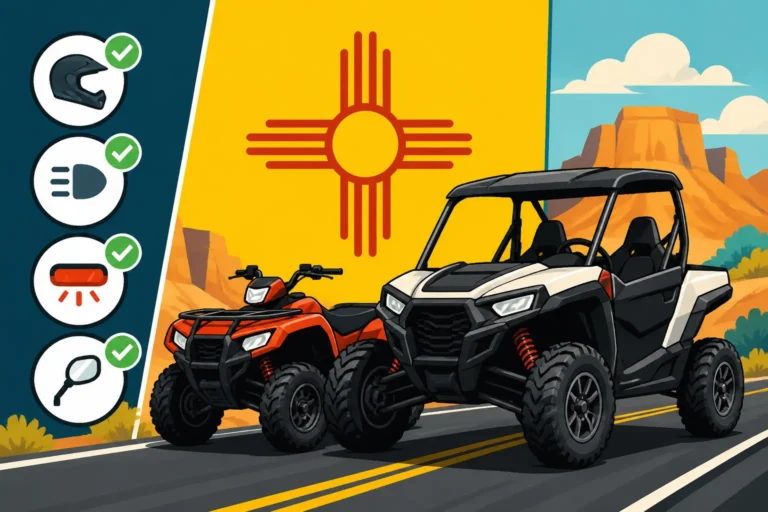
Just like any vehicle on a paved road, your OHV needs to meet certain equipment standards to be safe and legal. These aren't just suggestions; they're requirements designed to protect you and others.
- Headlights and Taillights: Your machine needs to have a working headlight that projects at least 150 feet ahead, and a taillight visible from 200 feet behind. This is crucial for visibility, especially during dawn, dusk, or inclement weather. [New Mexico Headlight and Taillight Rules]
- Brake Lights: A functioning brake light is essential to signal your deceleration to other drivers.
- Mirrors: You'll need at least one rearview mirror, typically on the left side, allowing you to see at least 200 feet behind your machine. This is vital for situational awareness in traffic. [Mirrors and Brakes for New Mexico Road Use]
- Horn: A working horn is necessary for signaling and warning others.
- Spark Arrester: While important for off-road riding to prevent wildfires, it's also a standard safety requirement for any OHV.
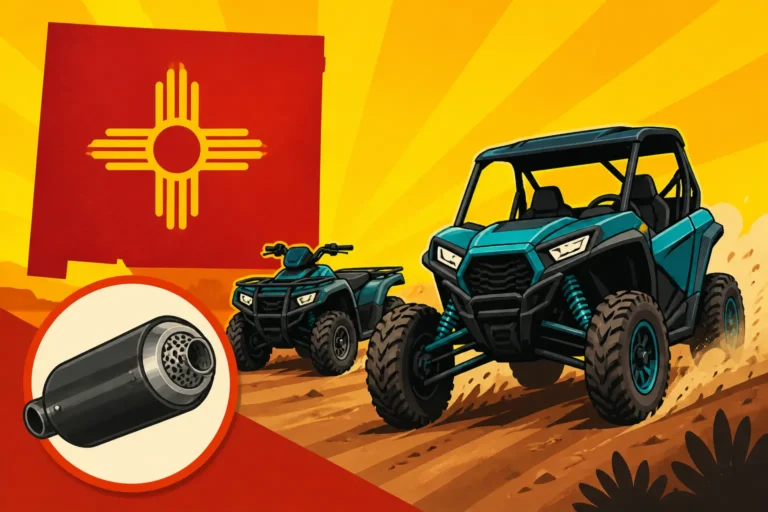
- Muffler: Your exhaust system must be in good working order and meet New Mexico's sound limit of 96 decibels. Excessively loud machines can be a nuisance and are illegal on public roads. [New Mexico's 96 Decibel Ceiling]
- Helmets and Eye Protection: While adults aren't always mandated to wear helmets off-road, if you're riding on paved roads, it's highly recommended for everyone. For those under 18, helmets and eye protection are generally mandatory regardless of the surface. For all riders, eye protection is required on pavement. [New Mexico Helmet Law for ATV Riders] [Eye Protection at Any Age on Pavement]
Meeting these equipment requirements is paramount. If your machine doesn't have them stock, there are plenty of aftermarket solutions available. Companies like SuperATV offer a wide range of accessories, from mirrors and turn signal kits to lighting upgrades, that can help bring your machine into compliance. It's a worthwhile investment for safety and legality.
The Application Process and What to Expect
Once you've got your machine up to snuff, the next step is actually obtaining that coveted paved road plate. It’s not overly complicated, but like any interaction with the MVD, coming prepared is half the battle. A little foresight can save you a lot of time and frustration.
Gathering Your Paperwork
To ensure a smooth process, you'll want to have all your ducks in a row before you head to the MVD. Imagine driving all the way there, waiting in line, only to find out you're missing one crucial piece of paper. Talk about a buzzkill! Here’s what you should have ready:
- Your New Mexico OHV Title: As we discussed, this is non-negotiable. It needs to be in your name.
- Proof of Current OHV Registration: Bring your current registration certificate and make sure your OHV decals are up to date.
- Proof of Financial Responsibility: This is your insurance card or declaration page showing that your OHV meets the minimum liability coverage for New Mexico.
- Your Valid Driver's License: You'll need to present this as identification and proof of your driving privilege.
- Vehicle Identification Number (VIN) Verification: In some cases, the MVD might require a VIN inspection, especially if you're titling a machine for the first time or if there are any discrepancies. It's always a good idea to have your VIN readily accessible.
Having photocopies of everything can also be a smart move, just in case they need to keep a copy. The more organized you are, the faster your visit will likely be. [New Mexico OHV Registration Paperwork]
Where to Apply for Your Plate
The New Mexico Motor Vehicle Division (MVD) is the place to go for your paved road plate. You'll need to visit one of their offices in person to complete the application. While some OHV registrations can be handled online or through authorized dealers, the paved road plate often requires an in-person visit to ensure all documentation is properly verified and that you understand the specific requirements.
Some OHV dealers in New Mexico are authorized to assist with MVD paperwork, which can be a huge convenience. If you purchased your machine from a dealer, or if you have a good relationship with a local one, it might be worth asking if they offer this service for the paved road plate. They can often streamline the process and make sure you have everything you need. However, don't assume; always call ahead to confirm if they can handle paved road plate applications, or be prepared to visit the MVD yourself. [New Mexico OHV Registration at MVD]
Costs and Renewal Considerations
The cost for the paved road plate itself is generally a one-time, relatively small fee, separate from your regular biennial OHV registration renewal. It’s designed to be an accessible add-on rather than a significant financial burden. While I can't give you exact numbers here, you can expect it to be a modest administrative fee. The best practice is always to check the official New Mexico MVD website or contact them directly for the most current fee schedule. [New Mexico OHV Paved Road Plate Cost]
Here's an important point about renewal: your paved road plate does not have its own separate expiration date. Its validity is tied directly to your underlying New Mexico OHV registration (your decal). As long as your two-year OHV registration is current and renewed, your paved road plate remains valid. This simplifies things considerably, as you don't have to remember two different renewal cycles. When your biennial OHV registration is due, you'll renew that, and your paved road plate will continue to be legitimate for paved road use.
Potential Roadblocks and Tips
Even with the best preparation, sometimes things can hit a snag. Knowing common roadblocks can help you navigate them.
- Missing or Incorrect Title: This is the big one. If your title isn't clean, in your name, or doesn't exist, that needs to be resolved first.
- Lapsed Registration: Make sure your basic OHV registration is current. A lapsed registration will prevent you from getting or maintaining the paved road plate.
- Incomplete Insurance Proof: Double-check that your insurance card or document clearly shows the required liability coverage for your OHV.
- Equipment Deficiencies: An MVD agent might ask questions or visually confirm certain equipment (like mirrors or lights). While a full inspection might not always be required for the plate, it's your responsibility to ensure your machine meets all safety requirements for road use.
Tips for a smoother process:
- Call Ahead: Always call your local MVD office before visiting to confirm hours, required documents, and if they have any specific procedures for the paved road plate.
- Go on a Weekday Morning: Avoid peak times like lunch hours or late afternoons. Early weekday mornings are often the least crowded.
- Be Patient: MVD offices can be busy. Bring a book or be prepared for a wait.
- Consider Aftermarket Upgrades: If your machine lacks basic road-legal equipment like mirrors or proper lights, invest in quality aftermarket parts. Companies like SuperATV specialize in these types of upgrades, making it easier to meet the requirements and enhance your riding experience.
Important Considerations for Paved Road Riding in New Mexico
Getting your paved road plate is a fantastic step, opening up new possibilities for your OHV adventures. However, simply having the plate doesn't give you free rein over every paved surface in the state. Responsible riding on pavement means understanding the ongoing rules and respecting local jurisdictions.
Understanding Local Ordinances
This is probably the single most important consideration once you have your paved road plate. New Mexico's law states that you can ride on paved county roads and municipal streets only if the local county commission or city council has passed an ordinance allowing it. This is not a blanket authorization! A paved road plate from the state means you can legally operate on pavement where allowed, but it doesn't automatically allow you to be on all pavement.
Think of it this way: the state gives you the license to drive, but local traffic laws tell you which roads are open. Some counties, like Sierra County, have opened nearly all their county roads. Other municipalities, like Red River, have very specific ordinances that might allow side-by-sides (ROVs) on certain streets while banning ATVs entirely, and often impose curfews. [New Mexico Rules for Riding a City Street] [New Mexico Rules for Riding a County Road] [Red River's ROV-Only Streets]
Before you plan a trip involving paved roads, always, always check with the specific county or city's administrative offices for their current OHV ordinances. A quick call to the county clerk or city hall can save you from an expensive ticket or having your trip cut short.
Distinguishing Between State Highways and Local Roads
Another critical distinction is understanding the difference between state highways (those numbered NM roads, US routes, or interstates) and county or city roads. Even with a paved road plate, you are generally prohibited from riding your OHV on New Mexico state highways, except for making a perpendicular crossing. This means you can cross a state highway at a 90-degree angle to get from one side to another, but you cannot travel along the highway. This rule is in place for safety, as state highways often have higher speed limits and greater traffic volumes not suited for most OHVs. Always stick to the designated county and city roads that have explicitly been opened for OHV use. [Why New Mexico State Highways Are Off Limits]
The Role of Aftermarket Accessories
Meeting the equipment requirements for paved road use often means adding aftermarket accessories to your OHV. Many machines come straight from the factory ready for the dirt, but not necessarily for the street. This is where brands like SuperATV become invaluable. They offer a wide array of products designed to bring your machine into compliance, from full turn signal kits with integrated horns and brake lights, to sturdy side and rearview mirrors, and even windshields.
When choosing accessories, always prioritize compliance and safety. Don't just pick the cheapest option; ensure it meets the legal specifications for visibility, sound, and function. A proper mirror from SuperATV, for example, will offer the field of vision needed to safely navigate alongside cars, while a robust lighting kit ensures you're seen by other drivers. Investing in these upgrades isn't just about avoiding a ticket; it's about making your paved road riding experience as safe as possible for everyone.
Fines and Penalties for Non-Compliance
Riding an OHV on paved public roads without the proper paved road plate, current registration, valid insurance, or required equipment can lead to significant fines and penalties. Law enforcement officers are increasingly aware of OHV laws, and they won't hesitate to issue citations for violations. These fines can quickly add up and put a damper on your riding budget, not to mention potentially leading to your machine being impounded in some cases.
The state takes these rules seriously because it's about public safety. An OHV without proper lighting, mirrors, or insurance is a hazard on shared paved roads. So, before you venture onto any paved surface, take the time to ensure you're fully compliant with all state and local regulations. A little preparation goes a long way in ensuring your New Mexico OHV adventures are fun, safe, and legal. [New Mexico Fines for Illegal Road Riding]
| Requirement | Off-Road Only (Default) | Paved Road Ready (With Plate) |
|---|---|---|
| New Mexico OHV Title | Recommended, often required | Mandatory |
| Current OHV Registration | Yes (Yellow/Green Decal) | Yes (Yellow/Green Decal) |
| Paved Road Plate | No | Yes |
| Liability Insurance | No (Recommended) | Mandatory |
| Driver's License | No (Required for minors by age) | Mandatory |
| Headlights | Yes (for night riding) | Mandatory (Meets distance) |
| Taillights | Yes (for night riding) | Mandatory (Meets distance) |
| Brake Lights | Often stock, not always req. | Mandatory |
| Rearview Mirrors | No | Mandatory (1, 200ft vision) |
| Horn | No | Mandatory |
| Spark Arrester | Mandatory on public land | Mandatory |
| Muffler (96 Decibel) | Recommended | Mandatory |
| Helmet (Adult) | Recommended | Highly Recommended |
| Helmet (Under 18) | Mandatory | Mandatory |
| Eye Protection | Recommended | Mandatory |
| Travel on State Highways | No | No (Perpendicular Crossing ONLY) |
| Travel on County/City Roads | No | Yes (If local ordinance allows) |
Disclaimer
This article is for general informational purposes only and does not constitute professional advice. Laws, prices and regulations vary by location and change over time. Consult a qualified professional for guidance on your specific situation.