Guided ATV Tours in New Mexico
Guided ATV tours in New Mexico can make a remote ride easier to plan, but the right booking depends on more than the machine. Terrain, pace, group experience, access rules, and what the operator supplies all matter. Here’s how to compare tours, prepare for the ride, and understand the rules that still apply when a guide leads the way.
What a guided ATV tour can solve
New Mexico’s riding environments vary widely. A tour may take place on open desert ground, a forest route, or a designated trail system, and each setting brings different conditions and expectations. Booking with a guide can help you choose a route that matches your comfort level and avoid guessing about access, navigation, or where to turn around.
A guide does not make every route suitable for every rider. A trail described as scenic may still include loose surfaces, steep grades, narrow sections, rocks, dust, or changing weather. Ask what the actual route involves rather than relying on a broad label such as “beginner” or “family friendly.” If you are new to off-road riding, say so before booking and ask how the operator handles riders who need a slower pace or an easier route.
Tours can also differ in how much independence they leave to participants. Some outings are led closely by a guide, while others may use a route plan or GPS directions alongside an initial briefing. These are useful distinctions to clarify, not assumptions to make from a tour description. For an overview of the choices available, see New Mexico Guided UTV Tours.
A guided ride can be a practical choice when you do not own a machine, do not want to haul one, or are unfamiliar with local routes. It may also suit a group with mixed experience: a knowledgeable guide can explain the route and expectations, while the operator can tell you whether the pace and vehicle options fit the group. But a guide cannot remove the need to follow land-access rules, ride within your ability, or use the required safety equipment.
Before booking, decide what you want most from the outing. You might be looking for a relaxed introduction to off-road riding, time on a particular kind of terrain, a family activity, or a longer day outdoors. Tell the operator what matters to your group and ask which available tour best matches that goal. If the route or format is not a fit, it is better to find out before you arrive.
Choose the machine and format around your group
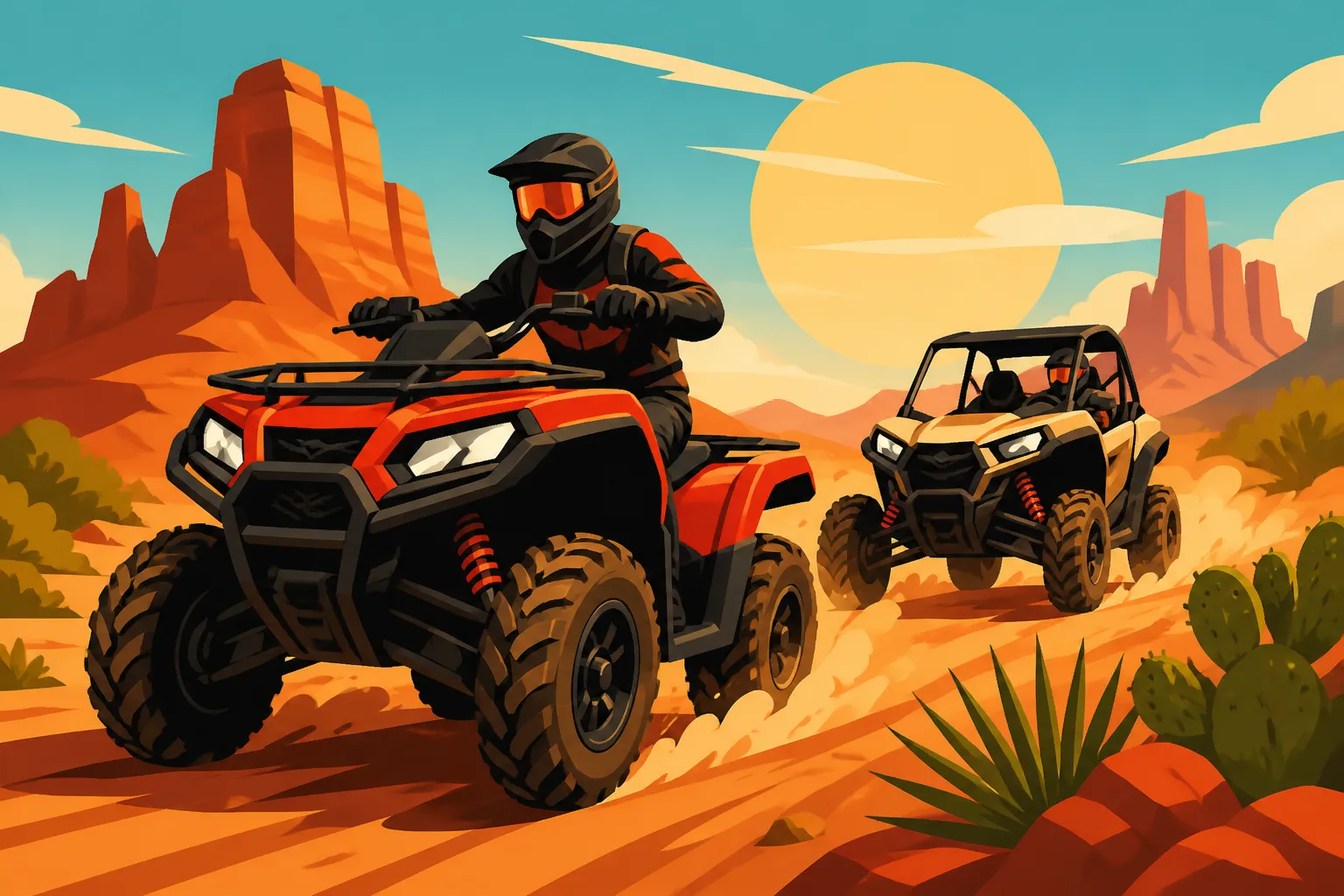
An ATV is generally a single-rider machine, while a side-by-side or UTV can carry a driver and passenger when the vehicle is designed and equipped for that use. Check the specific machine and seating arrangement the operator is offering. Do not assume a booking includes a vehicle with enough seats for everyone in your party, or that a passenger can be added after you arrive.
The right choice is about more than seating. Consider who will be driving, how comfortable each rider is with steering and terrain, and whether anyone in the group would rather ride as a passenger. Ask whether the tour uses ATVs, side-by-sides, or a mix, and whether participants can choose or must take the machine assigned by the operator.
If you are comparing a guided tour with a self-guided rental, think about the support you want. A guided outing offers a person who leads the ride and explains the route. A self-guided option may provide more flexibility but puts more responsibility on your group to navigate and make decisions. For more on rentals as a separate option, read Renting an ATV in New Mexico.
Use the guide’s local knowledge, but verify the basics
A guide can explain how to ride the planned route responsibly and may help you recognize when conditions call for a change in pace or direction. Still, do not treat the presence of a guide as proof that every road, trail, or nearby public area is open to motorized travel. Access depends on the land and route. Ask where the tour goes and whether the operator has permission or authorization for the route it uses.
This is especially important when a trip description names a broad destination rather than a specific riding area. “Near a forest,” “in the desert,” or “on public land” does not tell you which routes are included or whether the route is currently accessible. Ask for enough detail to understand the type of ground you will ride and any restrictions the operator has already identified.
How to choose a New Mexico tour
A good comparison starts with the route, not the promotional photos. Ask what kind of terrain the tour covers, how technical it is, whether it stays on designated routes, and what happens if weather or trail conditions change. The operator should be able to explain the experience in language you can use to judge whether it suits your group.
The phrase “guided tour” alone does not tell you how the day works. Find out where you meet, how the guide communicates with the group, what the briefing covers, and whether the ride is intended for first-time riders or people who already have off-road experience. If you are booking for someone else, confirm that person’s comfort and ability rather than assuming the tour’s label settles the question.
Use the table below to compare tour formats and questions to ask. These are planning prompts, not promises about what any operator offers.
| Tour format or feature | A possible fit for | Ask before booking |
|---|---|---|
| Closely guided group ride | Riders who want a guide leading the route and setting expectations | How closely does the guide stay with the group, and can the pace be adjusted? |
| Private or custom outing | Groups that want to discuss their experience and route preferences directly | What can be changed, and which route limits cannot be changed? |
| Side-by-side tour | Groups that prefer a larger vehicle or want passenger seating | How many people can ride in each machine, and who is allowed to drive? |
| ATV tour | Riders who want to operate an individual machine | What riding experience is recommended, and is the route suitable for a first-time rider? |
| GPS-led or self-guided ride | Riders comfortable navigating with less direct guidance | What support is available if the group gets lost, delayed, or has a mechanical issue? |
| Family booking | Groups with children or riders who need extra planning | What are the age, height, supervision, and passenger rules for the specific machines? |
Ask about pace and difficulty in concrete terms
“Easy” can mean different things to different people. Ask the operator to describe the ground: is it mostly smooth, or should riders expect loose sand, rocks, ruts, narrow tracks, or climbs? Ask whether the route includes places where riders must manage a machine carefully, and whether there is an alternate route if someone in the group is uncomfortable.
Also ask about the pace and spacing. Will the guide stop to regroup? How does the operator handle a rider who is falling behind? Is there a way to communicate with the guide while moving, or do questions wait until a stop? These details can matter as much as the terrain for a group that includes new riders.
If someone has limited mobility, a health concern, or little experience operating an off-road vehicle, tell the operator privately before booking. Ask whether the vehicle and route are appropriate and what support is realistically available. Avoid assuming that an advertised passenger seat or a short description of the route guarantees an accessible experience.
Compare booking channels without assuming they offer the same trip
You may encounter tour listings through operators, local businesses, travel marketplaces, or brands such as Polaris Adventures and Viator. Treat each listing as a starting point for questions, not as a substitute for confirming the details with the company responsible for the ride. Confirm who operates the tour, where it takes place, what the booking includes, and who to contact if plans change.
Check that the route, duration, vehicle type, group size, and meeting arrangements match what you intended to book. Ask whether a listing refers to a guided ride or a rental with suggested routes; those are different experiences. Confirm whether the guide is physically leading the group or whether the outing relies on a route map or GPS instructions.
Before you pay, review the cancellation and weather policies, the required arrival time, and any conditions that could affect participation. For rental-specific terms such as damage responsibility, see What a New Mexico Rental Waiver Does Not Cover. Do not assume a waiver covers every loss, or that it changes public-land requirements.
Check what is included and what is not
Ask whether the operator provides the vehicle, helmet, eye protection, fuel, and any other equipment needed for the outing. If an item is not included, ask what type is acceptable and whether you can bring your own. Clarify whether food, water, or transport to the ride location is part of the booking rather than inferring it from the listing.
Confirm how the operator handles damage, breakdowns, and recovery. Ask who to contact if the machine stops working and whether the group should stay together while help is arranged. The details may vary by company and route, so get the terms from the business that will conduct the tour.
Understand permits, access, and operator responsibilities
A guide can lead a ride, but the tour still has to comply with the rules that apply to the land and vehicles. New Mexico’s Department of Wildlife says that operating an off-highway vehicle on public land requires the user to register the vehicle or obtain a permit. The department also identifies itself as responsible for the state’s OHV program, which aims to support off-highway recreation while balancing cultural, historic, and resource values with public safety.
For a visitor, the practical question is not simply “Does the tour company have a permit?” Ask how the vehicle and each participant are covered for the planned ride, and whether there is anything you need to carry or complete. Requirements can depend on the vehicle, the rider, the land, and the circumstances. Read New Mexico OHV Permits Explained and New Mexico Rules for Riding Federal Land if you want to understand the general framework before contacting an operator.
Commercial operators offering guided ATV tours on federal public lands managed by the Bureau of Land Management in New Mexico must obtain a Special Recreation Permit, according to the Bureau of Land Management. That requirement concerns the commercial operator and the covered activity. It is not a reason to assume that every guided outing takes place on BLM-managed land, or that an operator’s authorization replaces all state safety requirements.
Ask the business what public land the tour uses and whether the route has any access limits. The operator should be able to tell you whether the outing is on BLM land or another type of land and what the group must do to ride there. If the answer is unclear, pause before booking and ask for clarification rather than relying on a general description such as “public trails.”
The operator should also explain any route boundaries. A tour may not be allowed to leave a designated route, enter an adjacent area, or continue after a closure. A guide’s route is not a general pass to ride elsewhere after the tour ends. For more on how route access and location limits can affect a rental, see New Mexico Rentals and Where You Cannot Go.
Registration and permit questions for the customer
New Mexico Department of Wildlife says users of OHVs on public land must register or obtain a permit. New Mexico residents must register OHVs used on public lands, according to the New Mexico Taxation and Revenue Department Motor Vehicle Division. That agency says residents who have proof of any valid OHV registration are not required to purchase a New Mexico permit.
Those statements do not establish that every visitor, rental customer, or tour participant is covered in the same way. Before the ride, ask the operator what proof or permit applies to the vehicle being used and whether the customer needs to do anything. If you are bringing your own machine, make clear that you are not using the company’s vehicle and ask what documentation you should have with you.
A company may handle paperwork for its own machines, but you should not assume that it does. Ask who is responsible for making sure the machine meets applicable requirements and who is responsible for the rider’s permit or safety obligations. If you are still unsure, check the official program information before the ride rather than waiting until you reach a trailhead.
Equipment rules still apply
The Motor Vehicle Division NM says off-highway motor vehicles must be equipped with a spark arrester approved by the United States Forest Service. The New Mexico Department of Wildlife also says all OHVs must have a Forest Service-approved spark arrestor. Ask the operator whether the machines used on the tour meet that requirement, especially if the outing is on public land.
Vehicle requirements are only part of the picture. The Motor Vehicle Division NM says that people under eighteen must wear eye protection and a securely fastened safety helmet when operating or riding an OHV. The agency also says operators under eighteen must possess an OHV safety permit and may not carry a passenger while operating an off-highway motor vehicle. Read New Mexico OHV Safety Permit Requirements if a young person will participate, and confirm the operator’s policy before booking.
The Motor Vehicle Division NM says children under ten must ride an ATV that is an age-appropriate size-fit vehicle. The New Mexico Department of Transportation says riders under six may not operate an ATV or ROV on public land. These are separate rules, and a tour company may have additional age, height, or supervision limits for its vehicles. Ask the company how its policy applies to the specific child and machine instead of relying on a general minimum age in a listing.
A tour operator can set conditions for who may drive or ride, and its rules may be stricter than the minimum state requirements. Confirm age limits, who may drive, passenger arrangements, and required safety gear before you book. Do not plan on switching drivers during the outing unless the operator says that is allowed.
Safety and trail etiquette during the ride
A good tour is not just about following a guide. Each rider remains responsible for paying attention, controlling the machine, and following instructions. Listen closely during the briefing, especially for information about spacing, stopping, hand signals or other communication methods, and what to do if you lose sight of the group.
Do not ride faster or more aggressively than you can manage. If the surface changes or you feel uncertain, ease off and let the guide know when it is safe to do so. Trying to keep up by taking risks can put you and other riders in danger. The guide needs an honest picture of the group’s ability to make sensible decisions about pace and route.
Keep a safe gap from the vehicle ahead and avoid sudden maneuvers unless they are needed to avoid a hazard. Dust can reduce visibility, and loose or uneven ground can affect steering and braking. Follow the operator’s directions about passing, stopping, and regrouping, and do not leave the planned route just because a different track looks tempting.
Share trails respectfully
Off-highway routes may pass through places used by other people, including hikers, horseback riders, and land managers. The New Mexico Department of Wildlife says riders who encounter horses should pull off the trail on the low side, stop the engine, remove the helmet, and speak to the rider. The department says riders must wait until all horses have passed 50 feet beyond their location before restarting the engine.
Do not approach horses quickly or assume they will react predictably to a vehicle. Follow the guide’s direction and give the horse rider time to manage the encounter. If you are unsure where to pull over, ask the guide rather than choosing a spot that could put the horse, rider, or group at risk. More background on considerate riding is available in New Mexico Trail Etiquette on Shared Ground.
Water crossings also require care. The New Mexico Department of Wildlife says streams must be crossed where designated and at a 90-degree angle wherever possible. Follow the guide’s route and do not create a new crossing or drive through water simply because it looks shallow. The condition of a streambed or bank may not be obvious from the approach.
Stay alert for signs, barriers, gates, and changes in the route. A guide may explain what a particular marker means, but a closed route should not be treated as an invitation to go around the barrier. Ask the operator how it handles closures or route changes and follow directions from land managers as well as the guide.
Respect the briefing and speak up early
Tell the guide if you are uncomfortable, confused, or having trouble controlling the machine. This is easier to address before the group reaches a difficult stretch. Do not wait until a stop feels impossible or assume that silence is the safest option. Guides need participants to communicate clearly, especially when the group’s pace or conditions change.
If the machine develops a problem, stop where the guide directs and wait for instructions. Do not attempt an unfamiliar repair or leave the group to look for help without telling the guide. Ask in advance how the company handles mechanical problems, injuries, and a rider who needs to end the outing early.
A well-run briefing should make the group’s expectations clear. If you do not understand the route instructions, ask for an explanation before setting off. Make sure you know how the guide wants the group to regroup and what to do if you become separated. Those details are especially important when riders have different experience levels.
Prepare for the day and avoid booking surprises
Start with the operator’s own instructions. Ask what to wear, what gear is supplied, and whether there are restrictions on personal items. Clothing suitable for an outdoor ride may depend on the route, weather, and vehicle, so use the operator’s guidance rather than assuming that one outfit works for every tour.
Plan for changing conditions. New Mexico has both desert and higher-elevation environments, and temperature, wind, dust, or precipitation can affect comfort and visibility. Ask whether the route is exposed, whether the tour can be changed or canceled for weather, and how the company will contact customers if conditions shift. Carry water and any personal essentials the operator recommends, and avoid bringing loose items that could interfere with riding.
Before travel, confirm the meeting location and how to recognize the business or guide. Ask whether you need to arrive early for paperwork or a safety briefing, and what happens if you are delayed. Do not assume the meeting point is the same as the place where the ride begins; confirm whether transport or a trailer transfer is involved.
If you are driving your own vehicle to the starting area, check parking and access instructions. Ask whether the route begins at the meeting location or whether the group travels elsewhere. Keep any confirmation details available and make sure someone in your group knows who to contact if plans change.
Use a focused pre-booking checklist
Before confirming, get clear answers to these questions:
- What kind of machine will each participant use, and who will drive?
- What terrain and route conditions should riders expect?
- Is the tour suitable for a first-time rider or for the least-experienced person in the group?
- Where does the route take place, and what land-access rules apply?
- What permits, registration, or proof must the operator or customer provide?
- What safety equipment is included, and what must participants bring?
- What are the company’s age, passenger, and supervision rules?
- How does the operator handle weather, closures, breakdowns, and early returns?
- What are the cancellation, damage, and other booking terms?
- Where is the meeting point, and what should the group do if it is running late?
It is useful to save the operator’s answers with your booking details. If the listing and the company’s instructions do not match, ask which information controls before you travel. For a broader look at route planning and navigation, see New Mexico Trail Maps Worth Carrying.
Set expectations for families and mixed-experience groups
A family booking needs more than a general confirmation that children are welcome. Ask what machines are available, which people can operate them, whether passengers are allowed, and what supervision the operator requires. New Mexico rules and company policies may both apply, and the company may set limits based on a vehicle’s size or the nature of the route.
For younger riders, confirm helmet and eye-protection requirements, safety-permit requirements, and whether the child’s machine is appropriately sized. The Motor Vehicle Division NM says children under ten must ride an age-appropriate size-fit ATV. The New Mexico Department of Transportation says riders under six are prohibited from operating an ATV or ROV on public land. The company should confirm how these requirements relate to the exact tour and vehicle.
For a group with different abilities, ask whether everyone has to ride the same route and pace. A private booking may give a group more opportunity to discuss preferences, but do not assume it guarantees a modified route. Confirm what the operator can accommodate, what is not possible, and whether a rider can stop or return early without separating from the group.
What to expect from the booking and the guide
A tour provider should give you a clear description of what you are buying. Read the full listing and the terms supplied by the actual operator. A booking that appears simple may involve separate requirements for the vehicle, the rider, and access to the land. Ask who is responsible for each part.
Before you agree to a waiver or damage policy, read it carefully. Ask what counts as damage, how the company handles a mechanical issue, whether a customer may be charged for recovery, and what the policy says about damage caused by another rider. Do not assume that a waiver eliminates every financial responsibility or that a guide can approve an exception after the ride begins.
On arrival, expect to confirm the booking, receive instructions, and learn how the operator wants the group to ride. Give accurate information about your experience and any concern that could affect your participation. If the assigned vehicle is not the one you expected or a key part of the booking differs from the listing, resolve it before departure.
A guide’s role is to lead and support the outing within the operator’s plan. The guide is not a substitute for a rider’s attention or an excuse to disregard signs, closures, or safety instructions. Follow the guide, but also speak up if something is unclear or if you believe conditions have changed.
After the ride, follow the company’s return procedure and report any issue with the machine. If there was a problem on the route, explain what happened while the details are fresh. Keep any written record of the operator’s response and review the final terms if there is a question about damage or a booking change.
Frequently Asked Questions
Do I need my own ATV for a guided tour?
Not necessarily. Many tour bookings involve a vehicle supplied by the operator, but you should confirm exactly what is included. Ask whether the booking is for a guided ride or a rental, who drives, and whether each person has a machine or rides as a passenger.
Does the guide’s permit cover every rider?
Do not assume so. New Mexico Department of Wildlife says users operating OHVs on public land must register the vehicle or obtain a permit. Ask the operator how the vehicle and participants are covered for the specific route and whether you need to carry or obtain anything yourself.
Are guided ATV tours suitable for beginners?
Some may be designed for less-experienced riders, but the label alone is not enough to judge. Ask about terrain, pace, vehicle type, and how the guide handles a rider who is uncomfortable. Tell the operator your experience level before booking.
Can children join a New Mexico ATV tour?
That depends on state requirements, the machine, the route, and the operator’s own rules. The Motor Vehicle Division NM says children under ten must ride an age-appropriate size-fit ATV, and the New Mexico Department of Transportation says riders under six may not operate an ATV or ROV on public land. Confirm the company’s age, passenger, supervision, and safety-equipment policies directly.
What should I confirm before booking a BLM tour?
Ask whether the route is on BLM-managed land, who operates the tour, and whether the commercial operator has the required Special Recreation Permit. The Bureau of Land Management says commercial operators offering guided ATV tours on BLM-managed federal public lands in New Mexico must obtain an SRP. Also confirm the vehicle and rider requirements that apply to your trip.
Sources
- New Mexico Department of Wildlife — OHV Ethics | Ride New Mexico (checked November 3, 2026)
- New Mexico Department of Wildlife — Ride New Mexico | The Land of Enchantment (checked November 3, 2026)
Disclaimer
This article is for general informational purposes only and does not constitute professional advice. Laws, prices and regulations vary by location and change over time. Consult a qualified professional for guidance on your specific situation.