Does a Provisional License Count for a Teen Rider?
A teen with a New Mexico provisional license may be able to skip the state OHV safety permit, but that does not make the teen exempt from every riding rule. The important distinction is between a provisional driver’s license and a learner’s permit. Here’s how to tell which one applies and what else to check before riding.
Does a provisional license count?
In general, yes. A current New Mexico provisional driver’s license is a driver’s license, not an instructional permit. If the OHV safety-permit rule allows a minor with a valid driver’s license to ride without that separate permit, a provisional license should qualify for that exception.
That exception is narrow: it concerns the OHV safety permit. It does not turn an ATV or UTV into a street-legal vehicle, replace the machine’s registration or a required nonresident OHV permit, or give a teen permission to ride anywhere a driver’s license would allow a car to go. The vehicle and the place where it will be used still determine the other requirements.
The key word is valid. The license should be current and in good standing. A learner’s instruction permit is a different credential and should not be treated as a provisional license. If the teen has only an instruction permit, has an expired license, or is unsure what document they hold, the safer choice is to complete the OHV safety course and carry the resulting permit rather than rely on an uncertain exception.
| Teen’s document | Does it generally qualify for the driver’s-license exception? | Practical approach |
|---|---|---|
| Current provisional driver’s license | Generally, yes | Carry the physical license and confirm the exception applies to the planned ride |
| Learner’s instruction permit | Do not assume so | Get the OHV safety permit unless the responsible agency confirms otherwise |
| Expired or suspended license | No safe basis for relying on the exception | Resolve the license issue or carry the required OHV safety permit |
| No driver’s license | No | Check the age rules and complete the required OHV safety training |
| Out-of-state provisional license | Do not assume New Mexico treats it the same way | Confirm the rules with the relevant agency before riding |
The terms matter because a teen may casually call either document a “permit.” When checking the rule, use the credential’s exact name. For details about the separate OHV credential, see New Mexico OHV Safety Permit Requirements and New Mexico Safety Permit for a Minor.
What the license exception does not cover
An OHV safety permit is not the same thing as vehicle registration, a nonresident riding permit, proof of ownership, or permission to use a particular route. A provisional license can address only the safety-permit question; it does not replace any of those separate requirements.
Registration and nonresident permits
A New Mexico-registered OHV may still need its current registration and required decal. A visitor’s machine may need a New Mexico nonresident permit, depending on the home state’s OHV program and whether its registration is recognized. A teen’s driver’s license does not settle that reciprocity question. Check New Mexico OHV Reciprocity Rules and New Mexico OHV Registration for a Nonresident if the machine is registered elsewhere.
Keep the paperwork for the machine available, not just the teen’s license. Riders can run into trouble when they carry personal identification but cannot show that the OHV is properly registered or permitted for the ride. The same is true if a machine is borrowed or rented: establish which registration and permit documents apply to that machine before leaving.
Land access and route restrictions
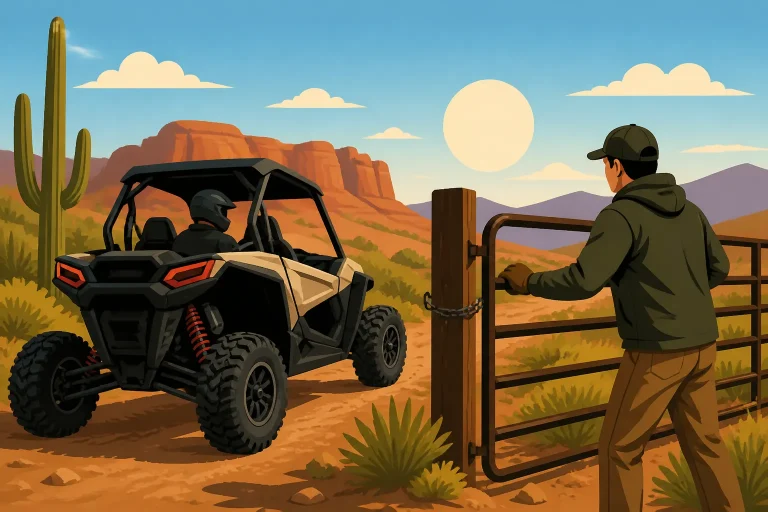
A valid license does not grant access to private property, tribal land, state trust land, or a closed road. Public-land riding is also limited to routes open to the type of vehicle being used. A trail or road may be open to one class of OHV but closed to another, or closed temporarily because of weather, fire restrictions, maintenance, or seasonal limits.
Before a ride, identify who manages the ground and check the current route information for that land. For example, riding on a national forest requires following that forest’s travel-management rules; having a provisional license does not authorize travel beyond a designated route. See [New Mexico Rules for Riding a National Forest] for the separate access rules.
The location matters just as much when riding on roads. State highways and other public roads are not automatically open to ATVs or UTVs simply because the rider has a driver’s license. A roadway may have its own rules, and a machine may need additional qualifications for an allowed paved-road use. Review New Mexico Paved Road Plate Requirements if pavement is part of the plan.
Age, supervision, and protective equipment
The safety-permit exception should not be read as a blanket exemption from rules for riders under 18. Age-related requirements can still apply, including rules about supervision, passengers, helmets, and the minimum age for riding on public land. A provisional license does not necessarily change those requirements.
Check the rules for the teen’s exact age and the kind of OHV involved. Requirements can differ for a small youth machine and a full-size ATV or UTV, and passenger rules matter if another young person will ride along. For a closer look at supervision, see New Mexico Supervision Rules for Young Riders. Do not assume that having a license means a teen may ride alone, carry a passenger, or operate any size of machine.
Protective gear also remains important even when a rider qualifies for the license exception. Follow the applicable helmet and eye-protection requirements, and use gear suitable for the terrain. On a dusty or rocky route, eye protection is particularly practical even when the ride is slow.
Check the teen’s status before the ride
A quick review can prevent the most common mistake: treating a provisional license as permission to ignore every other OHV requirement. Work through these steps before loading the machine.
- Read the credential’s exact name. Confirm that the teen has a provisional driver’s license, not an instruction or learner’s permit. If the wording is unclear, ask the Motor Vehicle Division or the agency responsible for the OHV safety permit.
- Check that it is current. Do not rely on an expired, suspended, or otherwise invalid license to qualify for an exception.
- Confirm the safety-permit rule. Verify that the driver’s-license exception applies to the teen and the planned type of riding. If you cannot confirm it, completing the OHV safety course is a practical way to avoid a dispute about what the license covers. The rules and course details are discussed in New Mexico Safety Permit for a Minor.
- Check the machine’s documents. Make sure the registration, decal, or nonresident permit required for that machine is current and available. Keep personal credentials and vehicle documents together, but do not confuse one with the other.
- Confirm where the route is open. Check the land manager’s current route map, closures, and any local restrictions. A public road, private road, forest route, and trail can have different access rules.
- Review the rules for the rider’s age. Confirm supervision, passenger, helmet, and other youth requirements independently of the provisional license.
- Carry proof. Have the teen carry the current license, and bring any OHV safety permit, registration, or nonresident permit that applies. Carrying documentation makes it easier to explain which exception or permit applies during a roadside or trail check.
If the ride is organized by a rental company, club, or land manager, ask what documents it expects before the trip. A business may request proof of training or impose its own age and supervision conditions even when a state rule provides an exception. Those policies do not change what the state law says, but they can affect whether the teen can participate in that particular ride.
When to get the safety permit anyway
Even when a provisional license appears to qualify, getting the OHV safety permit can be the simpler choice in a few situations. The teen may ride in more than one state, the family may not be sure whether the credential is a provisional license or a learner’s permit, or the planned trip may involve a group or land manager that asks for proof of OHV training.
A course also addresses safe operation in ways a driver’s license test may not. Driving a car and controlling an ATV or UTV involve different balance, braking, visibility, terrain, and rollover risks. A driver’s license should not be treated as evidence that a teen has practiced those skills.
If the teen already has the OHV safety permit, carry it even if the provisional license might make it unnecessary. If the teen does not have one, do not wait until arriving at a trailhead to resolve an unclear rule. Check the applicable state and land-manager requirements in advance. For advice on keeping proof accessible, see Carrying Your Permit Number on a Card.
The practical answer is that a current provisional driver’s license generally counts for the minor’s driver’s-license exception to the OHV safety-permit requirement. A learner’s permit is not the same thing, and neither credential replaces vehicle paperwork, land access permission, or age-specific riding rules. When the document or exception is unclear, confirm it before the trip or have the teen obtain the OHV safety permit.
Disclaimer
This article is for general informational purposes only and does not constitute professional advice. Laws, prices and regulations vary by location and change over time. Consult a qualified professional for guidance on your specific situation.