Can an Adult Supervise From the Staging Area?
If a young rider is heading out on a New Mexico trail, it can be tempting to stay at the staging area and keep in touch by phone or radio. But “supervision” is not the same as being reachable. The practical test is whether the adult can keep the rider in sight and respond as the ride unfolds—and whether the rider separately meets the state’s safety-permit rules.
The short answer: only if the rider stays in sight
An adult can supervise from a staging area only when that position allows them to maintain a clear view of the young rider. If the rider goes around a bend, drops behind a ridge, enters trees, or otherwise disappears from view, the adult is no longer providing continuous visual supervision from that spot.
A phone, radio, GPS tracker, or another rider’s promise to check in can help with communication, but none lets an adult see what is happening. A rider could fall, take a wrong turn, encounter another vehicle, or need immediate help while still being able to transmit a message—or before getting a chance to do so.
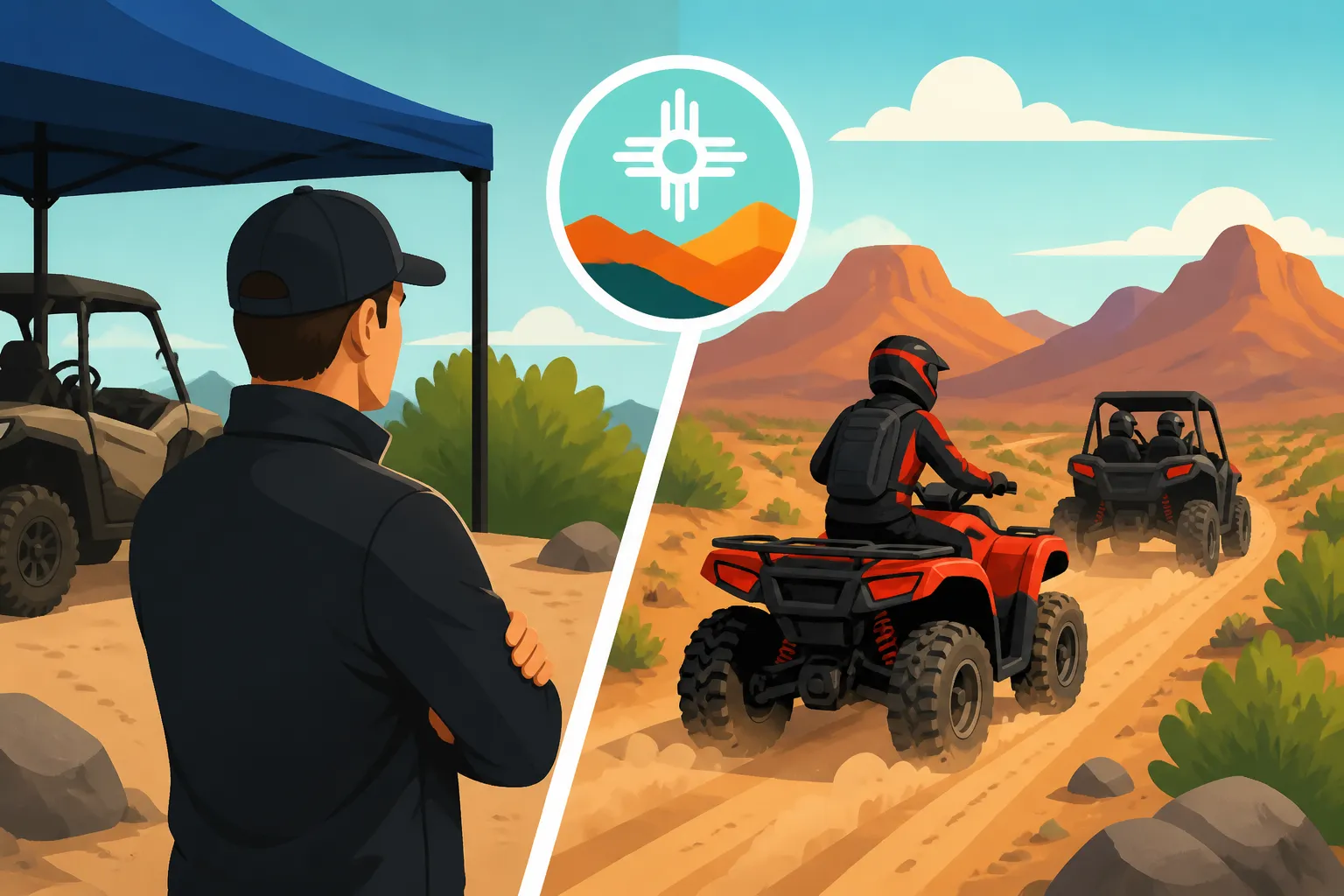
In practice, the staging area often works as the launch point for the ride, not as a place to supervise from after the group leaves. It may be suitable if the riding area is small, open, and fully visible from the adult’s position. On a longer or winding route, the adult usually needs to ride along, walk to a position with a clear view, or choose another activity that keeps the child within sight.
| Situation | Is the adult providing visual supervision? | Safer approach |
|---|---|---|
| The rider stays in an open area that the adult can see clearly | Potentially, as long as sight is maintained | Stay in position and keep watching |
| The rider passes behind a hill, trees, or a bend | No, not while the rider is out of view | Follow at a suitable distance or stop the ride |
| The adult can hear the engine but cannot see the rider | No | Choose a route or position that preserves a clear view |
| The adult is at the staging area and relies on radio check-ins | No; communication is not visual supervision | Ride with the child or use a fully visible riding area |
| The adult can see the route but loses sight when dust rises | Not reliably during the loss of visibility | Slow down, increase distance, or pause until visibility improves |
Treat “I can see the trail entrance” and “I can see the rider” as two different things. Being able to watch the start of a route does not mean you can supervise the full ride. The same is true if the adult can see a general area but cannot tell where the young rider is or what they are doing.
Supervision does not replace a safety permit
Adult supervision and the young rider’s safety-permit requirements are separate questions. Do not assume that having a parent, guardian, or other adult nearby makes a permit unnecessary. A minor who needs a safety permit still needs to meet that requirement even when an adult is watching.
The rules for young riders are different from the rules for adults. Check New Mexico’s Safety Permit for Under-18 Riders and Does an Adult Need a New Mexico Safety Permit? before heading out. If a young rider believes a license or other credential changes what applies, confirm the specific exception rather than relying on a general assumption; Can a 15-Year-Old Driver Skip the Safety Permit? explains why age and credentials can matter.
A course can help the rider understand controls, trail etiquette, and common hazards, but completing training does not make it safe to ride beyond the adult’s view. Likewise, having the required permit does not establish that a particular route, machine, or riding arrangement is appropriate for the child. The permit question is about meeting a state requirement; supervision is about whether a responsible adult can observe the rider while they operate.
For a child who has not taken the required course, review Approved Courses for a New Mexico Permit. Before departure, also make sure the rider can carry proof of the required permit. Carrying the Safety Permit on a New Mexico Ride covers that practical step. If a card is missing, do not assume the adult’s presence can stand in for it; check the process in Replacing a Lost Safety Permit.
These requirements matter on public land, but the places people call “public land” are not all governed in the same way. Federal land, state trust land, tribal land, and private property may have different access rules. A safety permit does not grant permission to ride wherever a machine can physically go. Check the land manager’s route rules and any access permission needed for the area.
What counts as meaningful visual supervision
Visual supervision should be continuous enough that the adult knows where the young rider is and can react if something changes. That does not mean the adult has to be next to the machine at every moment. It does mean that the adult should not lose sight of the rider and simply hope that everything is fine until the next radio check.
A useful way to plan is to ask whether the adult could immediately notice and respond if the rider:
- Stops unexpectedly or falls.
- Turns onto the wrong trail.
- Gets separated from the group.
- Approaches a hazard or another vehicle.
- Has a machine problem and needs help.
If the answer depends on a call, a text, or another person reporting what happened, the adult may be too far away to provide effective visual supervision.
The sightline needs to hold up under real riding conditions, not just while everyone is parked. Dust can obscure a rider on a dry route. Trees and terrain can block visibility even when the trail looks open from the staging area. A route that seems visible from a map or trailhead may have blind sections once the group is moving. Stop and reassess if dust, changing light, weather, or a route choice makes it difficult to keep the rider in view.
Riding alongside the child is often the clearest arrangement, but it still takes planning. Leave enough space to ride safely and avoid crowding the young rider. On a narrow trail, an adult should not tailgate or put pressure on a child to keep up. Choose a route and pace that leave room for safe stops, clear communication, and changes in terrain. If staying close would create a new hazard, select a different route or do not make that ride a supervised outing.
A second adult can help, but only if the arrangement is clear. Agree on who is watching the child, which route the group is taking, and where everyone will stop. A companion who assumes someone else is supervising is not a dependable plan. Nor is a group spread across several trails where no adult can keep the young rider in view.
For broader preparation, see New Mexico Supervision Rules for Young Riders and Visual Supervision and What It Means. Those topics are especially useful when deciding whether a proposed ride is appropriate before the machines are unloaded.
Plan the ride around the view, the route, and the rider
Start by selecting an area where an adult can maintain sight of the young rider. If the only way to watch is to stay at the staging area, keep the riding within the area that can actually be seen from there. Do not let a child travel farther just because the adult expects them to return quickly.
Before riding, talk through the route and agree on a simple rule: if the adult loses sight of the child, the group stops or turns back to restore visual contact. Make that expectation clear before the engines start, when it is easier to discuss calmly. A young rider should know not to continue around a blind corner simply to stay ahead of the group.
Match the route to the rider’s skill, the machine, and the conditions. A small, open practice area may be a better choice than a long trail with steep grades, blind turns, loose surfaces, or heavy traffic. The adult should be able to observe the rider without having to divide attention among navigation, other children, and several machines.
Use a pre-ride check that covers both compliance and supervision:
- Confirm the rider’s requirements. Check whether the young rider needs a New Mexico safety permit and make sure any required proof is available.
- Confirm that the route is open and permitted for the machine. Check the current route information and land-access rules rather than assuming a visible road or trail is open to OHVs.
- Choose a supervision position. Decide whether the adult will ride with the child or stay in a place from which the entire riding area remains visible.
- Agree on the boundary. Explain which route or area the rider may use and what to do if visibility is lost.
- Check the conditions. Dust, weather, crowds, and changing light can make an otherwise workable sightline unreliable.
- Stop if the plan stops working. If the child disappears from view, pause the ride and regroup instead of treating a radio call as an equivalent substitute.
If you are unsure whether a young rider meets the permit requirement, whether an area allows OHV use, or how supervision is defined for a particular activity, confirm with the relevant official source before riding. Requirements for a public trail should not be assumed to apply in the same way on private property or on land controlled by another agency.
The practical bottom line is simple: an adult may supervise from the staging area only while the young rider remains within clear, continuous view. Once terrain, trees, distance, or dust breaks that view, change the plan. Keep the rider visible, meet any separate permit requirements, and choose a route the adult can supervise safely.
Disclaimer
This article is for general informational purposes only and does not constitute professional advice. Laws, prices and regulations vary by location and change over time. Consult a qualified professional for guidance on your specific situation.