New Mexico Width Limits on Forest Trails
New Mexico forest trails do not all have the same width limit, and a machine that fits one route may be too wide for another. The key is to check the specific trail’s designation, not assume that an ATV or UTV can go wherever a smaller machine can. Here’s how to check your machine, read route information and avoid a costly wrong turn.
What width limits mean on New Mexico forest trails
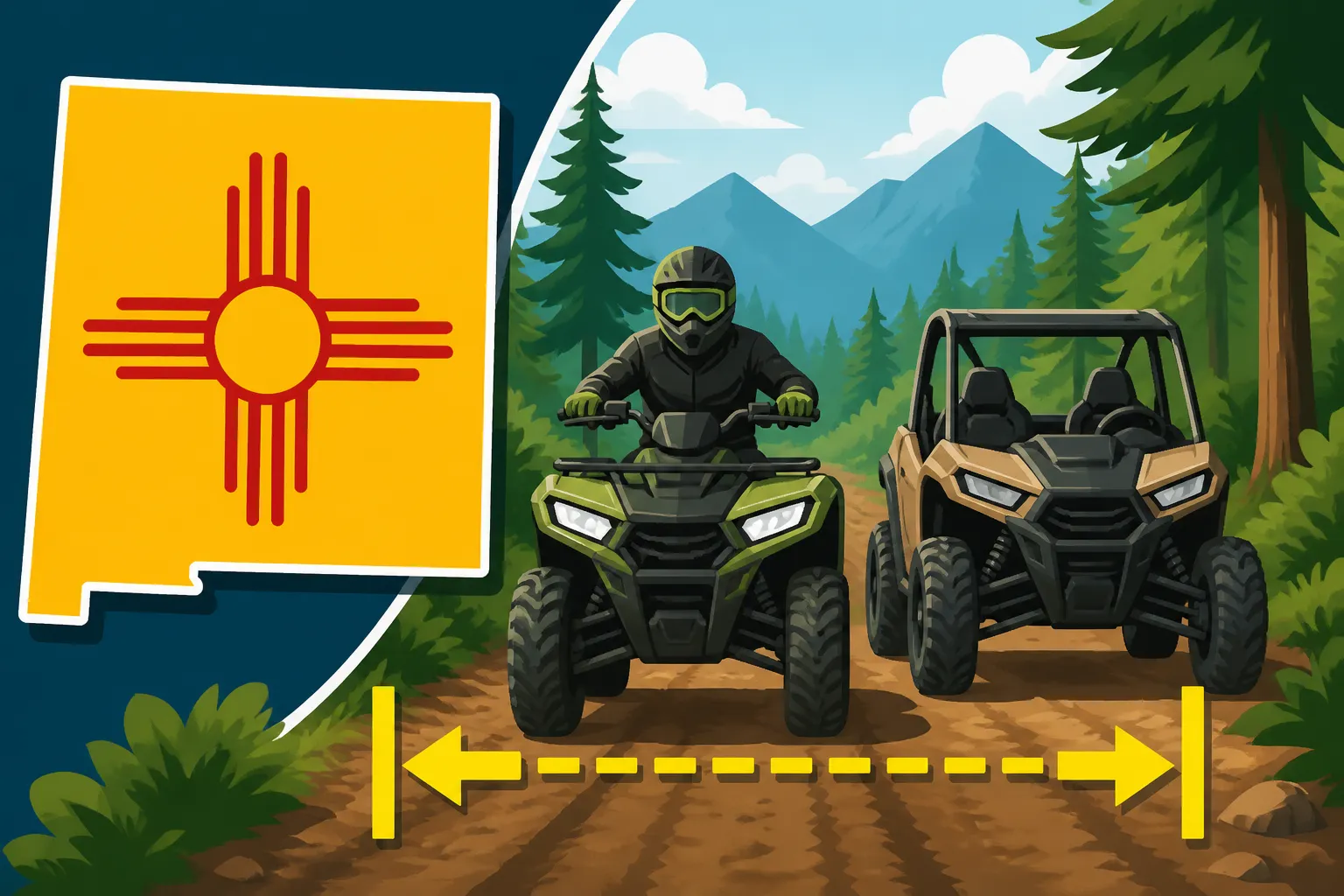
A width limit is a restriction on which vehicles may use a particular route. On forest land, it is generally tied to the route’s designation and the vehicles it is managed to accommodate. A trail marked for vehicles 50 inches wide or less, for example, is not automatically open to a wider side-by-side just because the trail looks broad enough at the trailhead.
That distinction matters because “forest trail” can describe very different routes. One may be a narrow single-track path, another a trail intended for narrower ATVs, and another a road open to wider vehicles. A forest road and a narrow motorized trail are not interchangeable. A route may also be closed to motorized use altogether.
There is no single width limit that makes every New Mexico forest route legal for every ATV or UTV. Restrictions can differ between forests, districts and individual routes. A common 50-inch designation is useful to recognize, but it is not a statewide permission slip or a complete description of every route. The controlling information is the current route designation, signs and land-manager direction for the specific area.
A physical gate or narrow spot should not be treated as the only test. A route might have a width restriction even when no barrier is installed, and a vehicle that can squeeze through a gap is not necessarily allowed on the route. Conversely, a wide-looking road may still have a seasonal closure or a vehicle-use restriction. Check access rules before riding rather than using the terrain itself as your guide.
A permit, registration or safety credential also does not override a width restriction. Those documents may satisfy separate requirements, but they do not grant permission to ride a route closed to your vehicle type. The same principle applies to visitors: reciprocity for an out-of-state registration is not the same as authorization for a particular trail. See New Mexico OHV Reciprocity Rules and [New Mexico Rules for Riding a National Forest] for the separate permit and access questions.
| What you see in route information | What it generally tells you | What to check before riding |
|---|---|---|
| A width-limited trail designation | The route is restricted to vehicles within the stated width category | Whether your machine meets the land manager’s definition and the route is currently open |
| A road open to motor vehicles | Wider vehicles may be permitted, subject to the route’s rules | Any vehicle, seasonal, or local restrictions |
| A closed-route symbol or sign | Motorized travel is not allowed while the closure applies | Whether the closure is temporary, seasonal, or permanent |
| No width information | The route’s vehicle limits are unclear from what you have | Current maps, posted signs, or guidance from the managing office |
How to check your ATV or UTV against the route
Start with the machine’s specifications, but do not rely on the model name alone. Two machines in the same product family can have different widths depending on trim, tires, wheel setup and installed accessories. A dealer listing or owner’s manual may give a width measurement, but confirm what is included in that figure and whether it matches the way the route authority applies its limit.
For a practical check, measure the machine at its widest point as it will be ridden. That often means checking the outside edges of the tires, but accessories such as extended fenders, mirrors or other equipment can also affect the actual clearance you need. Do not assume that removing an accessory changes the official classification of the vehicle; ask the managing agency if your machine is close to the route’s stated limit. A basic tape measure, including one bought from a hardware store or Amazon, can help you verify the machine’s physical width.
Measure on level ground, with the tires set up as they will be for the ride. Record the measurement and keep the owner’s manual or manufacturer specifications available. If a limit is close, take the uncertainty seriously. A small difference can matter on a restricted trail, and trail-side guessing is a poor substitute for confirming the designation in advance.
Also think beyond the number. A wide UTV may fit within a route’s width category but still be difficult to maneuver on a narrow, rocky trail. Width affects turning room, passing, brush clearance and the chance of scraping bodywork. A vehicle that is technically eligible is not necessarily a comfortable or sensible choice for every route.
When the route information uses terms such as “ATV,” “motorcycle,” “50-inch trail” or “full-size vehicle,” read the full map legend and local guidance. A familiar label can have a specific meaning in that forest’s route system. If the map does not make the restriction clear, contact the relevant ranger district or land manager and describe the exact route and machine. If your vehicle is close to the limit, give them the measured width and configuration rather than only the model name.
Check the vehicle as it will be used
Before leaving home:
- Find the manufacturer’s width specification and note whether it includes tires or accessories.
- Measure the machine’s widest point in its current riding setup.
- Compare that measurement with the actual route designation, not a general statement about the forest.
- If the number is close or the wording is unclear, confirm with the managing office.
- Carry the current map or route information and follow signs on the ground.
This is especially useful when a machine has aftermarket wheels, tires, spacers or bodywork. A stock specification may not describe the machine you are bringing. Keep the width check separate from equipment checks such as helmet, lighting and sound requirements; passing one check does not satisfy the others. For related riding rules, see New Mexico Rules for Riding a Designated Route and New Mexico Width Limits on Forest Trails.
Find the route’s current designation before you unload
A vehicle’s width is only half of the decision. You also need to know whether the exact route is open to motorized use and what vehicle class it allows. Use the land manager’s current motor-vehicle map or travel-management information for the area. A general recreation map may show roads and trails without spelling out every width or seasonal restriction, so look for the map legend and route-specific notes.
Check the information for the forest or district where you plan to ride. A trail network can cross administrative boundaries, and the same-looking route may be managed differently after it crosses one. Do not assume that a rule you confirmed for one trailhead applies to every nearby route. If your day includes several sections, check each one, including the return route.
Look for these details:
- Whether the route is open to motorized use
- Which vehicle types or width categories are allowed
- Whether the route is limited by season, weather, fire conditions or other temporary closure
- Whether travel is restricted to the signed route
- Whether the route passes onto land managed by another agency or owner
Maps and signs should be read together. A sign at an entrance can clarify a restriction, while a map can show how far it continues and where permitted routes connect. If a sign conflicts with an old map or a route appears newly closed, do not assume the older information controls. Follow current posted restrictions and check with the land manager.
The route surface is not a reliable way to judge its legal width class. A trail can widen from traffic, wash out, or have a broad staging area at the entrance while remaining restricted to narrower vehicles. The reverse can also happen: a route designated for wider vehicles may have a narrow section that requires careful driving. Stay on the authorized route rather than creating a bypass around a pinch point.
For broader planning, Travel Management Maps on Federal Ground explains why route maps matter, and New Mexico Trail Closures to Check First is relevant when seasonal or temporary access may change. If your ride includes a section outside national forest land, verify its rules separately. Forest Service access does not grant permission on tribal, private or state trust land. See New Mexico Rules for Riding BLM Land and Tribal Land and Why You Need Permission when your route may cross into those areas.
Plan for the machine you have, not the machine you wish you had
If your UTV is wider than a trail’s permitted category, choose a route that allows your vehicle or bring a narrower machine. Do not try to solve the problem by driving around a sign, riding beside the trail or following tracks made by other riders. Unauthorized travel can damage vegetation and soil, widen the trail, and create a route that future riders may mistake for an approved path.
When planning with a group, check every machine individually. A route that works for the narrowest ATV in the group may not work for the widest UTV. Make sure the lead rider and the person navigating know where the width restrictions apply. If the group contains different vehicle sizes, agree on a route that all machines are permitted to use before setting off.
A useful pre-ride plan includes a legal alternative. If a route is closed, too narrow, or unclear, decide where the group will turn around and what broader route it can take instead. This is more practical than reaching a restriction late in the day, when fuel, weather or daylight may make backtracking harder.
Width is also a safety issue. A machine that barely fits between rocks or trees has less room for steering corrections. Brush can hide branches, and a narrow shelf or uneven shoulder can make a squeeze-through more dangerous than it appears from the seat. Keep a safe pace, allow room for other trail users, and do not force a pass where the route is too narrow.
If your machine is near a posted limit, treat confirmation as part of trip preparation. Save the route map, note the managing office’s guidance and verify that no closure has changed access. For a wider machine, New Mexico Trails for a Wide Side-by-Side can help with route planning, while New Mexico Trail Maps Worth Carrying covers the value of having route information available during the ride.
The simplest rule is to match the vehicle to the route before you tow or unload. Confirm the actual width, confirm the route’s current designation, and obey the signs on the ground. A valid permit and a capable machine are important, but neither makes a restricted forest trail suitable or legal for a wider UTV.
Disclaimer
This article is for general informational purposes only and does not constitute professional advice. Laws, prices and regulations vary by location and change over time. Consult a qualified professional for guidance on your specific situation.