New Mexico Rules for a Rider Aged 13
A 13-year-old may be able to ride an ATV or UTV on New Mexico public land, but age alone does not settle the question. The rider’s safety certification, adult supervision, machine, and the rules for the specific land all matter. Here’s how to check the main requirements before you load up.
What a 13-year-old needs before riding
New Mexico’s youth safety rules are separate from vehicle registration and visitor permits. A 13-year-old should not assume that having a registered machine—or permission from a parent—is enough to ride on public land.
For a young rider, the key document is generally the state’s OHV safety permit. It is tied to completing an approved safety course, not to owning a particular ATV or UTV. The permit is also different from a nonresident permit, which addresses whether an out-of-state visitor may ride in New Mexico.
| Requirement | What it addresses | What it does not replace |
|---|---|---|
| OHV safety permit | A young rider’s required safety training | Vehicle registration or land-use permission |
| Registration or accepted out-of-state credentials | The machine’s registration status | A minor’s safety permit |
| Nonresident OHV permit, when required | A visitor’s authorization to ride in New Mexico | Safety training or adult supervision |
| Adult supervision | A minor’s oversight while riding | The rider’s own required credentials |
A 13-year-old should complete an approved course and carry the resulting permit while riding wherever the requirement applies. Don’t rely on a parent’s completion certificate, a rental company’s paperwork, or the machine’s registration as a substitute. More detail is available in New Mexico Safety Permit for a Minor and Approved Courses for a New Mexico Permit.
The requirement applies to the rider, not just to the vehicle. If two children take turns on one quad, each child needs to meet the rules that apply to them. Likewise, a permit attached to one child does not make another child eligible to ride.
Age 13 is not, by itself, a blanket ban on riding an OHV in New Mexico. But that does not mean every 13-year-old may ride every machine, on every route, under any conditions. Check the rider’s eligibility, the machine’s size and handling, and the land manager’s rules before setting out. New Mexico Minimum Age to Ride Public Land explains how age-related access questions fit into the broader rules.
Supervision, licensing, and the machine itself
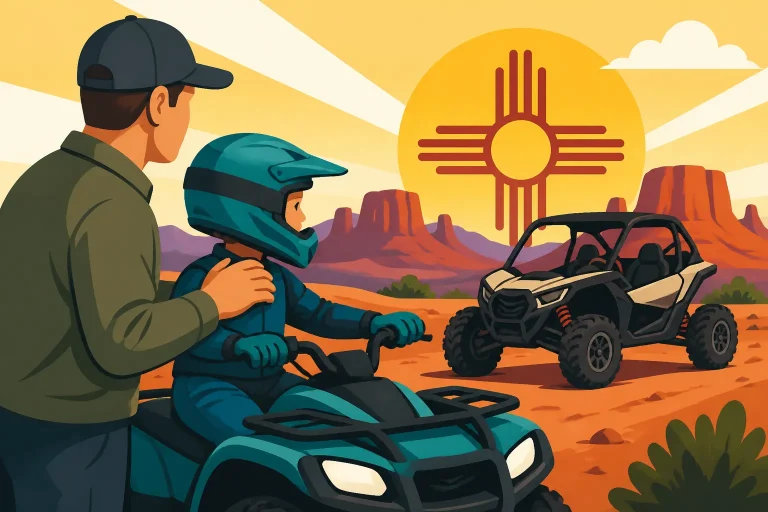
A 13-year-old should ride under the direct visual supervision required for a minor. In practical terms, the supervising adult needs to be able to see the young rider and respond promptly—not simply be somewhere else on the same trail system or reachable by phone. A parent or guardian should confirm who may supervise and what the applicable rule requires before the ride. The detail is covered in New Mexico Supervision Rules for Young Riders.
This affects route choice. A long ride with blind corners, separate trail branches, or steep terrain can make it difficult to keep a younger rider in sight. Choose a route where the adult can maintain supervision, and agree on simple rules for stopping, regrouping, and what to do if the rider loses sight of the group.
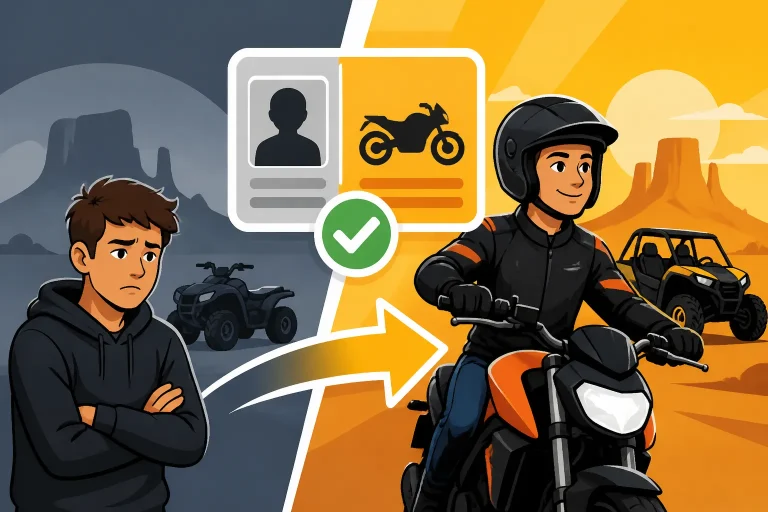
A motorcycle license is not the same as an OHV safety permit
A 13-year-old may ask whether a motorcycle license or endorsement changes the OHV requirements. The answer depends on the exact credential and the applicable exemption. A license to operate a motorcycle on public roads does not automatically prove that the rider has completed the OHV course required for off-highway riding.
Before relying on a license, confirm with the responsible New Mexico agency whether that specific credential satisfies or exempts the rider from the OHV safety-permit requirement. Don’t assume the rules for a licensed 15-year-old apply to a 13-year-old. These questions are addressed in Can a 13-Year-Old With a Motorcycle License Ride? and New Mexico Permit Rules at Fifteen.
A license also does not waive supervision, helmet, eye-protection, or land-use rules that apply to the ride. And an OHV safety permit is not a driver’s license: it does not authorize a young rider to use a road or street where a driver’s license or other road-use condition is required.
Match the machine to the rider
Legal eligibility is only one part of deciding whether a 13-year-old should operate a machine. Consider the rider’s ability to reach and use the controls, steer, brake, and handle the machine’s weight. A UTV can feel more stable than a quad, but its size and speed still demand judgment, and a passenger can affect how it handles.
Use the manufacturer’s age and size guidance as a starting point, then consider the terrain and the child’s actual skills. A machine that is manageable on a flat, open practice area may be a poor fit for a narrow trail, loose sand, steep ground, or a route shared with full-size vehicles. A safety course teaches important habits, but it cannot make an unsuitable machine or route safe.
Before riding, check that the child understands how to stop, how to respond to an approaching vehicle, and what to do if the machine stalls. The adult should also set limits on speed, spacing, passing, and riding out of sight. For a young rider, an easy route and frequent stops are usually a better choice than trying to keep pace with experienced adults.
Registration, visitor permits, and where the ride happens
A child’s safety permit does not register the ATV or UTV. New Mexico residents generally need to meet the applicable registration rules for their machine, while visitors must check whether their home-state credentials are accepted or whether a New Mexico nonresident permit is required. Those are separate questions from the youth rider’s course and supervision requirements.
This distinction matters when a family is visiting from another state. A machine might qualify for reciprocity, but that does not automatically exempt a 13-year-old from New Mexico’s youth safety rules. Conversely, a child’s safety permit does not necessarily satisfy the visitor-permit requirement for the machine or rider. Check both sets of requirements before traveling. See New Mexico OHV Reciprocity Rules and Do Visitors Need a New Mexico OHV Permit?.
The rules can also vary with the land and route. A valid registration or permit does not give riders permission to use every road, trail, or parcel. On federal land, routes may be limited to designated roads and trails, and a closed route remains closed even if the machine and rider have all required documents. Private and tribal lands have their own access conditions, so don’t assume that a public-land permit grants entry. New Mexico Rules for Riding Federal Land explains why route designation matters.
A 13-year-old’s ride should be planned around the most restrictive relevant rule: the youth requirement, the machine’s registration status, the access rules for that land, and any limits on the route. Before heading out, identify the exact trailhead and land manager rather than relying on a general statement that an area is “open to OHVs.”
A practical pre-ride checklist
Use this checklist before taking a 13-year-old out. If a point is unclear, confirm it with the agency responsible for the rider requirement or the land where you plan to ride.
- Confirm the rider’s eligibility. Check the current age and safety-permit rules. If the child has a motorcycle credential, ask whether that particular credential affects the OHV requirement; don’t assume it does.
- Complete the required safety course. Make sure the course is approved for the applicable New Mexico permit and that the child receives the correct proof of completion.
- Carry the child’s permit. Keep the safety permit accessible during the ride, rather than relying on a photo or a parent’s paperwork without confirming what is accepted.
- Check the machine’s credentials. Verify that the ATV or UTV is properly registered or covered by accepted out-of-state credentials. Determine separately whether a nonresident permit is needed.
- Confirm land access and route status. Check the rules for the specific property and route, including closures, designated-route restrictions, and any permission required.
- Plan for visual supervision. Choose a route and pace that let the adult keep the rider in sight. Set clear stopping and regrouping rules before starting.
- Fit the machine and protective gear to the child. Check that the rider can operate the controls, and use the required helmet and eye protection. Confirm any additional requirements for the vehicle or riding area.
- Recheck before each trip. A route may close, conditions may change, and requirements can be updated. Verify current information before relying on an old permit or previous ride plan.
The most common planning mistake is treating one piece of paperwork as a pass for everything. Safety training, vehicle registration, visitor authorization, adult supervision, and land permission answer different questions. For a 13-year-old, check each one rather than expecting a permit or license to cover the rest.
Disclaimer
This article is for general informational purposes only and does not constitute professional advice. Laws, prices and regulations vary by location and change over time. Consult a qualified professional for guidance on your specific situation.