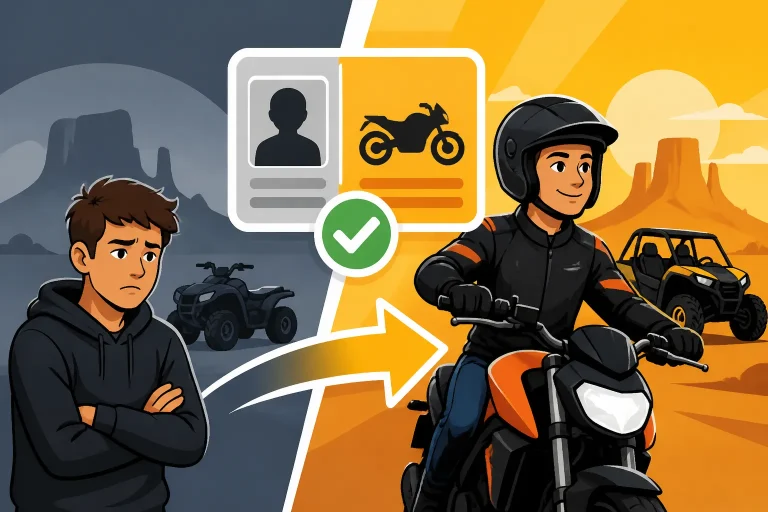
Where to Take a New Mexico OHV Safety Course
Finding a New Mexico OHV safety course can be confusing when course providers, safety permits and vehicle registration are all described as “permits.” The key is to use a course approved for New Mexico’s requirements and check whether the rider needs a safety permit before heading onto public land. Here’s how to find the right course, confirm it counts and keep proof ready for a ride.
Where to find a New Mexico OHV safety course
Start with the New Mexico Department of Game and Fish’s official OHV safety information. Use its current course links or instructions to identify an approved provider. The official agency page is the safest starting point because course options and acceptance requirements can change. A course advertised online as general ATV or UTV training may not meet New Mexico’s specific requirements.
Approved online courses are a convenient option for many riders. A student can usually work through the material at home and complete the course requirements online. Before enrolling, check that the provider is linked or recognized by the state, and that the course is intended to meet New Mexico’s OHV safety requirement. Don’t rely only on a search result, an old forum post or a provider’s claim that its course is accepted nationwide.
If you prefer instruction in person, check the state’s current course information or contact the agency to ask whether an in-person class is available. Local availability can vary, and a class that covers safe riding in general may not issue the New Mexico credential a minor needs. Confirm the course’s status before signing up.
A useful check before you begin is to compare the provider’s details with the state’s information about Approved Courses for a New Mexico Permit. If the provider or course name does not appear in the state’s current instructions, ask the agency to confirm it before paying or investing time.
What to check before enrolling
Make sure the course is right for the rider and the intended use. In particular, confirm:
- The course is approved or accepted for New Mexico’s OHV safety requirement.
- The rider’s age and any applicable exception are covered by the course information.
- The course provides a completion record or explains how the safety permit is issued.
- You know how to access or replace proof after completing the course.
- Any requirements for the rider’s machine or the land where it will be used are clear.
Course providers may describe a completion certificate, a safety card or a permit. Those terms can sound interchangeable, but they may refer to different steps. Follow the state’s process for obtaining the credential New Mexico requires, rather than assuming that a course-completion screen is all a rider needs to carry.
The state’s guidance on New Mexico OHV Safety Permit Requirements is a good place to confirm what the course must satisfy. For a closer look at who is covered, see New Mexico’s Safety Permit for Under-18 Riders.
Who needs the course and what the safety permit covers
New Mexico’s OHV safety course requirement is especially important for riders under 18 who operate an off-highway vehicle on public land. A young rider may need to complete an approved course and carry the resulting safety permit. The precise rules can depend on the rider’s age and qualifications, so check the current state requirements rather than relying on a general age rule from another state.
Do not confuse the safety permit with vehicle registration or a visitor’s OHV permit. They address different requirements:
| Item | What it relates to | What to check |
|---|---|---|
| OHV safety permit | A rider’s safety training and eligibility requirements | Whether the rider’s age and circumstances require one |
| OHV registration or decal | Registration of a New Mexico machine | Whether the vehicle is registered for the kind of riding planned |
| Nonresident OHV permit | Riding requirements for some visitors and out-of-state machines | Whether the machine’s home-state status qualifies for reciprocity |
Completing a safety course does not automatically register a vehicle, and vehicle registration does not necessarily satisfy a minor’s safety-training requirement. Visitors should also check whether their home-state registration is honored or whether they need a separate permit. New Mexico OHV Reciprocity Rules explains the difference between accepted out-of-state credentials and New Mexico’s visitor permit requirements.
The safety permit is tied to the rider, not simply to the ATV or UTV. A family should not assume that one child’s course completion covers siblings, or that a permit attached to one machine covers whoever rides it. Each young rider should have the required training and proof for their own situation.
Rules can also vary by rider qualifications. A driver’s license or motorcycle endorsement may affect whether a particular teen needs the course or permit, but don’t guess based on the wording on a license. Check the state’s current instructions for the rider’s age and credential. The information in New Mexico Safety Permit for a Minor can help families identify the questions to verify.
The course requirement is only one part of riding legally. Riders still need to follow machine, route and land-access rules. A registered OHV is not automatically allowed on every road or trail, and a safety permit does not grant access to private, tribal or restricted land. Check the rules for the specific place you plan to ride, including [New Mexico Rules for Riding a National Forest] or [New Mexico Rules for Riding BLM Land].
Riders who are renting or borrowing a machine
A rental or borrowed ATV does not remove the rider’s responsibility to meet applicable safety requirements. Before a minor rides, confirm with the rental business or machine owner what proof is needed and whether the rider is allowed to operate that vehicle under the company’s rules. Rental policies may be stricter than the minimum public-land requirement.
Also ask what permit or registration applies to the machine itself. A rental provider may handle some vehicle paperwork, but that does not necessarily mean it has arranged the rider’s safety credential. For a rented quad, review Riding a Rented Quad on New Mexico Public Land and ask the provider what it expects the rider to bring.
How to complete the course and prepare for a ride
Once you have confirmed that a course is approved, use the provider’s instructions from start to finish. Enter the rider’s details carefully, since errors in a name or date of birth can make it harder to match a completion record to the person riding. Save the confirmation and any completion documents as soon as the course is finished.
If the provider says a separate step is needed to receive the New Mexico safety permit, complete that step before the ride. Keep the course record and permit information together until you have confirmed which document or format is accepted as proof. If the rider’s status is unusual—for example, the teen has a license or endorsement, or the machine will be used in a special setting—ask the state agency to clarify the requirement.
A practical way to prepare is:
- Identify the rider’s age, qualifications and planned riding location.
- Check the state’s current safety-permit instructions for that rider.
- Choose a course that the state recognizes for New Mexico.
- Complete the course and follow any directions for receiving the permit.
- Save proof in an accessible format and carry it as directed.
- Check vehicle registration, visitor-permit rules and land access separately.
Before leaving, confirm how the rider should show proof during a roadside check. The state’s advice on Carrying the Safety Permit on a New Mexico Ride can help avoid relying on a document that is difficult to access without cell service. If proof is stored on a phone, consider keeping an offline copy and a paper backup where practical.
A course certificate is useful, but it does not answer every age question. Parents should check the minimum age and supervision rules that apply at the riding location. Start with [New Mexico Minimum Age to Ride Public Land] and verify any additional rules for a particular trail system or machine. The course itself also does not replace supervision where supervision is required.
Think about the ride as a complete set of checks, not just a course requirement. Confirm that the route is open to the type of OHV you plan to use, that the machine has the required registration or permit, and that the rider has any required safety credential. For visitors, New Mexico’s broad reciprocity rules may mean a separate permit is unnecessary in some situations, but that does not eliminate other riding rules. Review New Mexico’s Broad OHV Reciprocity if the machine is registered outside New Mexico.
If you cannot confirm whether a course counts, pause before enrolling or riding. Contact the agency using the current contact information on its official site and ask a specific question: whether the provider is approved, what proof the rider must carry, and whether the rider’s age or license changes the requirement. That short check is more reliable than assuming a course from another state, a school program or a rental counter satisfies New Mexico’s rules.
Disclaimer
This article is for general informational purposes only and does not constitute professional advice. Laws, prices and regulations vary by location and change over time. Consult a qualified professional for guidance on your specific situation.