Why the State Park Gate Turns You Away
Arriving at a New Mexico state park with an ATV or UTV and being turned away can feel confusing, especially when the park has wide-open desert or dirt roads nearby. The key distinction is that a park being open to visitors does not mean it is open for off-highway riding. This guide explains what the gate restriction usually means, what to check before unloading, and how to find an appropriate riding area instead.
Why a state park gate may turn OHV riders away
Park access is not the same as OHV access
A state park may welcome campers, boaters, anglers, hikers, and visitors traveling in ordinary road-legal vehicles while still prohibiting recreational ATV and UTV riding. A dirt surface does not automatically make a road an OHV route, and open-looking terrain is not permission to leave a road and ride cross-country.
That distinction catches people out. You might see a broad, sandy area from the entrance and assume there is room to ride. But the park’s land-use rules, signs, and designated routes determine where motor vehicles can go—not how open the landscape looks from the parking area. Why New Mexico State Parks Ban OHVs explains the broader reason for the restriction.
It also helps to separate two different questions: “Can I enter this park?” and “Can I ride my OHV here?” A park may allow you to visit or camp while requiring your ATV or UTV to stay on a trailer. A road-legal vehicle may be permitted on ordinary park roads, but that does not make the vehicle approved for trail riding or off-road use within the park.
A gate restriction may apply to riding, not every kind of visit
Being told that an OHV is not allowed does not always mean the entire park is closed to you. Staff may be explaining that the machine cannot be unloaded or ridden on park land. If you are towing a machine to a campsite, launching a boat, or visiting for another reason, ask what is allowed for your specific situation rather than assuming either that the whole visit is prohibited or that riding is permitted.
The difference matters at places such as Elephant Butte Lake State Park. Visitors may associate the area with open shoreline and nearby desert, but that does not make the park a designated ATV riding area. Why Elephant Butte Is Not a New Mexico Riding Area covers that common mix-up.
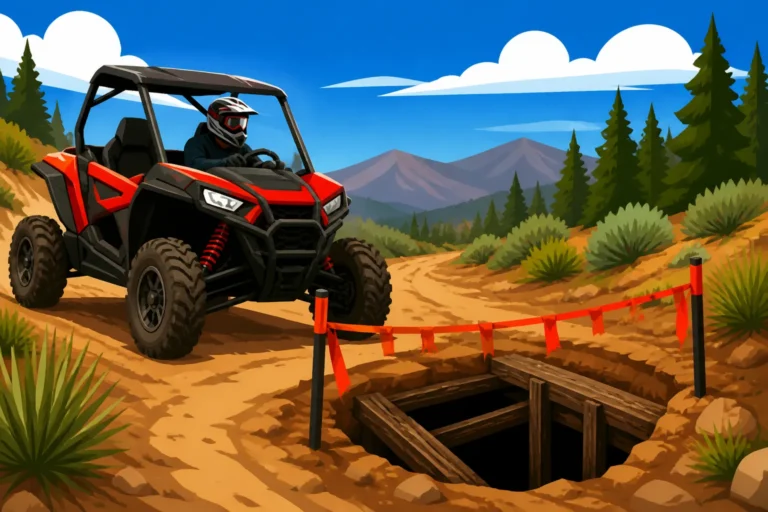
If a gate is closed or a sign says a road is restricted, do not drive around a barrier or follow another vehicle through. Closures can reflect land-use rules, safety concerns, seasonal conditions, or a route that is not open to public motorized use. Ask park staff which activities and roads are allowed, and where the park boundary ends.
The land beyond the park may have different rules
A state park can sit near federal, county, tribal, or private land. Seeing an OHV trail or dirt road nearby does not mean it belongs to the park—or that it is open to riding. Every land manager sets its own rules, and boundaries can be hard to recognize on the ground.
This is one reason a planned ride can unravel at the entrance. A route that looks connected on a phone map may cross from a state park onto BLM land, private property, or a road that is closed to motorized travel. Before unloading, identify the land manager for the exact route and check its current access rules. The guide Riding BLM Land Instead of Elephant Butte can help explain why land just outside a park may have a different access status.
What to check before you haul an ATV or UTV to a park
Confirm the activity and route, not just the park’s opening status
A park’s hours, campground availability, or general visitor information do not confirm that OHV riding is allowed. Look specifically for motorized-use rules, vehicle restrictions, designated routes, and any posted closures. If the information is unclear, contact the park and describe what you plan to do: bring the machine on a trailer, unload it, ride on a road, or use a nearby trail system.
Ask about the exact route rather than asking only, “Are ATVs allowed?” The answer may depend on whether you mean riding on a designated public road, operating off-road, crossing a road, or transporting the machine to a campsite. New Mexico Rules for Riding a State Park is a useful related read, but posted signs and park staff should guide decisions at the location you plan to visit.
Also check whether rules differ for an ATV and a side-by-side, whether a road is temporarily closed, and whether there are restrictions tied to an event or season. Do not assume that a route shown online is open simply because it appears on a map.
Use maps to plan, but verify the land manager’s information
Digital maps can help you understand the shape of an area, spot nearby roads, and build a rough route before you leave home. Tools such as onX Offroad can be useful for route-planning and for keeping track of where a planned ride may go. Still, a map is a planning aid—not permission to ride. Confirm access with the agency responsible for the land and follow posted signs at the trailhead.
When comparing a map with what you see on the ground, pay attention to the route’s legal status, not just its surface or line color. A road that looks passable may be closed to motorized use; a trail that appears to connect to another area may cross private land or a protected boundary. For background on how designated routes work, see Designated Routes and Travel Management in New Mexico.
Before the trip, save or note the official contact information and the permitted access point. Cell reception can be limited in riding areas, so it is sensible to have route information available offline as well. If an app and a sign disagree, do not treat the app as the deciding authority. Stop, check with the land manager, and choose a route you can confirm is open.
Separate park visits from riding-area plans
If your main goal is to ride, choose an established OHV area rather than hoping a park will allow it once you arrive. Start with Where to Ride an ATV in New Mexico and look for an area that fits your vehicle, experience, travel distance, and facilities needs. Verify current closures, access points, and any vehicle or permit requirements before making the drive.
A useful pre-trip check is:
- Identify the exact place where you intend to unload and ride.
- Confirm which agency or landowner manages that ground.
- Check whether the route is open to your type of machine.
- Read the access and safety rules, including any permit requirements.
- Confirm that the planned route does not cross a closed area or private boundary.
- Have a backup riding location in case of a closure.
A little checking can save a long drive with a trailer, a disappointed group, and the awkward question of where to go next. New Mexico Trail Maps Worth Carrying offers more context on planning routes and keeping useful map information at hand.
Common reasons riders get turned away
| What you see or hear | What it may mean | A sensible next step |
|---|---|---|
| The park is open, but the ATV cannot be unloaded | Visitor access is available, but recreational OHV riding is not authorized | Ask whether you may visit or camp while keeping the machine on the trailer |
| A dirt road appears to lead into open terrain | The road may not be an approved OHV route | Check signs and ask park staff or the land manager |
| A nearby trail shows on a map | The trail may be outside the park, closed, or on land with separate rules | Identify the landowner and confirm access before riding |
| A gate or barrier blocks the road | The route may be closed, restricted, or unsafe to use | Do not bypass it; ask about an alternate legal route |
| Another vehicle is driving on a park road | Its access does not necessarily authorize ATV or UTV trail riding | Follow the rules for your vehicle and intended activity |
The machine’s registration does not create riding access
Registration, a decal, or other required paperwork does not give a rider permission to use every public road or open-looking area. Those requirements address whether a machine or rider has met applicable obligations; land access is a separate question. A registered OHV can still be prohibited from a state park route.
The same goes for a permit that is valid for one kind of land or riding program. Do not assume it grants access to a state park, a neighboring parcel, or a route managed by another agency. Check both the machine-related requirements and the land-use rules for the place where you intend to ride.
If you are visiting from outside New Mexico, check the rules that apply to visitors as well. [New Mexico Rules for Riding Federal Land] is relevant when your planned route is on federal ground, but it does not replace the rules for state parks or other land managers.
How to handle a turn-away and find a better option
Stay calm and get a clear explanation
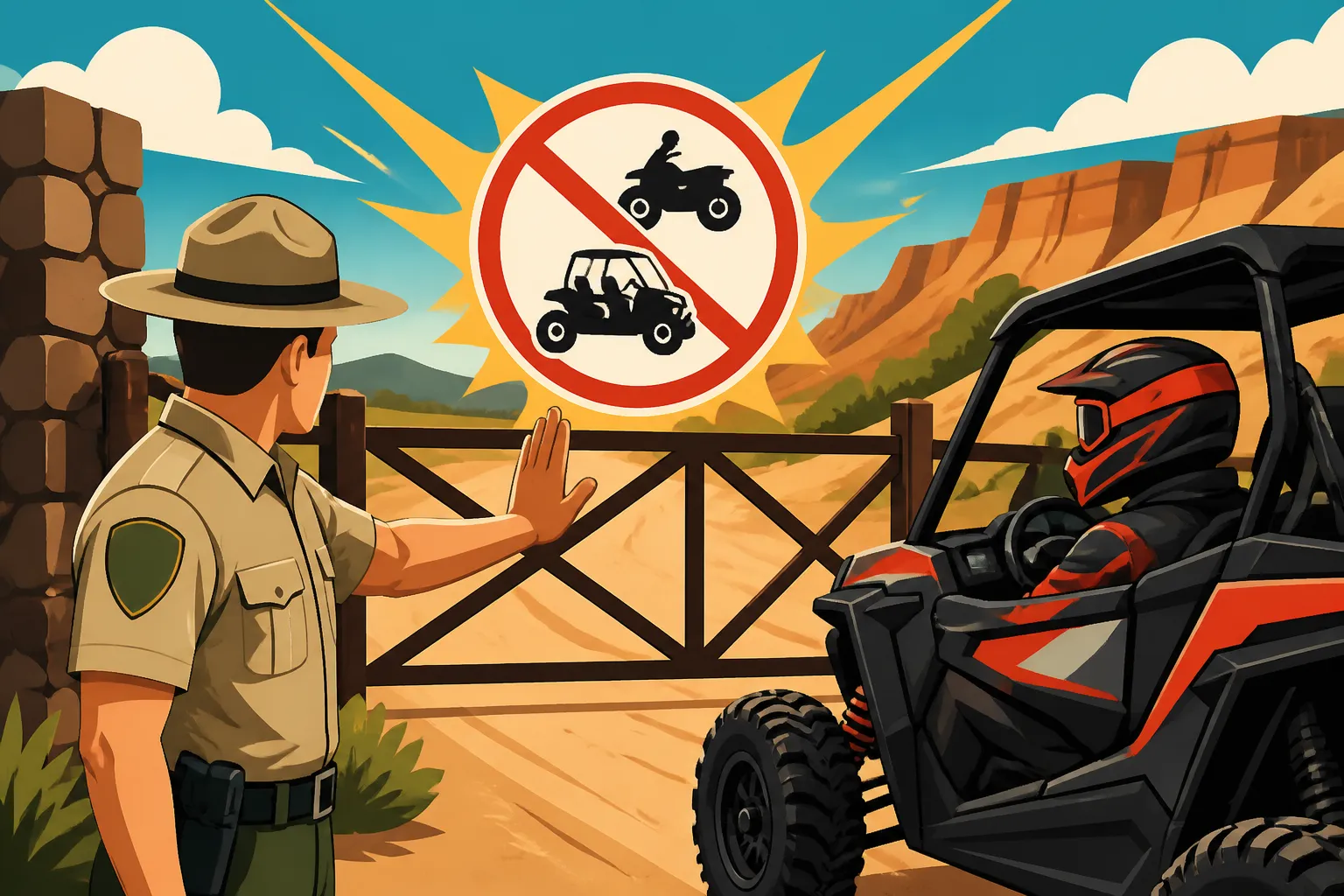
A gate interaction can be frustrating, particularly after hours on the road. Keep the conversation practical: explain whether you are trying to enter, camp, unload, or ride, then ask which rule or boundary applies. Staff may be able to clarify whether the restriction covers the entire visit, only OHV operation, or a specific road.
Do not argue from what you saw on a map or from what another rider said. Rules can vary between nearby areas, and access may change at a boundary. If the staff member points you toward another riding area, ask for the correct entrance and whether there are restrictions you should know before driving there.
If you are asked to turn around, do so safely and without blocking the entrance. Then check your route and choose a confirmed alternative. Continuing past a gate, riding around a barrier, or unloading outside the designated area can turn a disappointing trip into a citation, a trespass problem, or a safety issue.
Pick an alternative based on your actual ride
Not every riding area is right for every machine or group. A wide side-by-side may need routes with enough width and turning room. A beginner may be happier on clearly marked, less demanding trails than on steep or technical terrain. A family may care more about nearby facilities and easy access than about covering the greatest distance.
Use New Mexico OHV Areas Near Las Cruces or another location-specific guide as a starting point if you are planning around a particular city. Then confirm the route and access details with the responsible land manager. Conditions such as fire restrictions, weather, road work, or seasonal closures can affect a trip even when an area is normally used for OHV recreation.
Keep a backup in mind, especially when traveling far from town. The closest alternative on a map may not be the best one if it has a different vehicle limit, access point, or surface. Check the details before you commit to the drive.
Make the next trip easier with a simple verification routine
Before loading the trailer, write down the intended riding area, entrance, and route. Check official park or land-manager information for motorized access, then use an app such as onX Offroad as a supplemental planning reference—not as the final word on whether a trail is open. If you cannot confirm that a route is legal for your machine, choose a route you can verify.
At the destination, read signs before unloading and confirm that you are on the correct side of any boundary. Keep your registration and any required permits accessible, but remember that paperwork does not override a closure or land-use rule. These small steps make the gate conversation less stressful and help ensure that your riding day starts at a place intended for OHVs.
Disclaimer
This article is for general informational purposes only and does not constitute professional advice. Laws, prices and regulations vary by location and change over time. Consult a qualified professional for guidance on your specific situation.