New Mexico Registration for a Ranch Machine
It can feel like a real head-scratcher when you've got an ATV or UTV that rarely, if ever, leaves the ranch, yet you hear whispers about needing to register it with the state. "Why in the world would I need to register a machine that only touches my own dirt?" you might wonder. It's a valid frustration, and frankly, it's a question many New Mexico ranch and farm owners grapple with. This guide is here to untangle the complexities of New Mexico's OHV registration laws specifically for those workhorse machines that are integral to daily ranch operations, helping you understand when and why registration becomes essential, even for those "private land only" scenarios.
Understanding the "Why" Behind Ranch Machine Registration
For many ranch owners, an ATV or UTV isn't a recreational toy; it's a tool, plain and simple. It's used for checking fences, herding livestock, hauling feed, or simply getting across vast expanses of private land. The idea of registering it, like you would a passenger car, can seem completely counterintuitive. However, New Mexico's laws cast a wide net, and understanding the state's perspective can help clarify why your trusty ranch machine might need a little paperwork.
The Myth of "Private Land Only" Exemption
The biggest misconception out there is that if your machine never leaves your private property, you're automatically exempt from registration. While there's a kernel of truth to that for truly isolated scenarios, the reality for most working ranches is far more complex. It's rare for a ranch machine to never interact with public infrastructure or land. Think about it: Do you ever cross a county road, even for a few yards, to access another part of your property? Do you ever trailer your machine on a public highway to get it from the main ranch house to an outlying pasture? Do any of your grazing allotments fall on Bureau of Land Management (BLM) land or State Trust Land, even if it's just a sliver?
Any of these seemingly minor interactions with public roads or land can trigger the need for registration. The state isn't necessarily trying to track your every move on your own acreage, but rather to ensure accountability, aid in theft recovery, and provide a framework for machines that could potentially be on public ground. This is especially true for theft, where a registered VIN makes it much easier for law enforcement to track and return stolen property. It's about preparing for those "just in case" moments rather than just the day-to-day.
Funding Trails and Supporting OHV Infrastructure
Another important aspect, often overlooked by those who primarily use their machines for work, is how registration fees contribute to the broader OHV community in New Mexico. When you register an OHV, a portion of those fees goes directly into a fund managed by the New Mexico Department of Game and Fish. This fund is crucial for maintaining and improving public OHV trails, developing staging areas, providing signage, and supporting safety and education programs across the state.
Even if you, as a rancher, aren't regularly out exploring the scenic trails of the Carson National Forest or tearing up the dunes at Mescalero Sands, your registration still plays a vital role. It contributes to the infrastructure that benefits other riders, which in turn helps ensure the long-term viability and good standing of OHV recreation throughout New Mexico. It's a collective effort, and everyone who owns a machine that might touch public land, even indirectly, is asked to chip in. For more details on where this money goes, you can look into [Where New Mexico OHV Fees Go].
When Does a Ranch Machine Need New Mexico Registration?
This is the million-dollar question for many ranch owners. It boils down to one primary factor: any interaction with "public" spaces, however brief or unintentional it might seem. It's easy to assume your property lines are a hard and fast boundary for state regulations, but in practice, the lines can blur quickly.
Riding on Public Roads or Land
Let's break down the common scenarios where your ranch machine, despite its primary use, would absolutely require New Mexico OHV registration. If your ATV or UTV ever leaves the confines of your wholly private property to:
- Cross a county road: Even if it's just a quick dash from one side of your property to another where a county road bisects it, that momentary exposure to public right-of-way usually means you need to be registered. This isn't about lengthy joyrides, but rather acknowledging the public nature of the road itself.
- Access grazing allotments on public land: Many ranches utilize grazing permits on federal lands, like those managed by the Bureau of Land Management (BLM), or on State Trust Land. If you ride your machine onto these public lands to check fences, move cattle, or access water sources, it must be registered. These are not private roads, even if they feel like an extension of your ranch. You can find more information on specific rules for these areas in [New Mexico Rules for Riding a County Road] and [New Mexico Rules for Riding BLM Land].
- Use roads or trails on Forest Service land: Similar to BLM land, if your ranch borders or includes access to National Forest lands, and you use your machine on designated roads or trails within those boundaries, registration is required. Even if you consider it "your" area for ranching, the Forest Service views it as public land.
These scenarios, which are commonplace for working ranches, move your machine out of the "strictly private" category and into the realm of state oversight. It's about legal compliance and ensuring that if an incident occurs on public ground, your machine is properly identified.
Trailering on Public Highways
This is another major area of confusion. Many ranchers believe that as long as they aren't riding their machine on public roads, they don't need to register it. However, if you transport your ATV or UTV on a trailer behind your truck on any public highway, interstate, or paved county road in New Mexico, the machine itself is typically required to be registered.
Why? Because the state wants to ensure proper identification for all vehicles that move on public roads. If your trailer unhitches, or if you're involved in an accident, law enforcement needs to be able to identify the OHV being transported. A registration helps establish a clear chain of custody and ownership. This means even if your side-by-side only sees dirt once it's off the trailer and deep on your ranch, the act of getting it there via public roads often necessitates registration. It's a common oversight, but one that can lead to fines if you're stopped and your machine isn't properly registered.
Selling the Machine Later On
Even if you somehow manage to keep your ranch machine entirely off public land and only trailer it on private property (a truly rare feat for most operations!), you might still consider registration for future dealings. Eventually, you might want to upgrade, downsize, or pass the machine on to a new owner. Trying to sell an OHV that has never been registered or titled can be a headache, both for you and the potential buyer.
A clear title and current registration prove legitimate ownership and can significantly streamline the sales process. Buyers, especially those who plan to use the machine recreationally or on other properties, will almost certainly require proof of ownership and a clear title. Having these documents in order from the start avoids last-minute scrambling and potential delays. When drawing up a private sale, a solid bill of sale is essential for both parties, and resources like LawDepot can provide customizable templates to ensure all legal bases are covered. Having all your ducks in a row with the MVD also smooths the transfer, preventing questions about provenance. For guidance on sale documents, you can refer to [A New Mexico Bill of Sale for an ATV].
The Registration Process for a Ranch Machine
Registering your ranch machine with the New Mexico Motor Vehicle Division (MVD) isn't overly complicated, but it does require attention to detail and the right paperwork. Thinking of it as a necessary step for maintaining your ranch's operational integrity can make the process feel a bit less burdensome.
Gathering Your Paperwork
Before you even think about heading to the MVD office, you'll need to gather a specific set of documents. Having everything in order beforehand can save you multiple trips and a lot of frustration. Here's what you'll typically need:
- Proof of Ownership: This is paramount. Ideally, this would be the manufacturer's statement of origin (MSO) if the machine is new, or the vehicle's title if it's been previously owned. If you bought it used from a private party, a notarized bill of sale is crucial, clearly identifying the machine by its Vehicle Identification Number (VIN) and signed by both buyer and seller. If the machine has been in your family for generations and original paperwork is lost, this can get trickier and might require a bond or a court order to establish ownership, so it's always best to try and track down any existing documents.
- Proof of Identity: Your valid driver's license or state-issued ID.
- VIN Verification: Sometimes an MVD agent will perform a VIN inspection on-site, but in other cases, especially if there's any ambiguity about ownership history, you might need to have law enforcement or an authorized MVD inspector verify the VIN. It's always a good idea to call your local MVD office ahead of time to confirm their specific requirements.
- Application Form: The MVD will have a specific application form for OHV registration that you'll need to complete.
Ensuring a clear chain of ownership is vital. If you've just acquired a machine for the ranch, perhaps from an auction or a less formal private sale, make sure you have solid proof. Tools like LawDepot can assist in generating legally sound bills of sale or affidavits to help document ownership, minimizing potential hurdles at the MVD. Having all your [New Mexico OHV Registration Paperwork] organized, alongside understanding [New Mexico OHV Title Requirements], will make a huge difference.
Visiting the MVD Office
Once your paperwork is meticulously gathered, your next step is to visit a New Mexico MVD office. Unlike some other states where OHV registration might be handled by parks departments or game and fish agencies, in New Mexico, it's all through the MVD, just like your car or truck. This simplifies things by keeping all vehicle-related services under one roof. For a clearer picture on why this is the case, see [Why MVD Registers New Mexico OHVs].
When you arrive, you'll submit your application and documents to an MVD agent. They will review everything, check the VIN, and process your payment for the registration fee. The initial registration fee is usually a bit higher than a renewal, as it covers the administrative costs of setting up a new record. After everything is processed and approved, you'll receive your registration certificate and the appropriate OHV decal. Remember to ask any questions you have during this visit; the MVD staff can clarify any specific situations related to ranch use. This whole process is detailed further in [New Mexico OHV Registration at MVD].
Decals and Placement
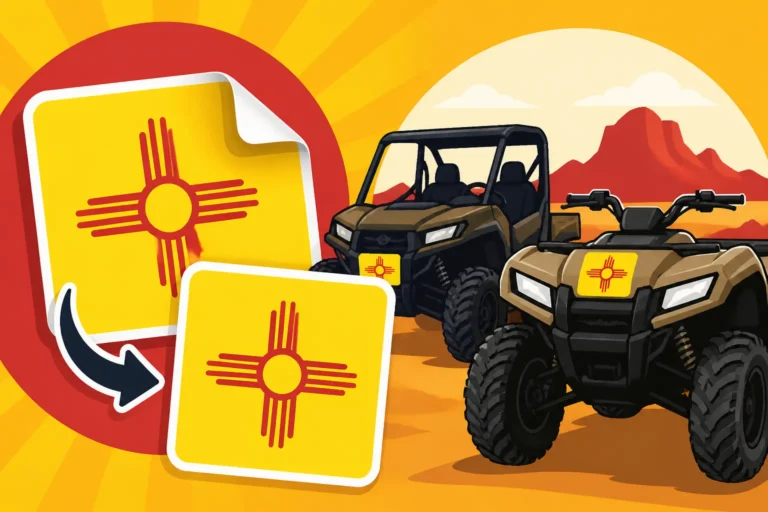
Once your ranch machine is registered, you'll be issued a decal. New Mexico uses two main types of decals for OHVs, and understanding the difference is crucial for ranch machines:
- Yellow Off-Highway Decal: This is the most common decal for machines that will primarily be used off-road. It signifies that your machine is registered for off-highway use only. For most ranch machines that might occasionally cross a dirt county road or operate on BLM grazing land, this yellow decal is typically what you'll need. It clearly marks your machine as registered within the state's system. More information on this can be found in [New Mexico's Yellow Off-Highway Decal].
- Green On and Off-Highway Decal: If your ranch machine will regularly operate on paved public roads (not state highways or interstates, but paved county or city roads where allowed), you'll need this green decal. This signifies that your machine is equipped and registered for both on-highway and off-highway use. This is often accompanied by the need for a paved road plate, which we'll discuss next. For specifics, refer to [New Mexico's Green On and Off-Highway Decal].
Regardless of which decal you receive, proper placement is essential for compliance. For ATVs and quads, the decal typically goes on the left rear fender. For side-by-sides (ROVs/UTVs), it's usually on the left-hand side of the rear quarter panel. Dirt bikes require placement on the left fork leg. The key is to ensure it's clearly visible and securely affixed. Given the rough and tumble nature of ranch work, choose a spot that won't easily get obscured by mud or brush. The general guidelines for this are found in [New Mexico OHV Decal Placement Rules].
What About the Paved Road Plate for Ranch Machines?
While most ranch machines will spend their lives on dirt, gravel, or across open pastures, there are specific situations where a paved road plate becomes a necessity. This is particularly true if your ranch operations require you to travel along public paved roads for any significant distance, rather than just a quick perpendicular crossing.
When a Paved Road Plate Becomes Necessary
The distinction between merely crossing a paved road and riding along it is critical. New Mexico law allows for perpendicular crossings of public paved roads (excluding state highways and interstates) without a paved road plate, as long as you stop, yield to traffic, and cross at the nearest safe and practicable point. However, if your ranch activities involve using a paved county road or an approved city street to get from one part of your property to another, or to access a specific gate, then your machine needs to be street legal for that specific use.
This means obtaining a paved road plate in addition to your green on/off-highway decal. This plate is your permission slip for limited paved road use. It's a significant step beyond basic off-highway registration and comes with its own set of responsibilities and requirements. If you intend to operate your ranch machine on any public paved road for travel, no matter how short the distance, a paved road plate is typically your legal pathway. For more details, consult [New Mexico's Paved Road Plate] and [New Mexico Paved Road Plate Requirements].
Additional Requirements for Paved Road Use
It's important to understand that getting a paved road plate isn't just about the plate itself. It's a package deal that includes several other crucial requirements to ensure safety on public roadways:
- Equipment Upgrades: Your ranch machine will need to meet specific equipment standards. This typically includes working headlights (visible for at least 150 feet), taillights (visible for 200 feet), brake lights, turn signals (if legally required for a specific type of OHV in that jurisdiction), a horn, and at least one rearview mirror. While these might seem excessive for a work vehicle, they're standard safety features for road-legal vehicles.
- Liability Insurance: New Mexico requires proof of financial responsibility (i.e., liability insurance) for any vehicle operating on public paved roads. This means your ranch machine will need an OHV-specific insurance policy that meets the state's minimum coverage requirements. This insurance protects you and others in case of an accident.
- Driver's License: The operator of the machine on public paved roads must possess a valid driver's license.
- Safety Requirements: While helmets aren't universally mandated for adults on off-road trails, they are generally required for anyone under 18. However, for paved road use, specific regulations might apply regardless of age, so it's always best to err on the side of caution. Eye protection is typically mandatory at all times on public roads.
Failing to meet any of these requirements while operating on paved roads can result in citations and fines. It's a more stringent set of rules designed for mixed traffic environments. You can review [New Mexico Equipment Rules for Road Use] and [New Mexico ATV Insurance Requirement] for a deeper dive into these regulations. Should you need to document compliance or understand liability in these scenarios, LawDepot offers resources that can assist with legal documentation.
Specific Scenarios and Exemptions for Ranchers
The regulations around OHVs can sometimes feel like a puzzle with missing pieces, especially when trying to apply them to the unique context of a working ranch. Let's look at some specific scenarios and address common questions ranchers have about exemptions and unusual situations.
Ranch-Only Machines That Don't Need Registration
So, can a ranch machine truly remain unregistered in New Mexico? The short answer is yes, but the criteria are extremely strict and often don't apply to the average working ranch. For an OHV to be truly exempt from state registration, it must meet all of the following conditions:
- Never Leaves Private Property: The machine must never be operated on any public land (BLM, Forest Service, State Trust Land), nor on any public road (county, city, state highway) – not even for a quick crossing.
- Never Trailered on Public Roads: The machine must never be transported on a trailer or in the back of a truck on any public road. This means if you move it from one part of your ranch to another via a public highway, it would need registration.
- No Public Access: There must be absolutely no scenario where the machine could be confused for a public-use vehicle or interact with the public infrastructure.
In essence, this exemption is for machines that are permanently enclosed within a private property boundary, never crossing external roads or being transported. While theoretically possible, it's often an impractical reality for most working ranches that need to transport equipment or access scattered parcels. The question [Must a Ranch-Only Machine Still Be Registered?] explores this exact dilemma, often concluding that for peace of mind, registration is usually the safer bet.
Agricultural Use Considerations
You might assume that because your ATV or UTV is used exclusively for agricultural purposes, it would automatically fall under some kind of farm equipment exemption, similar to a tractor. While some states have specific carve-outs for farm vehicles, New Mexico's OHV registration laws are quite broad and generally apply to any off-highway vehicle, regardless of its primary use.
This means that simply being used for ranching or farming doesn't, by itself, exempt your ATV or UTV from registration if it meets the criteria for public land or road use as described above. If your "farm machine" crosses a county road to check crops, access a feedlot, or inspect irrigation, it's typically subject to the same registration rules as a recreational quad. The intent of the machine owner (work vs. play) often takes a backseat to the location of its operation when it comes to registration. Always assume registration is required if there's any chance of it interacting with public access points.
Inherited or Older Machines
One common hurdle for ranch owners is dealing with older machines that have been passed down through generations. The original title or manufacturer's statement of origin might be long lost, making the registration process feel impossible. Don't despair, but do be prepared for some extra legwork.
If you don't have a title, you'll need to establish proof of ownership. This can involve:
- Bill of Sale: If you received the machine as a gift or bought it informally years ago, a formal, notarized bill of sale from the previous owner (if they can be found) is invaluable. LawDepot can provide blank bill of sale forms that can be customized and notarized.
- Affidavit of Heirship: If the machine was inherited, an affidavit of heirship or other legal documents proving your right to the property might be necessary.
- Bonded Title: In some cases, if you can prove you've made a good faith effort to locate the previous owner and original title, the MVD may allow you to apply for a bonded title. This involves purchasing a surety bond for a certain value, which protects the state and any previous unknown owners in case a claim arises.
- VIN Inspection: For older machines, a thorough VIN inspection by law enforcement is often required to ensure it's not stolen and to accurately identify the vehicle.
It's a more involved process than registering a new machine with a clear MSO, but it's not insurmountable. The MVD wants to ensure legitimate ownership before issuing a title or registration. For those looking to register a machine that's been passed down, [Registering an Inherited Machine in New Mexico] offers specific advice.
| Usage Scenario | New Mexico Registration Required? | Yellow Off-Highway Decal? | Green On/Off-Highway Decal? | Paved Road Plate? | Insurance Required? |
|---|---|---|---|---|---|
| Exclusively on Private Land | No (if truly isolated) | No | No | No | No |
| Crossing Paved County Road | Yes | Yes | Optional | No (for crossing) | No (for crossing) |
| Riding Along Paved County Rd | Yes | No | Yes | Yes | Yes |
| BLM/Forest Service Land | Yes | Yes | No | No | No |
| Trailering on Public Highway | Yes | Yes | No | No | No |
| Selling to New Owner | Recommended (for smooth transfer) | Yes | As applicable | As applicable | No (unless road use) |
Disclaimer
This article is for general informational purposes only and does not constitute professional advice. Laws, prices and regulations vary by location and change over time. Consult a qualified professional for guidance on your specific situation.