Crossing a Highway on an ATV in New Mexico
It’s a scenario many of us New Mexico ATV and UTV enthusiasts have faced: you’re out enjoying some incredible trails, maybe exploring some of the vast open lands that make our state so special, and suddenly, you hit a paved road – specifically, a highway – that you need to cross to get to the next section of your adventure. The pavement looms, and instantly, you’re hit with uncertainty. Can you cross it? What are the rules? Is it even legal? It’s a frustrating moment that can stop a great ride cold. This guide is here to clear up that confusion, lay out New Mexico’s specific rules for crossing highways on your off-highway vehicle (OHV), and help you navigate these situations safely and legally.
Understanding the Core Challenge: Highway Versus Street
When we talk about riding an ATV or UTV on a paved surface in New Mexico, it's really important to distinguish between a "street" and a "highway." Many riders lump them all together, but the law definitely doesn't. And getting this distinction wrong can lead to a lot more than just a ruined ride – it can mean hefty fines and even putting yourself and others in serious danger.
Why Highways Are Different from Other Roads
Think about the highways we drive every day in our cars – US-285 heading south from Santa Fe, or NM-70 cruising out of Las Cruces towards White Sands. These aren't your typical county roads or city streets. Highways are designed for high-speed traffic, often with multiple lanes, limited access points, and drivers who are generally not expecting to see an OHV, especially one crossing their path. The speed differential alone is a massive safety concern. A vehicle traveling at 65-75 mph has very little time to react to an ATV attempting to cross, and your ATV, even if it's a powerful side-by-side from, say, SuperATV, isn't built to accelerate quickly enough to safely clear that kind of fast-moving traffic.
Furthermore, state highways, and especially interstates, are usually under state or federal jurisdiction, meaning they have different rules than the local roads that cities and counties might open up for OHV use. While a county might pass an ordinance to open certain paved county roads, that authority generally doesn't extend to state highways. This legal framework is a big reason why crossing them isn't as simple as, say, cruising down a quiet neighborhood street in a town that allows OHVs.
The "Street Legal" Myth Versus Reality
There's a lot of chatter out there about making ATVs and UTVs "street legal" in New Mexico. And it's true, New Mexico does have an option for OHVs to gain limited access to paved county roads and city streets with the proper registration, decals, and equipment. However, this "street legal" designation, which involves getting the green on-highway decal, does not magically open up all state highways for casual travel. It's a critical point of confusion for many riders.
The state's intent with the green decal is to allow riders to connect trails, access services, or travel short distances on specific local roads that have been explicitly opened by local ordinances. It's not a green light to take your side-by-side on US-54 or I-25. So, while you might have all the right lights, mirrors, and even a driver's license, the "street legal" status in New Mexico is strictly defined and generally excludes state highways from general OHV travel, even for connecting purposes, except under very specific crossing conditions. This is where [Why New Mexico State Highways Are Off Limits] becomes important.
Safety Concerns on High-Speed Roads
Let's be brutally honest: safety is the absolute top priority. Riding an OHV on a highway, even for a brief crossing, inherently carries significant risks. The vehicles are designed for off-road conditions, not the smooth, high-speed flow of highway traffic. Your tires might not have the same grip on asphalt, your suspension is built for bumps, not stability at speed, and your machine's visibility to other drivers is dramatically lower than a full-sized car or truck.
Imagine you're trying to cross US-70 east of Alamogordo. That's a stretch of highway where vehicles are moving incredibly fast. If you misjudge the speed of an approaching vehicle, or if a driver isn't paying full attention, the consequences can be catastrophic. The compact size of an ATV, combined with its slower acceleration compared to highway traffic, makes it incredibly vulnerable. Even with all the required equipment, the sheer difference in speed and mass makes any interaction with highway traffic extremely dangerous. This is precisely why the law is so restrictive about these types of crossings.
New Mexico's Specific Crossing Rules
Alright, let's get down to the brass tacks of what New Mexico law actually says about crossing highways. It's not a free-for-all, but there are specific, tightly defined conditions under which you can perform a highway crossing. Ignoring these rules isn't just illegal; it's genuinely dangerous.
The Perpendicular Crossing Mandate
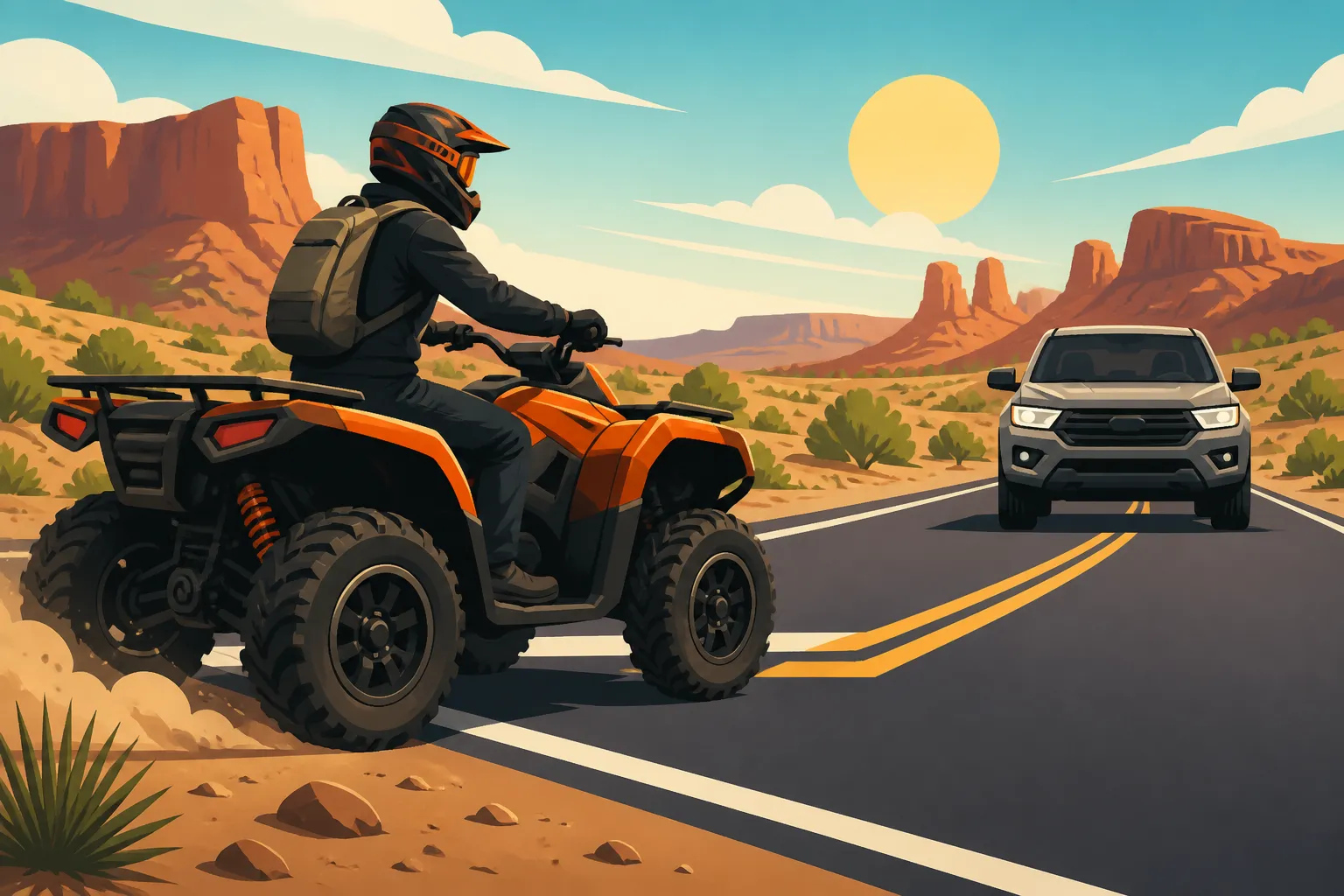
This is perhaps the most crucial rule to understand: New Mexico law specifically states that an OHV may cross a highway perpendicularly. What does "perpendicularly" mean in practice? It means you drive straight across the road, at a 90-degree angle to the flow of traffic. You are not allowed to drive down the highway, even for a short distance, to reach a crossing point. You can't merge into traffic, travel a hundred feet, and then turn off. You approach the edge of the paved highway, you wait for a safe opening, and you drive directly across to the other side. Think of it like a pedestrian crossing a street at a crosswalk, not a car turning onto a main road. This is covered in detail by [New Mexico's Perpendicular Crossing Rule].
The purpose of this rule is to minimize your exposure to high-speed traffic. By crossing directly, you spend the least amount of time on the actual paved surface and prevent yourself from becoming a slow-moving obstacle in a traffic lane. It forces you to get off the highway as quickly as possible. This also means you need to plan your route carefully so that your off-road trail on one side lines up as directly as possible with your intended trail on the other. You can’t just stop at any point and decide to cross; you need a safe, clear line of sight and a direct path.
Stopping and Yielding Before Crossing
Before you even think about putting a tire on that pavement, New Mexico law requires you to stop. And I mean a complete stop, just like you would at a stop sign. You must yield to all oncoming traffic on the highway. This isn't a suggestion; it's a legal mandate and a fundamental safety practice. You need to assess the traffic in both directions thoroughly. Are there any blind spots? Is there a crest in the road? Is the sun in your eyes, or in an approaching driver’s eyes?
Don't assume approaching vehicles will see you or slow down. They won't be expecting you. It's your responsibility to ensure the crossing is clear before you proceed. This might mean waiting for several minutes, or even longer, if it’s a busy highway. Patience is absolutely critical here. Rushing this step is a recipe for disaster. Think about what a New Mexico officer would check if they caught you: [Stopping Before You Enter a New Mexico Roadway]. Take your time, look, look again, and only proceed when you are absolutely certain it is safe.
Highways You Absolutely Cannot Cross (Interstates)
While the perpendicular crossing rule applies to many state highways, there's a crucial exception that you absolutely cannot ignore: interstates. You cannot ride an OHV on, or even cross, any interstate highway in New Mexico. This includes I-10, I-25, and I-40. These are federal arteries designed for extremely high-speed, controlled-access traffic, and OHVs are expressly prohibited.
This prohibition extends beyond just riding on the interstate. You cannot cross an interstate, even perpendicularly, where there's an underpass or overpass, unless you are doing so in a vehicle legally permitted on the interstate (like trailering your OHV). Attempting to cross an interstate, even if it seems like a quick dash, is incredibly dangerous and comes with severe penalties. These roads are simply not designed for OHV interaction, and the risk to yourself and others is astronomically high. Familiarize yourself with [Freeways New Mexico Riders May Not Cross] to avoid these areas entirely. There’s no legal loophole or special decal that allows OHV access to interstates.
Required Equipment for Crossing
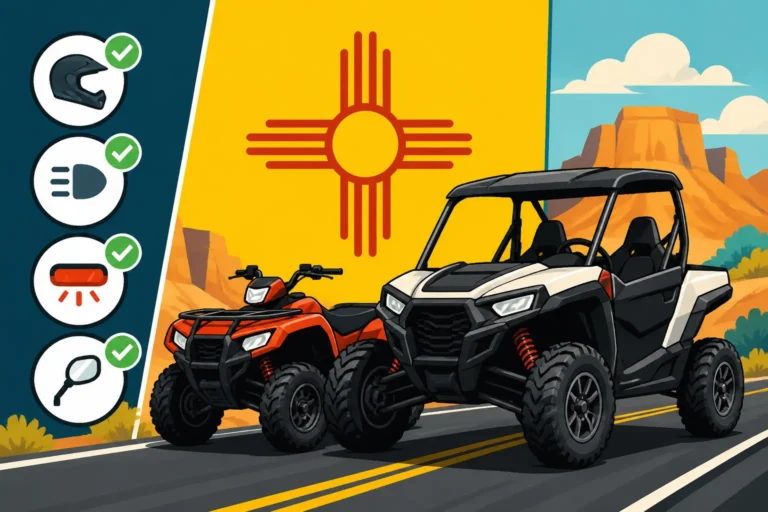
Just having a running ATV or UTV isn't enough to legally and safely cross a New Mexico highway. Your machine needs to be equipped with certain safety features that improve visibility and control, especially when you're interacting with faster-moving traffic. Think of these requirements not as nuisances, but as vital safeguards for everyone on the road.
Headlights and Taillights for Visibility
Visibility is paramount, especially if your crossing happens near dusk, dawn, or under adverse weather conditions. New Mexico law requires your OHV to have both a headlight and a taillight that meet specific visibility standards. Your headlight needs to be able to illuminate objects at a distance of at least 150 feet in front of your machine. The taillight, on the other hand, must be visible from a distance of 200 feet from the rear. These aren't just for riding at night; they significantly increase your presence to drivers even during daylight hours.
Many aftermarket accessories are available to upgrade your lighting, but make sure they meet these minimum standards. A dim, old headlight bulb might be fine for cruising a dirt trail, but it won't cut it when you're momentarily on a highway. Companies like SuperATV offer a range of robust lighting solutions that can easily meet or exceed these requirements, providing excellent visibility. Before you head out, do a quick check to make sure both your headlight and taillight are clean, fully functional, and bright enough. Don't just assume they work; actively test them. For more details on these requirements, see [New Mexico Headlight and Taillight Rules].
Mirrors and Brakes: Essential Safety Gear
Just like any other vehicle on the road, your OHV needs to be equipped with proper mirrors and functional brakes. A rearview mirror is crucial for scanning traffic behind you as you prepare for your crossing. While some off-road machines come with basic mirrors, consider upgrading to larger, more stable mirrors that provide a clearer, wider field of view. On a highway, every bit of information about your surroundings is valuable.
Your brakes, of course, must be in good working order. This sounds obvious, but off-road riding can put a lot of stress on braking systems. Before any ride that might involve a highway crossing, give your brakes a thorough check. Do they engage firmly? Is there any sponginess? Are your brake lights working? The ability to stop quickly and reliably is non-negotiable when you're dealing with traffic. New Mexico law mandates functional brakes for a reason. Make sure your machine meets these criteria by checking [Mirrors and Brakes for New Mexico Road Use].
The Importance of a Spark Arrester
While not directly tied to road safety in the same way lights and mirrors are, a properly functioning spark arrester is a legal requirement for riding on most public lands in New Mexico, including federal lands like National Forests and BLM areas. If the trails you're connecting via a highway crossing are on public land, then having a spark arrester is non-negotiable.
A spark arrester prevents incandescent particles from escaping your exhaust, which could otherwise ignite dry vegetation and cause devastating wildfires. In New Mexico, especially during dry seasons, wildfire prevention is taken very seriously. An officer checking your OHV at a roadside stop might well check for a spark arrester. So, while it won't help you see traffic, it's a vital piece of equipment for legal and responsible riding in our beautiful, often arid, state. Don't overlook it. Learn more about its importance at [Spark Arresters on New Mexico Public Land].
| Equipment Item | New Mexico Requirement | Purpose |
|---|---|---|
| Headlight | Visible 150 feet forward | Illuminate path, increase visibility to oncoming traffic |
| Taillight | Visible 200 feet to the rear | Increase visibility to following traffic |
| Rearview Mirror | At least one, providing clear view to the rear | Monitor traffic from behind when preparing to cross |
| Brakes | Fully functional, capable of stopping machine | Essential for control and safe stopping in traffic situations |
| Spark Arrester | US Forest Service approved (for public land use) | Prevents wildfires, required on most public lands |
| Muffler | Effective in limiting noise to 96 decibels or less | Reduces noise pollution, important for community relations |
| Horn | Audible from 200 feet | Alert pedestrians or other vehicles to your presence |
Note: Always check the latest New Mexico statutes and local ordinances for the most current and specific equipment requirements.
Rider Requirements for Crossing
It's not just your machine that needs to be up to snuff; you, the rider, also have responsibilities and requirements that must be met to legally cross a highway in New Mexico. These rules are in place to ensure you have the necessary skills, awareness, and documentation to operate an OHV, especially when interacting with public roads.
Driver's License and Age Considerations
To operate an OHV on any public road in New Mexico, including for a highway crossing, you generally need to possess a valid driver's license. This means you need to be at least 16 years old and have successfully passed the state's driver's license examination. This isn't just a formality; it means you've demonstrated a basic understanding of traffic laws and safe driving practices, which are absolutely crucial when you're briefly sharing space with cars and trucks.
For younger riders, the rules are even more stringent. While New Mexico has specific regulations for minors riding OHVs off-road, those rules change significantly when any part of the ride involves a public road. A provisional license for a 15-year-old generally wouldn't qualify for this purpose unless it specifically grants the right to operate an OHV on public roads under specific conditions. Always confirm the exact age and licensing requirements before allowing a minor to attempt a highway crossing. The bottom line is that operating an OHV on a public road, even briefly, falls under the realm of licensed driving. For more on this, check out [A Driver's License on a New Mexico Paved Road].
Helmet and Eye Protection Rules
New Mexico has clear helmet laws for OHV riders. If you're under 18 years old, wearing an approved helmet is mandatory at all times when riding an OHV, whether on-road or off-road. But here’s the kicker: when operating an OHV on any paved public road, all riders, regardless of age, are required to wear eye protection. This means goggles, a face shield on a helmet, or some other form of protective eyewear.
Think about it: at even low speeds, a rock, insect, or piece of debris kicked up by a passing vehicle can cause serious injury and instant loss of control. Eye protection shields you from these hazards. While an adult might choose to forgo a helmet on a dirt trail (where it's not legally mandated for those over 18), the moment you touch pavement for a highway crossing, eye protection becomes a legal necessity for everyone on the machine. Don't risk your vision or a citation. [New Mexico Helmet Law for ATV Riders] provides more specifics.
Carrying Proof of Registration and Insurance
You might be thinking, "It's just a quick hop across the highway, do I really need all my paperwork?" The answer is a resounding yes. If you're going to be on a public road, even for a moment, you must carry proof of your OHV's current registration and, if applicable, proof of financial responsibility (insurance).
For New Mexico residents, your OHV needs to be registered with the Motor Vehicle Division (MVD) and display the appropriate decal (yellow for off-road only, or green for on- and off-road use, depending on where you plan to ride). The green decal is specifically what allows you to use permitted paved roads, which would cover the context of crossing a highway.
If you are using the green decal and therefore accessing paved roads (even briefly for a crossing), you also need to carry proof of liability insurance. This is New Mexico's Mandatory Financial Responsibility Act in action. An OHV insurance policy must meet the state's minimum liability coverage requirements. This is critical because if there's an accident, you need to be able to cover damages. An officer encountering you on a paved road will undoubtedly ask for this documentation. Not having it can lead to fines and even impoundment. Don't leave home without it. See [New Mexico OHV Registration and Liability Insurance] for further details.
Navigating the Crossing Process: Step-by-Step
Okay, you've got your machine ready, you're wearing your gear, and you understand the rules. Now, let's walk through the actual process of making that highway crossing as safe and stress-free as possible. It's not something to take lightly; every step is important.
Scouting the Crossing Point
Before you even get close to the pavement, you should have already scoped out your crossing point. This isn't just about finding the shortest distance across. It's about finding the safest shortest distance.
- Visibility, Visibility, Visibility: Look for a point where you have clear, unobstructed views of the highway in both directions for as far as you can see. Avoid crossing near blind curves, hill crests, or heavy vegetation that blocks your line of sight. Also, consider the visibility for approaching drivers. Are there any features that might hide you until the last second?
- Direct Alignment: Ensure the off-road trail on one side aligns directly with the trail you intend to take on the other. You don't want to cross diagonally or have to immediately turn sharply once you hit the shoulder on the other side.
- Shoulder Conditions: Check the shoulders of the highway. Are they wide and stable enough to stop your machine safely and allow you to get a good view of traffic? Is there loose gravel or sand that could make stopping or accelerating tricky?
- Traffic Flow: Observe the general traffic patterns. Is it a notoriously busy stretch of highway? Are there peak times you should avoid? Sometimes, waiting an extra 15-20 minutes can make a world of difference in traffic volume.
You might even have to ride a bit further down your off-road trail to find a truly optimal crossing spot, but taking that extra time is a smart investment in safety.
Executing the Crossing Safely
Once you've identified your spot and you're ready to make the move, here’s how to execute it:
- Stop Completely: Bring your OHV to a complete stop before entering the paved portion of the highway. Position yourself safely on the shoulder or very edge of the trail, allowing you maximum visibility without obstructing traffic.
- Look Both Ways (Multiple Times): Scan left, then right, then left again. Check for oncoming vehicles, paying attention to their speed. Don't just glance; actively assess the situation. Remember, you're looking for a gap in traffic that is large enough for you to cross safely, with plenty of buffer time. This isn't a race.
- Signal Your Intent (If Possible): If your OHV has turn signals, use them to indicate the direction you're crossing. Even if it doesn't, a clear hand signal can help communicate your intentions to any distant vehicles you might spot.
- Engage First Gear and Be Ready: Have your machine in the appropriate gear (usually first for an ATV or low range for a UTV) and be prepared for immediate acceleration. You want to cross smoothly and purposefully, not hesitate mid-highway.
- Cross Perpendicularly: When the coast is absolutely clear, proceed straight across the highway at a 90-degree angle. Accelerate steadily but not recklessly. Keep your eyes up, scanning for any changes in traffic.
- Clear the Pavement: Focus on getting off the paved surface and onto the opposite shoulder or trail as quickly and safely as possible. Don't linger on the highway.
It sounds like a lot of steps, but with practice, it becomes second nature. The key is never to rush and always prioritize safety over speed.
What to Do After the Crossing
Congratulations, you've made it to the other side! But the process isn't quite over.
- Safely Exit the Pavement: Once you’re off the highway and onto the opposite shoulder or trail, pull over to a safe spot. Don't stop immediately in a way that could cause an obstruction or confusion for highway traffic.
- Re-Evaluate Your Path: Take a moment to reorient yourself to the trail you're now on. Double-check your GPS or map if needed.
- Adjust Gear (If Necessary): If you shifted into a specific gear for the crossing, now might be the time to shift back to a more appropriate gear for the off-road conditions ahead.
- Continue Your Adventure: With the highway behind you, you can now fully immerse yourself back into the off-road experience.
By following these steps, you minimize your risk and ensure a smooth transition from one section of your ride to the next.
Common Mistakes and How to Avoid Them
Even with the best intentions, it's easy to make mistakes when dealing with highway crossings, especially if you're unfamiliar with the specific rules or the nuances of interacting with high-speed traffic. Being aware of these common pitfalls can help you avoid them and keep your ride safe and legal.
Treating a Highway Like a Dirt Road
This is arguably the most dangerous mistake a rider can make. On a dirt road, you might cruise along at a comfortable speed, perhaps even for a mile or two, before finding your next turn-off. You might not pay as much attention to other vehicles, assuming they'll see you or that speeds are low. This mindset absolutely cannot carry over to a highway.
Highways are not extensions of your dirt trails. They are zones of high-speed, controlled traffic where your OHV is a significant anomaly. Trying to travel down a highway to find a better crossing point, or to connect to a trail further along, is illegal and extremely dangerous. Even if it's only 50 yards, you are putting yourself directly in the path of vehicles traveling at speeds your OHV is not designed for. Always remember the perpendicular crossing rule. Your only legal and safe option is to go straight across, not along. This is why [Why New Mexico State Highways Are Off Limits] is such a critical read.
Ignoring Traffic and Visibility
Another common mistake is misjudging traffic speed and distance, or underestimating visibility challenges. It's easy to see a car a quarter-mile down the road and think, "I have plenty of time." However, a vehicle traveling at 70 mph covers that distance in mere seconds. Your OHV simply doesn't have the acceleration to get out of the way quickly if you miscalculate.
Furthermore, factors like weather, sun glare, and even the color of your machine can impact visibility. Don't assume other drivers see you. Always operate under the assumption that they don't see you until you've confirmed they have. Ignoring the need for clear sightlines, both for yourself and for approaching drivers, is a recipe for disaster. If you can't see far enough, or if conditions (like heavy fog or blinding sun) are poor, then don't cross. Wait for better conditions, or find an alternative route, even if it adds miles to your trip.
Not Being Prepared with the Right Gear
We've covered the equipment requirements, but a common mistake is simply neglecting to ensure everything is in working order before you leave. You don't want to discover your taillight is out or your mirror is loose just as you approach a busy highway. Similarly, forgetting your driver's license, registration, or proof of insurance means you're operating illegally, even if you execute the crossing perfectly.
Think of your pre-ride check as a ritual:
- Lights: Are they clean and bright?
- Brakes: Do they feel solid? Are the brake lights working?
- Mirrors: Are they secure and providing a good view?
- Spark Arrester: Is it present and in good condition?
- Documentation: Is it easily accessible and current?
Being unprepared with your gear not only puts you at risk but also makes you an easy target for law enforcement. A quick stop by an officer, especially if they see you on a paved road, will likely involve a check of your documentation and equipment. For details, refer to [What a New Mexico Officer Checks Roadside].
Penalties for Illegal Highway Crossing
Let's not sugarcoat it: violating New Mexico's OHV laws, especially those related to road use and highway crossings, comes with consequences. These aren't just minor inconveniences; they can be costly, time-consuming, and potentially impact your ability to ride in the future. It's truly not worth the risk of a citation, let alone an accident.
Fines and Citations
The most immediate consequence of an illegal highway crossing is usually a citation and a fine. New Mexico law, specifically NMSA 66-3-1011, outlines penalties for OHV violations. While the exact fine can vary depending on the specific violation (e.g., no registration, no driver's license, improper equipment, illegal operation on a roadway), you could be looking at fines that start in the hundreds of dollars. For instance, operating an OHV on a highway where it's prohibited is a specific offense.
And it's not just one fine. If you're caught without a valid driver's license and without registration and without insurance and operating illegally on a highway, each of those can be a separate charge, quickly multiplying the financial hit. These fines are designed to be deterrents because the risks associated with these violations are so high. Don't assume a warning; assume a ticket. You can find more information about these at [New Mexico Fines for Illegal Road Riding].
Impoundment and Other Consequences
Beyond just fines, an OHV found operating illegally on a highway could be subject to impoundment. If your machine is unregistered, uninsured, or if you're operating it without a valid license in a manner that's deemed reckless or dangerous, law enforcement has the authority to seize the vehicle. Getting an impounded OHV back is a bureaucratic nightmare. You'll likely face impoundment fees, daily storage fees, and potentially other administrative costs, all on top of your original fines. This can quickly run into thousands of dollars.
Furthermore, repeated violations, especially those involving operating without a license or insurance, could lead to more severe legal consequences, potentially impacting your driving record and even future driving privileges. It's a serious matter, and the state takes it seriously because of the inherent dangers involved.
Why It's Not Worth the Risk
Ultimately, the penalties for illegal highway crossing—financial, legal, and personal—far outweigh any perceived convenience or time saved. Is shaving a few minutes off your ride really worth hundreds or thousands of dollars in fines and fees, or the stress of dealing with impoundment? More importantly, is it worth risking your safety, or the safety of others, by engaging in such a dangerous activity?
The answer is a resounding no. The rules are in place to protect riders and the public. Respecting them isn't just about avoiding a ticket; it's about being a responsible member of the OHV community and ensuring that we can all continue to enjoy the incredible trails and landscapes New Mexico has to offer. Always prioritize safety and legality. When in doubt, find an alternative route, trailer your machine, or simply turn back. There's always another adventure waiting that doesn't involve unnecessary risks on a highway.
Disclaimer
This article is for general informational purposes only and does not constitute professional advice. Laws, prices and regulations vary by location and change over time. Consult a qualified professional for guidance on your specific situation.