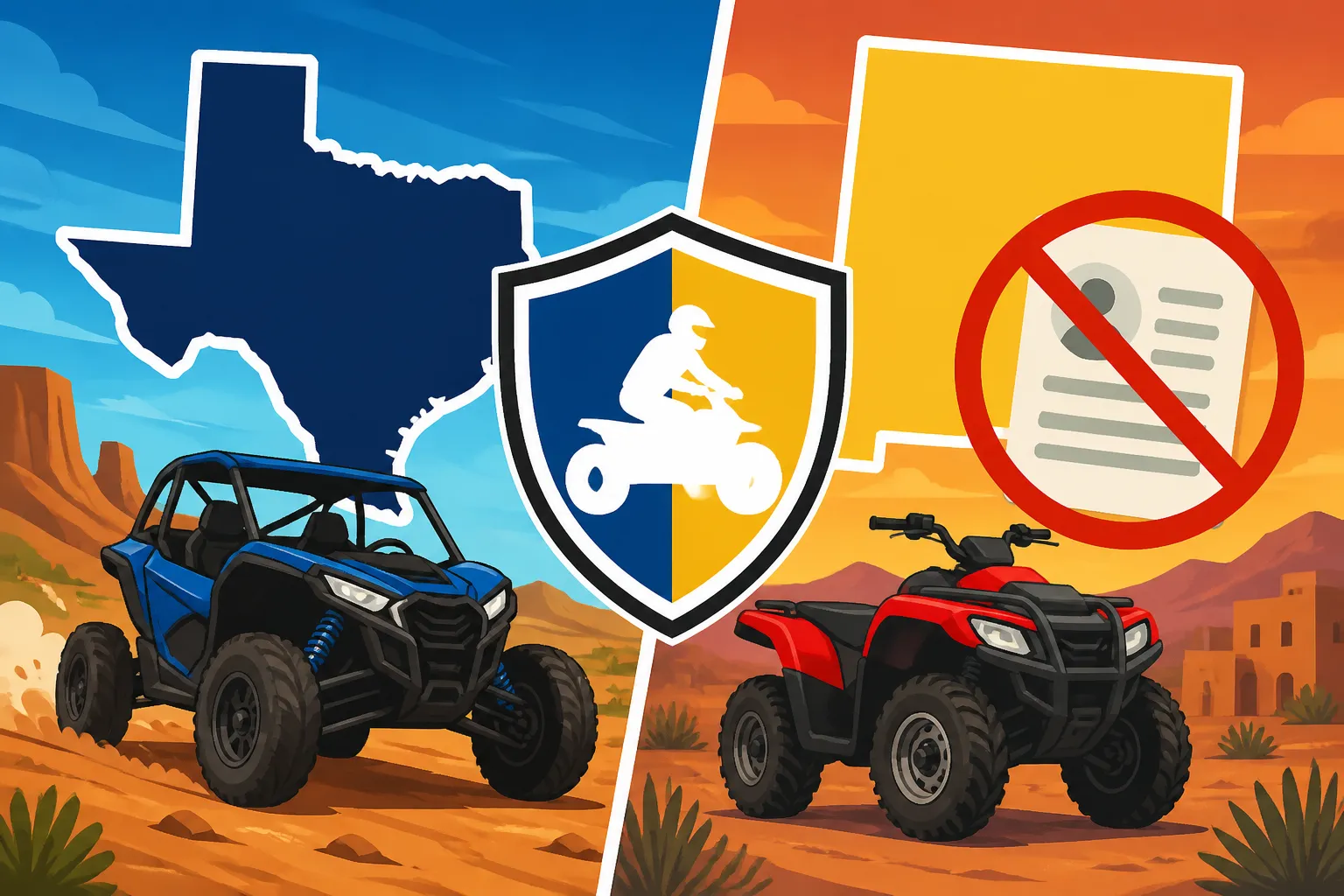
Why Texas Riders Need No New Mexico Permit
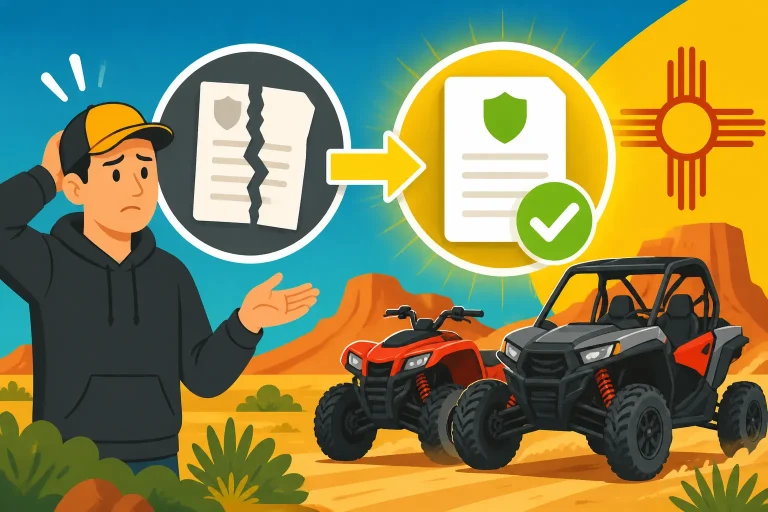
Texas riders can usually ride in New Mexico without buying a separate New Mexico nonresident OHV permit if their machine has valid Texas OHV credentials recognized under New Mexico’s reciprocity rules. The key is knowing what qualifies, carrying proof, and understanding that reciprocity does not grant access to every road or parcel of land. Here’s how to check before you load up.
Why a Texas OHV credential can satisfy New Mexico’s permit rule
New Mexico generally requires a nonresident OHV permit when an out-of-state rider’s machine does not have qualifying registration or permit credentials from its home state. The state recognizes valid credentials from states with OHV programs, so a Texas rider whose machine is properly covered by Texas’s OHV program can generally rely on that credential rather than purchasing a second New Mexico permit.
Texas uses an OHV decal program for qualifying off-highway use. It is not the same thing as a standard vehicle registration or license plate. For reciprocity, what matters is whether the machine has the current Texas OHV credential that applies to it—not simply whether the owner is a Texas resident, has a Texas driver’s license, or has a road registration for another vehicle.
This distinction can be easy to miss. A Texas plate on a tow vehicle does not prove that the ATV or UTV has the OHV credential it needs. Likewise, owning a machine in Texas or having a bill of sale does not automatically establish that it is covered by the state’s OHV program.
New Mexico’s reciprocity policy is meant to avoid making a visitor buy a duplicate state permit when the machine already meets the home state’s OHV requirements. The general concept is explained in New Mexico OHV Reciprocity Rules. For the Texas-specific application, see Why Texas Riders Need No New Mexico Permit.
Before leaving home, make sure the credential is valid for the machine and the kind of riding you plan to do. Texas program requirements can depend on the vehicle and where it is operated. If you are not sure whether your ATV or UTV needs a Texas decal, check current information from Texas Parks and Wildlife and compare it with New Mexico’s current nonresident permit guidance.
Reciprocity is about the machine’s credentials
The permit question follows the OHV, not the driver’s home address. A Texas resident riding a machine that lacks qualifying Texas OHV credentials may not be able to claim reciprocity just because the rider lives in Texas. Conversely, a visitor from another state may be able to rely on that machine’s qualifying home-state credential if New Mexico recognizes it.
The rider should be able to show that the credential belongs to the machine being ridden. Where possible, carry the supporting paperwork as well as keeping the decal in place. If you have recently bought the machine, replaced a decal, or are borrowing someone else’s ATV, confirm the credential is current and properly associated with it before traveling.
A valid home-state registration or permit can usually serve as the basis for reciprocity, but not every document with the word “registration” on it is an OHV credential. New Mexico’s overview of acceptable proof is covered in Any Valid OHV Registration Counts in New Mexico. For a broader look at which visitors need to purchase a permit, see Do Visitors Need a New Mexico OHV Permit?.
What Texas riders should carry
A decal attached to the machine is useful, but it is not the only thing worth bringing. If an officer or land manager asks about your riding credentials, having the relevant paperwork available can help show that the vehicle is covered by the Texas program and that the decal is current.
Before the trip, assemble a small document set for each machine:
- The Texas OHV credential or decal required for that machine.
- Any Texas-issued paperwork that supports the credential.
- Proof of ownership or permission to use the machine, especially if it is borrowed or rented.
- Your New Mexico permit purchase confirmation, if you choose to buy one as a backup.
- Any land-specific pass, reservation, or authorization required for the route or riding area.
Keep the decal mounted where Texas requires it. Do not remove it and assume a phone photo will take its place. A photograph of the credential and the machine’s identification information can be useful for your own records, but it does not necessarily replace the official decal or paperwork.
A weather-resistant document sleeve can keep papers from getting damp, dusty, or crumpled in a glove box or gear bag. If you order one through Amazon, choose a size that holds your documents without forcing you to fold them tightly. Keep the originals secure and make a separate digital backup in case the paper copy gets lost.
If a Texas credential is missing, expired, damaged, or hard to read, resolve that with the issuing program before the trip rather than relying on an explanation at a New Mexico trailhead. If your Texas paperwork is current but the decal is peeling, ask the Texas program how to replace or correct it. Do not assume that a receipt for a replacement automatically resolves every issue while you are riding.
Borrowed, rented, and newly purchased machines
A rider may be from Texas while the machine has a different history. A borrowed ATV might be registered or permitted in another state, and a recently purchased machine may not yet have the credential the new owner needs. In those situations, do not base the permit decision only on where the rider lives.
For a borrowed machine, ask the owner for the credential information and confirm that the vehicle is covered. For an out-of-state purchase, check whether the seller’s decal or paperwork remains valid after the sale and whether any transfer or new application is required. A bill of sale can help document ownership, but it is not a substitute for an OHV permit or registration.
Rentals need a separate check. Ask the rental company which credentials apply to the machine and whether the renter is expected to obtain anything before riding. Do not assume a rental has everything needed just because it is supplied by a business. New Mexico Rules for a Rented Machine explains the broader issue, while Riding a Rented Quad on New Mexico Public Land focuses on public-land use.
When a New Mexico permit may still be necessary
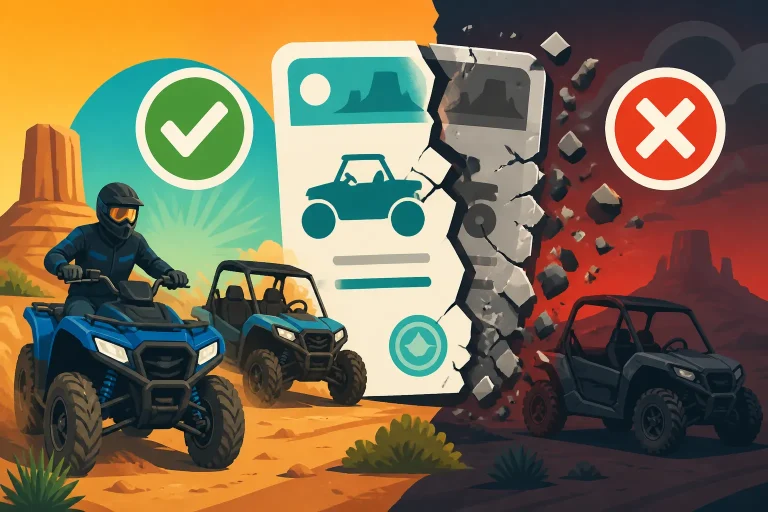
The Texas exemption depends on the machine having qualifying, valid Texas credentials. If that condition is not met, a New Mexico nonresident permit may be required. The safest approach is to resolve the question before the trip, not after reaching a staging area.
Check the permit situation carefully if:
- The machine has no Texas OHV decal or other qualifying credential.
- The decal is expired, missing, unreadable, or not attached as required.
- You are unsure whether the vehicle type is covered by the Texas program.
- The machine belongs to someone in another state or is newly purchased.
- Your paperwork shows only road registration, a title, or a bill of sale.
- You plan to ride more than one machine and have only checked the credential for one.
New Mexico offers nonresident permit options for riders who do not qualify for reciprocity. The available permit types and purchase process can change, so confirm the current requirements through the official permit channel before buying. If you need to compare options, New Mexico’s Nonresident OHV Permit explains the general purpose of the permit, and [Buying a New Mexico Permit Online] covers one way visitors may obtain it.
Do not confuse a permit exemption with a blanket exemption from other rules. A Texas decal does not make an ATV street legal in New Mexico, authorize travel on a closed route, or give you permission to ride private, tribal, or state trust land. It addresses a specific OHV permit requirement. You still need to follow the rules for the place where you ride.
Nor does reciprocity necessarily settle every question about a machine’s title, ownership, safety equipment, or road use. If you intend to travel on pavement, check the separate requirements for that use. New Mexico OHV Registration for a Nonresident can help clarify the difference between a nonresident permit and registration-related questions, while New Mexico Paved Road Plate Requirements covers a distinct issue for paved-road use.
| Situation | Likely permit approach | What to verify |
|---|---|---|
| Texas ATV or UTV with a current, qualifying Texas OHV credential | New Mexico’s separate nonresident permit is generally not needed under reciprocity | That the credential applies to this vehicle and is current |
| Texas resident with no qualifying OHV credential on the machine | Do not assume residency alone creates an exemption | Whether the machine needs a New Mexico permit or a Texas credential |
| Machine with a road plate but no clear OHV credential | Road registration alone may not answer the OHV permit question | Whether the vehicle has the credential New Mexico recognizes |
| Borrowed or recently purchased machine | Check the machine’s documents, not only the rider’s state of residence | Credential validity, ownership records, and any transfer requirements |
| Machine being rented | Ask the rental business what credentials cover the vehicle and what the renter must do | Whether the credential applies to the machine and planned riding area |
When the paperwork is ambiguous, buying a New Mexico permit may be a practical way to avoid uncertainty, but do not treat it as a substitute for confirming the applicable rules. A purchase may not cure an unrelated problem, such as a missing required Texas decal or lack of permission to ride on a particular property. Check the current official guidance before deciding.
Reciprocity does not decide where you can ride
A permit or qualifying Texas credential answers only one part of trip planning. New Mexico riding areas can involve a mix of federal, state, county, municipal, private, and tribal land. Each can have its own access rules, and a valid OHV credential does not open a route that is closed or restricted.
On federal land, follow the land manager’s travel rules. A route may be open only to certain vehicle types, limited to a designated trail, or closed seasonally. A route shown on an older map or an online track is not proof that it remains open. Check current travel-management information for the specific forest, district, or BLM area before setting out. The practical difference between a state credential and land-access rules is covered in New Mexico Rules for Riding Federal Land.
State trust land is another separate case. A state trust land permit or recreational access authorization may be required, and the land may have restrictions that do not apply to nearby public routes. Private land requires permission from the owner. Tribal land is governed by its own rules; do not assume that a public road or trail crossing near tribal land authorizes riding on it.
Local road access is also separate from OHV permit reciprocity. A county or town may open specific roads to OHVs, while another jurisdiction may prohibit riding on its streets. State highways have their own restrictions, and rules for crossing a road are not the same as permission to ride along it. Check the exact road and jurisdiction rather than relying on a general statement that “the area allows OHVs.”
This matters especially when a ride begins at a campground or lodging property and continues onto a trail. Ask where the riding route actually starts, whether the connecting road is open to your machine, and whether the route crosses land with separate access requirements. A machine that is properly credentialed can still be ticketed for traveling on a prohibited road or entering a closed area.
If you plan to carry a phone for maps, download the information you need before leaving cell service. Amazon sells a range of rugged phone mounts and waterproof cases, but a mount does not replace a paper or offline navigation plan. Keep the device secured so it cannot distract you or fall off on rough ground, and use a map that shows land boundaries and route closures where possible.
A pre-trip checklist for Texas riders
A short check before loading the trailer can prevent most permit-related surprises. Work through these steps for every machine, including a second ATV or a passenger’s side-by-side.
- Identify the machine. Note its make, model, vehicle type, and identification number. Confirm that the credential you are checking belongs to that exact vehicle.
- Check the Texas OHV credential. Make sure the decal or other required credential is valid, properly displayed, and applicable to the machine.
- Confirm New Mexico reciprocity. Review current official New Mexico guidance if you have any doubt about whether the Texas credential is recognized.
- Gather proof. Carry the relevant Texas paperwork and any ownership or permission documents. Keep a secure digital copy as a backup, not as a replacement for required originals.
- Check the land and route. Confirm that the riding area is open, your vehicle type is allowed, and any separate land-access authorization is in place.
- Review road-use rules separately. Do not infer street or highway permission from the fact that the machine has a valid OHV credential.
- Prepare for a roadside check. Keep the documents accessible without having to unload gear or search through a phone with no service.
If you are packing documents, a small organizer from Amazon can keep each machine’s papers together, especially when several riders share a trailer. Label the packets by vehicle rather than by rider so it is clear which documents go with which ATV or UTV. Before departure, check that the copies are legible and that the originals are still with the right machine.
For riders traveling in a group, make this a vehicle-by-vehicle check. One properly credentialed side-by-side does not cover a second machine. If a friend is bringing an ATV from a different state, that rider should check the rules for that machine’s home-state credential rather than assuming the Texas rider’s exemption applies to the whole group.
The basic takeaway is straightforward: Texas riders generally do not need to purchase a separate New Mexico nonresident OHV permit when their machine has valid Texas OHV credentials that New Mexico recognizes. But the exemption is tied to the machine and its qualifying credential. Check the decal, carry proof, and verify access rules for every route you plan to ride.
Disclaimer
This article is for general informational purposes only and does not constitute professional advice. Laws, prices and regulations vary by location and change over time. Consult a qualified professional for guidance on your specific situation.