Which 16 States Have No OHV Program
When you bring an ATV or UTV to New Mexico, your home-state paperwork can affect whether you need a New Mexico nonresident permit. The key question is whether your state has an OHV registration program that New Mexico recognizes. Here are the 16 states commonly identified as having no qualifying program, plus a practical way to check what you need before you ride.
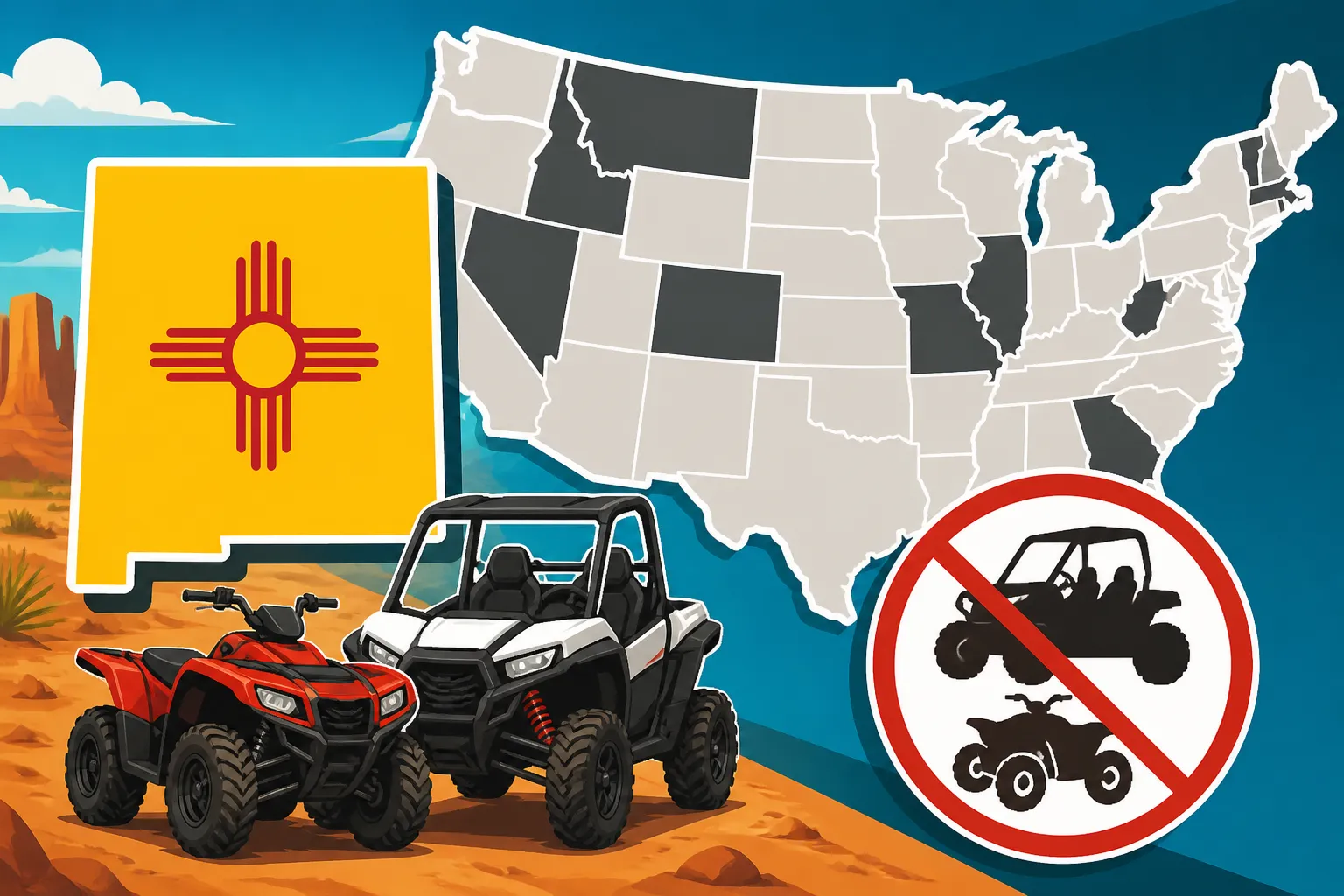
The 16 states identified as having no OHV program
Riders from the following states may need to buy a New Mexico nonresident OHV permit because their home state does not have a qualifying OHV registration program:
- Alabama
- Alaska
- Connecticut
- Delaware
- Hawaii
- Illinois
- Indiana
- Kansas
- Kentucky
- Maryland
- Mississippi
- Missouri
- New Jersey
- New York
- Tennessee
- West Virginia
The important word is qualifying. States can have rules for titles, road use, land access, or particular vehicle types without offering the kind of OHV registration New Mexico accepts for reciprocity. A state’s paperwork may also depend on where the machine is ridden and how it is classified.
Because reciprocity lists and program rules can change, confirm that your state is still on New Mexico’s current list before traveling. Use the official New Mexico permit information, and check what it says about your machine’s home-state documents. Don’t assume a registration-like sticker, title, plate, or purchase receipt will count as an OHV registration.
| Your situation | What to check before riding in New Mexico |
|---|---|
| Your state is on the 16-state list | Plan to obtain the required New Mexico nonresident permit, unless an official exception applies |
| Your state has an OHV registration program | Confirm that your current registration qualifies for New Mexico reciprocity |
| Your machine is not registered at home | Check whether you need a New Mexico permit even if your state is not on the list |
| You are borrowing or renting a machine | Ask which permit or registration applies to that machine and who is responsible for it |
| You plan to ride on paved streets | Check the separate rules for paved-road use, insurance, equipment, and local access |
For more background on how reciprocity works, see New Mexico OHV Reciprocity Rules and Riding New Mexico With an Out-of-State Registration. If you are from one of the listed states, New Mexico’s Nonresident OHV Permit explains the visitor-permit route.
What New Mexico means by reciprocity
Reciprocity is not a blanket promise that every out-of-state ATV or UTV can ride anywhere in New Mexico without extra steps. It generally means New Mexico accepts a qualifying OHV registration from another state in place of requiring a New Mexico nonresident permit.
That distinction matters because a state may issue documents that look official but serve a different purpose. A title is evidence of ownership; it is not necessarily proof that the machine is registered for OHV use. A plate or sticker might be for road use, private-land use, or a state-specific program that New Mexico does not recognize for this purpose.
A machine registered in a state with a qualifying program may be covered by reciprocity, but the registration should be current and belong to the machine you are riding. Bring proof with you. If the document is electronic, make sure you can access it where you ride; remote trailheads may have weak or no service. A saved copy can help, but it should be a copy of the actual registration document, not just an order confirmation or a photo of an unrelated decal.
If the vehicle came from a state without a qualifying program, a New Mexico permit may be the way to meet the state’s OHV requirement. That does not mean the machine is automatically legal on every trail or road. The permit addresses one requirement; land access and route rules are separate.
A title, purchase receipt, and registration are different things
These documents are easy to mix up, especially after buying a used machine or bringing one across state lines:
- Title: Usually identifies ownership and the vehicle.
- OHV registration: Shows that the machine is registered under a state program.
- Permit: Provides the authorization required for a particular use or jurisdiction.
- Bill of sale or receipt: Records a transaction but does not, by itself, prove current registration.
An online listing or receipt from Amazon is not a substitute for registration or a New Mexico permit. The same is true of an Amazon product page for a plate, decal, or paperwork kit: buying something that resembles an official document does not make it valid. If you bought the machine through an online marketplace, including Amazon, use the seller’s ownership and registration records as a starting point, then check the official requirements for your home state and New Mexico.
For help separating ownership paperwork from registration, see Titling an Off-Highway Vehicle in New Mexico and New Mexico OHV Registration for a Nonresident.
Reciprocity does not grant land access
Even with a valid registration or permit, you still have to ride where OHVs are allowed. A permit does not open a closed route, authorize travel across private land, or replace any separate permit required for state trust land or other specially managed property.
On federal land, follow the route designations and travel-management rules for the specific area. A road that looks rideable on a map may be closed to motorized use, and a route open to one class of vehicle may not be suitable or open to another. Start with [New Mexico Rules for Riding a National Forest], [New Mexico Rules for Riding BLM Land], and Designated Routes and Travel Management in New Mexico when planning a public-land ride.
How to decide whether you need a New Mexico permit
Use this sequence before loading your ATV or UTV. It helps prevent a common mistake: focusing on the state where you bought the machine instead of the state where it is currently registered.
-
Identify the home state that issued the machine’s current OHV registration.
The seller’s address, the dealership location, or the place you bought the machine does not necessarily determine reciprocity. Look at the current paperwork and identify the state program that issued it. -
Check whether that state appears on New Mexico’s current no-program list.
If it does, plan on obtaining the appropriate New Mexico nonresident permit unless official guidance says otherwise for your circumstances. If it does not, that alone does not prove you are covered; the registration must still meet New Mexico’s requirements. -
Confirm that the document is an OHV registration.
A title, ordinary vehicle registration, tax receipt, temporary tag, or dealer paperwork may not establish OHV registration. If the document’s purpose is unclear, ask the issuing state agency or the New Mexico permit office before you travel. -
Check that the registration is valid and matches the vehicle.
Verify the expiration date and the machine’s identifying information. Make sure the VIN or other vehicle identifier on the paperwork matches the machine. If a number is hard to read, deal with that before the trip rather than hoping it will not be checked. -
Check for separate requirements based on rider age or riding location.
A visitor permit does not replace a required safety permit for a young rider, permission for private or tribal land, or a separate authorization for state trust land. For the age-related rules, see New Mexico’s Safety Permit for Under-18 Riders. -
Carry proof in a usable form.
Keep the permit or registration with the vehicle or rider as required, and make sure you can show it during a roadside check. A clear paper copy or a downloaded document can be useful when there is no cell service. Follow the official instructions for the particular permit about what proof to carry and whether it must be displayed on the machine.
If you are unsure which category fits your machine, ask before you ride. A short call or check of the official permit information can be easier than sorting out the issue at a trailhead. Where to Buy a New Mexico OHV Permit covers the available purchasing channels, and [Buying a New Mexico Permit Online] is useful if you want to handle the permit before leaving home.
Choosing the right permit and understanding what it covers
New Mexico offers nonresident permit options with different durations. The right one depends on how long you expect to ride and whether you will make more than one trip. Check the current permit types, fees, eligibility, and instructions through the official source before buying; those details can change.
A permit is associated with the machine and its use under the program’s rules, not a general pass for every person in a group or every vehicle on a trailer. If you are bringing several ATVs or UTVs, check whether each machine needs its own permit or qualifying registration. Do not assume that one permit covers a household, a group, or all the vehicles owned by one person.
When comparing permit options, consider:
- Trip length: A short visit and several trips spread across a longer period may call for different permit durations.
- Number of machines: Work out the requirement for each vehicle you intend to ride.
- Who owns or operates the machine: A borrowed machine, rental, or machine owned by someone else can raise questions about which paperwork applies.
- Where you will ride: A permit does not replace local rules, landowner permission, or route-specific restrictions.
- Whether you expect paved-road use: A standard OHV permit does not automatically authorize use on paved streets.
For a visitor who has a valid registration from a state New Mexico recognizes, buying another permit may be unnecessary. But do not rely on a verbal assumption or an old decal. Check that the registration is current and that the state is still recognized under New Mexico’s reciprocity rules. If the registration has expired, or if the only document you have is a title, ask the official source what is required.
If your home state is on the no-program list, start with New Mexico’s Nonresident OHV Permit and What a Rider From a Non-Program State Must Buy. The state’s permit guidance can confirm which duration applies to your plans and how to document the machine.
Other rules still apply after you have a permit
A permit or accepted registration is only one part of planning a legal ride. You also need to make sure the route is open to your vehicle, your machine meets applicable requirements, and every rider follows the rules for their age and circumstances.
Route and land rules
New Mexico riding opportunities include areas managed by different agencies and landowners. Rules can differ from one property to the next, and route maps or signs may change. Before heading out, check current maps and closures for the place you intend to ride. Stay on routes open to motorized travel, and do not treat a visible track as permission to use it.
Private land requires permission from the owner. State trust land has its own access requirements. Tribal land and roads may require permission from the relevant authority; a New Mexico OHV permit does not provide that permission. For those situations, review [New Mexico Rules for Riding Private Land], State Trust Land and Its Own Permit, and Tribal Land and Why Permission Differs.
Be especially careful when a road connects different jurisdictions. A route may pass from county land to federal land, private property, or a town with its own restrictions. Confirm the status of the whole route, not just the trailhead or the first segment.
Young riders and safety requirements
The nonresident permit question is separate from the safety-permit rules for riders under 18. A young rider may have to meet training or supervision requirements even when the machine’s registration is in order. Age, experience, license status, and the type of machine can affect which rules apply.
Check the requirements before the trip and make sure the rider has any required permit or proof with them. Do not assume that an adult’s permit or registration satisfies a child’s separate requirement. The state’s information on [New Mexico OHV Safety Permit Requirements] and [New Mexico Supervision Rules for Young Riders] can help you plan.
Paved-road use is a separate question
A permit that allows OHV use does not automatically make an ATV or UTV street legal. New Mexico has separate requirements for paved-road use, and the answer depends on the road, local rules, vehicle type, equipment, insurance, and other conditions. Some roads are not open to OHVs at all.
If you plan to ride on pavement, research the route before you go. Do not assume that a green light from your home-state registration, a New Mexico permit, or a rental company means every paved road is open. Start with New Mexico Paved Road Plate Requirements and What New Mexico Law Says About Road Use. Also check whether the route crosses a highway or passes through a town with specific restrictions.
A practical pre-trip checklist for out-of-state riders
Before loading the trailer, take a few minutes to verify the paperwork and the route. This is particularly worthwhile if the machine is newly purchased, borrowed, or registered in one of the 16 states.
- Confirm the machine’s VIN and the details on its registration or permit.
- Check whether the home-state document is an OHV registration, not only a title or purchase record.
- Look up New Mexico’s current reciprocity list and verify the state that issued your registration.
- If your state is on the no-program list, check the official nonresident permit options and buy the correct permit in advance if appropriate.
- Check the permit instructions for whether proof must be carried, displayed, or both.
- Confirm the requirement for every machine you will ride, including a child’s machine or a borrowed vehicle.
- Review route maps, closures, land access, and any local restrictions for your destination.
- Check age, supervision, and safety-training requirements for each rider.
- Research paved-road rules separately if your route uses streets or road crossings.
- Save a copy of essential documents where you can reach them without cellular service.
If an online retailer or seller told you the machine was “ready to ride,” treat that as a claim to verify, not proof that its paperwork will satisfy New Mexico. An Amazon listing, for example, might describe a vehicle, accessory, or document holder, but it cannot confirm that the machine’s registration qualifies for reciprocity. Likewise, an Amazon receipt may help show when you bought an item, but it does not replace the registration issued by the proper agency.
When the paperwork is unclear, pause and resolve it before riding. It is easier to confirm the registration or obtain a permit at home than to discover at a checkpoint or trailhead that the documents do not meet the requirement.
Disclaimer
This article is for general informational purposes only and does not constitute professional advice. Laws, prices and regulations vary by location and change over time. Consult a qualified professional for guidance on your specific situation.