New Mexico Riding Areas Reachable Without a Trailer
Arriving at a New Mexico trailhead with an ATV but no trailer can take a little planning: many riding areas are outside town, and public roads are not automatically open to off-highway vehicles. This guide explains practical trailer-free options, from carrying a machine in a pickup to renting near the trails, and how to check access before you go.
What “reachable without a trailer” really means
Riding from town is different from driving to a trailhead
A riding area can be reachable without a trailer in two very different ways. You might drive a truck or SUV to a staging area, then unload an ATV from the vehicle’s bed or use a rental machine nearby. Or you might hope to ride your own machine directly from lodging to the trails. The second option is much more complicated because it depends on whether every road and connecting route is legally open to your type of vehicle.
A route appearing on a map does not necessarily mean an ATV or UTV can use it. A county road, town street, Forest Service road and designated off-highway route can all have different rules. Even where a local road is open to some OHVs, that does not mean every vehicle class can use it. New Mexico’s paved-road opt-in has requirements, and local restrictions can narrow access further. Before planning to ride from a hotel or campground, review [New Mexico's Paved Street Opt-In] and [New Mexico Rules for Riding a City Street].
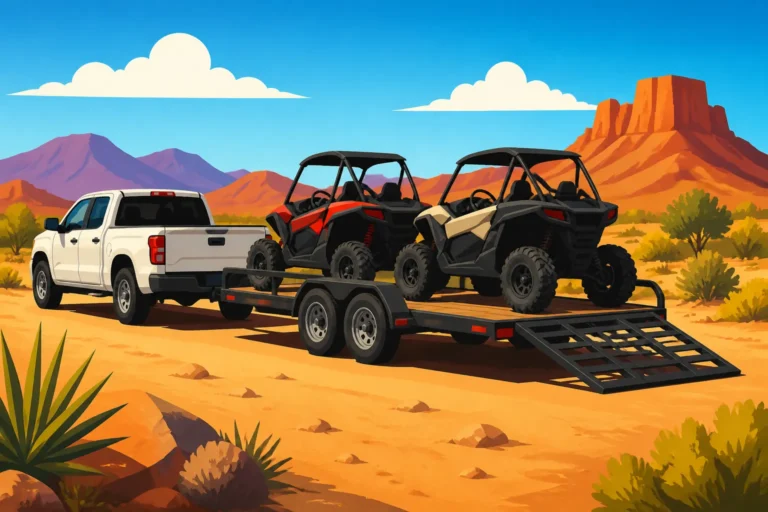
This distinction matters when you’re trying to avoid hauling a trailer. If you have a pickup, a ramp and a machine that fits safely in the bed may be enough to get you to a staging area. If you don’t have a vehicle that can carry the machine, renting close to the riding area may be the simplest trailer-free plan. In either case, you still need to confirm where the ride begins and which roads or trails you’re allowed to use.
A quick comparison of trailer-free options
| Option | What it means | Best suited to | Main thing to check |
|---|---|---|---|
| Carry the ATV in a pickup | Drive to a staging area and unload there | Riders with a suitable truck, ramps and tie-downs | Vehicle capacity, loading safety, parking and trail access |
| Rent near the riding area | Travel by car, then ride a local rental machine | Visitors without a machine or towing setup | Rental boundaries, permitted routes, age rules and included gear |
| Ride from lodging | Use roads or routes to connect lodging with riding terrain | Riders whose machine and route are both legally approved | Street and county rules, vehicle eligibility and current closures |
| Choose a close trailhead | Drive a passenger vehicle to a nearby riding area | People who want a shorter approach and straightforward staging | Whether the road is suitable for your vehicle and the area is open |
For a first trip, carrying a machine to a known staging area or arranging a rental is usually easier to plan than assuming you can ride out of town. Use [Where to Ride an ATV in New Mexico] to compare the state’s broader riding options, then narrow your plan to a specific trailhead and access route.
Riding areas to consider for a trailer-free trip
Red Sands OHV Area near Alamogordo
Red Sands, in southern New Mexico near U.S. 54, is a practical choice for riders who can drive a passenger vehicle to the riding area and bring a machine in a pickup. The key advantage is that your approach to the riding area does not have to involve towing a trailer if the ATV fits securely in your vehicle. You still need to plan for the final stretch of access road and confirm the area is open before leaving.
Red Sands is not the same as a place you can necessarily ride to from an Alamogordo hotel. Its proximity to a highway or town does not grant permission to ride along the connecting public road. Treat the outing as a drive-to-staging-area trip unless you have confirmed a legal, appropriate route for your vehicle. For local terrain and practical access details, read [Red Sands OHV Area in Southern New Mexico] and [Getting to Red Sands Off New Mexico's US 54].
The terrain and desert conditions also affect how you prepare. Loose sand can make a machine work harder and can complicate recovery if you get stuck, especially when riding alone. Bring water, let someone know where you plan to ride, and avoid treating the highway shoulder as an informal parking or unloading area. A mapped trail or open-looking track is not a substitute for checking land status, signs and current access information.
Haystack Mountain near Roswell
Haystack Mountain is another option to consider if you can transport your machine in a pickup rather than tow it. The riding area is outside Roswell, so plan on driving to the entrance or staging area with the ATV secured in your vehicle. This can work well for a day trip: you avoid managing a trailer while still getting your machine to a designated riding area.
Before you go, confirm the entrance, access road conditions and any current use requirements. A passenger car may be fine for the approach in ordinary conditions, but weather, road work or other changes can affect what is sensible. If you have a long-bed machine, check its measurements against the pickup bed and tailgate arrangement before you set off. A machine that technically fits can still create a risky load if it blocks visibility, exceeds the vehicle’s capacity or cannot be tied down at appropriate points.
Haystack Mountain is not a promise of ride-from-town access. Keep the truck as your transport to the riding area and ride only where permitted once you unload. The guide [New Mexico's 1,920-Acre Haystack Mountain] can help you understand the area, while [Paying at the Haystack Entrance] is useful to review when planning the arrival and entry process.
Glade Run and Chokecherry Canyon near Farmington
Glade Run and Chokecherry Canyon offer a different kind of trip, with riding terrain near Farmington and a mix of open riding and designated trail opportunities. For trailer-free travel, the practical approach is to drive to the relevant access point with your ATV carried in a suitable vehicle, or look into a rental arrangement that starts near the riding area. Don’t assume that proximity to Farmington means you can take an ATV through town to reach the trail network.
The area is broad, so choosing the right access point matters. A route that suits a small ATV may not be a good match for a wide side-by-side, and the road you drive to the staging area may differ from the route you ride once there. Check vehicle width, route designations, parking and current closures before committing to a particular entrance. [New Mexico's 19,000-Acre Glade Run] provides a helpful overview, and [42 Miles of Marked Trail at Glade Run] is relevant if you want a more route-focused plan.
Glade Run is also a place where an electronic map can help you keep track of trail choices, but it should be one part of your preparation rather than your only source. onX Offroad can help riders review mapped routes and orient themselves before setting out. Compare what you see there with posted signs and official land-management information, especially if a route crosses or approaches a boundary.
How to plan the trip without towing
Choose a transport method before choosing the trail
Start with the machine, not the destination. Measure its length, width and weight, then compare those figures with your pickup’s payload, bed dimensions and loading setup. Include the weight of fuel, riding gear and any equipment you’ll carry. If the ATV will extend beyond the bed, understand how it must be secured and marked, and do not rely on an improvised arrangement that shifts during braking or on rough access roads.
Loading and unloading deserve as much attention as the ride itself. Use ramps designed for the machine’s weight, park on stable ground, and have a second person assist if the loading angle or visibility makes the process awkward. Tie down the machine at suitable points so it cannot roll or tip. If the setup feels marginal in your driveway, it will not feel better at a dusty staging area with uneven ground and people waiting behind you.
If the machine will not fit safely, consider a rental rather than squeezing it into an unsuitable vehicle. A rental can remove the need to transport an ATV altogether, but confirm whether the rental begins at the trailhead or requires a separate drive to the riding area. Ask where the machine may be ridden, whether the route is self-guided or guided, and what happens if weather or a closure changes the plan. For broader location ideas, see [New Mexico Riding Areas Near a City].
Verify the route, land status and rules
Before leaving home, identify the exact place where you intend to unload or pick up a rental. Check whether parking is allowed, whether the access road is open to your vehicle and whether the riding area has seasonal or temporary restrictions. Public land is not a blank space for unrestricted riding: many routes are designated, and riding off-route may be prohibited. Review [New Mexico Rules for Riding a Designated Route] and [New Mexico Trail Closures to Check First].
Use more than one source when planning. A paper or offline map is helpful if cell coverage drops, and a trail app such as onX Offroad can make it easier to examine mapped routes before your trip. Save information you may need before driving into a low-signal area. Then compare the route with current agency notices and the signs at the trailhead. If a sign says a route is closed or a boundary is unclear, don’t treat a GPS track as permission to continue.
Check the requirements for your specific machine and rider, too. Registration, permits, safety requirements and insurance rules can depend on whether you are a New Mexico resident, a visitor, a renter or using the vehicle on a particular type of road. If your plan includes pavement, confirm that your machine is eligible and that the road itself is open to it. [New Mexico Rules for Riding a National Forest] and [New Mexico Rules for Riding BLM Land] can help you identify the kinds of public-land rules to investigate.
Common trailer-free trip problems and how to avoid them
Expecting to ride directly from a town or lodging
This is the most common planning mistake: someone sees a trail area close to a town and assumes the ATV can be driven there on the road. That can lead to a frustrating stop before the ride even begins. New Mexico’s rules do not make every public road an OHV route, and local ordinances may impose narrower rules than a rider expects.
Red River is a good example of why the details matter. The town has specific rules for road use, including restrictions that distinguish between vehicle types. A visitor with a side-by-side should not assume an ATV has the same access, and neither should assume that a road open to a certain class of machine connects all the way to a trail. Read [Red River's ROV-Only Streets] and [Riding Out of Red River on Forest Roads] before building a trip around riding from town.
If your goal is to avoid a trailer rather than avoid driving a truck, keep the plan simple: transport the ATV to an approved staging area, unload there, and begin the ride on a permitted route. If you want to leave the truck behind entirely, ask a local rental operator what routes are included and whether the rental can start near the riding area. Don’t improvise a road connection based on distance alone.
Arriving without enough information or equipment
A trailer-free trip can be convenient, but it leaves less room for spare gear. A pickup bed can hold basic recovery tools, water, a first-aid kit, extra layers and a paper map. Make space for those before loading the ATV rather than discovering at the trailhead that the machine has taken up every inch. In desert areas, sun and heat can make a short ride feel demanding; in higher terrain, weather can change quickly.
Carry enough fuel for your planned route and a reasonable margin, especially if services are far from the riding area. Tell someone where you intend to ride and when you expect to return. If your group includes riders with different experience levels, agree on a turnaround point before the ride begins. A route that looks manageable on a screen can involve loose sand, steep terrain, narrow sections or long distances between easy exits.
Finally, leave time for the return trip. Loading a dusty machine takes longer than unloading it, and a tired rider may be less patient with ramps and tie-downs. Keep the staging area orderly, avoid blocking other vehicles, and check that all equipment is secured before driving away. onX Offroad can be useful for reviewing your planned route before the ride, but signs, access rules and conditions on the ground should guide your decisions once you arrive.
Disclaimer
This article is for general informational purposes only and does not constitute professional advice. Laws, prices and regulations vary by location and change over time. Consult a qualified professional for guidance on your specific situation.