Camping at a New Mexico OHV Area
Camping near a New Mexico OHV area can turn a quick ride into a memorable weekend, but it also adds questions: where can you legally camp, can you ride from camp to the trail, and what happens when the nearest water or fuel is miles away? This guide helps you plan a practical, respectful base camp without assuming every riding area has the same rules or facilities.
Start With the Land Manager, Not the Campsite Photo
Identify who manages the riding area
New Mexico riding areas sit on a mix of public and private land, and the camping rules depend on who manages the specific spot you have in mind. A place that looks like open desert on a map may be managed by the Bureau of Land Management, the U.S. Forest Service, a county, a municipality, or a private landowner. Those distinctions affect where you may camp, whether you need a permit, and which roads or trails are open to motorized travel.
Before choosing a campsite, work out which agency or landowner manages both the riding area and the place where you plan to sleep. Don’t assume that permission to ride in one area automatically includes permission to camp there. Likewise, a campground nearby may be on a separate parcel with its own access rules. If you are unsure, check the land manager’s information for that exact location and ask about both overnight use and vehicle access.
This step is especially important when a route crosses more than one kind of land. A ride that begins near a campground can lead toward a boundary where the rules change, even if the terrain looks continuous. Review [New Mexico Rules for Riding Federal Land] before planning a route across federal property, and treat signs, gates, and posted closures as meaningful boundaries rather than suggestions.
Separate permission to ride from permission to camp
A valid registration or permit may be required for riding, but that does not answer whether you may camp at your chosen spot. Riders should check the rules that apply to the machine and the land separately. If you are visiting from out of state, learn whether your home-state registration is recognized or whether you need a New Mexico permit. Check the visitor-permit rules before you travel.
Camping permission can be more limited than riding access. Some areas have designated campsites; others may allow dispersed camping only in specific places or under certain conditions. An area may also close to camping or motorized travel temporarily because of fire danger, road conditions, resource protection, or another land-management concern. Confirm the rules close to departure, and make a second plan in case your first choice is unavailable.
A useful rule of thumb: confirm three separate things before you load the trailer—whether you can ride there, whether you can camp there, and whether you can drive or trailer your machine from the camping area to a legal route. Those permissions do not always come as a package.
Use maps to plan, then confirm on the ground
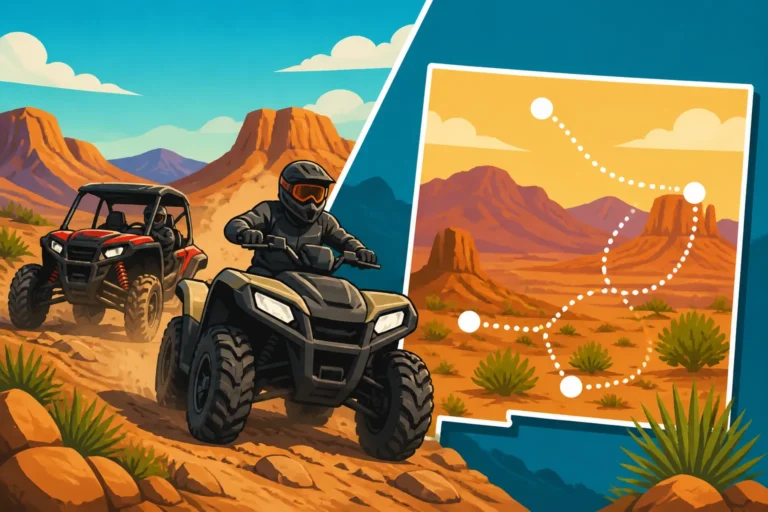
A phone map can help you see roads, boundaries, and possible access points, but a line on a screen is not proof that a route is open or that camping is allowed beside it. Use an up-to-date map alongside official information from the managing agency. Tools such as onX Offroad can help riders orient themselves and review mapped routes, but it is still important to compare what you see with current signs, notices, and land-manager rules.
Pay attention to the map’s level of detail. A broad overview may show a road without displaying a seasonal restriction, a private inholding, or a boundary that matters for camping. Download maps for offline use before leaving town, especially if you expect weak service. Then keep a paper map or another backup available for the moments when a phone battery, screen, or signal becomes a problem.
At the trailhead or campground, take a few minutes to match your plan to the information on site. If a sign conflicts with an older route in your app, follow the current posted restriction and ask the land manager when possible. For more help preparing your map kit, see [New Mexico Trail Maps Worth Carrying].
Choose a Camping Style That Fits Your Trip
Developed campgrounds for a simpler setup
A developed campground can be a good choice if you want a clearly defined place to park, pitch a tent, or set up an RV. It may offer amenities such as toilets or marked sites, but facilities differ widely. Never assume a campground has drinking water, a dump station, electricity, cell service, or room for a trailer just because it appears as a campground on a map.
Before booking or driving in, ask whether the campground is open, whether it accepts the kind of vehicle you’re bringing, and how far it is from the riding area. Also confirm whether OHVs may be ridden from the site to an authorized route. A nearby campground might require you to trailer your machine to a legal staging area rather than ride along a road or through a residential neighborhood.
Developed camping is often a practical option for families, first-time visitors, and groups with different comfort levels. Someone can stay at camp while another rider heads out, and marked sites can make it easier to keep gear organized. The tradeoff is less flexibility: reservations, site limits, quiet hours, or other rules may apply. Read the campground’s specific rules instead of planning around assumptions.
Dispersed camping for more independence
Dispersed camping usually means staying outside a developed campground, where facilities may be limited or absent. That freedom can be appealing in a remote area, but it comes with more responsibility. You need to know where camping is allowed, how to avoid sensitive ground, how to handle waste, and how far you are from water, fuel, and help.
Do not choose a spot simply because it is flat, empty, and close to a trail. It may be private property, a restricted area, a road corridor, or land where overnight camping is not permitted. Confirm local rules and use established disturbed sites where allowed. Keep vehicles and trailers on durable surfaces rather than driving across vegetation to find a more scenic place.
Dispersed camping also means planning for what you will do if conditions change. A sandy approach can become difficult after rain, and a remote camp can feel much farther away when a tire fails or a storm rolls in. For a deeper planning checklist, see [New Mexico Dispersed Camping for Riders] and [Camping Near New Mexico Riding Areas].
Match the camp to your group and equipment
The best camp is not always the one closest to the trail. A family with young riders may need a level place to sleep, a safe area for gear, and a dependable way to reach facilities. A group of experienced riders may prioritize access to a staging area and room to park multiple trailers. A solo rider may prefer a developed site with more people nearby rather than an isolated pull-off.
Think through the full footprint of your setup. An RV, truck, trailer, tent, fuel containers, and machines need more space than a single vehicle. A narrow road or small campsite may be manageable for a pickup but uncomfortable for a long trailer. If you are traveling with a wide side-by-side, consider whether the campground entrance, parking area, and trail network can accommodate it.
Before committing, sketch the setup in your mind: where the tow vehicle will sit, where the trailer will go, where people will sleep, and how machines will move without crossing another campsite. This simple check can prevent the familiar end-of-day headache of discovering that the only level spot is already occupied by your trailer.
| Camping choice | Usually works well for | Questions to confirm | Common tradeoff |
|---|---|---|---|
| Developed campground | Families, RVs, first-time visitors | Availability, vehicle fit, amenities, OHV access | Less flexibility and possible site rules |
| Dispersed campsite | Self-sufficient groups seeking space | Whether camping is allowed, access conditions, waste rules | Few or no facilities and more planning |
| Campground farther from the riding area | Mixed groups and longer stays | Legal route or trailer transfer to the trailhead | More driving or daily loading |
| Motel or cabin base | Riders who prefer a bed and indoor facilities | Parking for trailer and machine storage | Less direct access to camp-based riding |
Plan Around New Mexico’s Different Riding Areas
Red Sands and the southern desert
Red Sands near Alamogordo is known for desert riding, but a nearby riding area should not be treated as a guaranteed campsite. Confirm which land is open for overnight use and where you may park, stage, and ride. The desert can make distances feel deceptive: a spot that looks close on a map may still involve rough access or a longer drive than expected.
Desert camping calls for careful attention to heat, wind, dust, and water. Shade can be limited, and gusts can make a lightweight tent or loose awning a nuisance. Secure equipment before leaving camp, keep drinking water available, and avoid leaving food or trash exposed. If the group is riding different routes, agree on a return time and a way to contact one another before heading out.
Red Sands can be a rewarding place to build a trip around, but the details matter. Read [Red Sands OHV Area in Southern New Mexico] alongside local camping information, then confirm conditions and access before you set out. If the area is busy or the camping rules do not fit your plans, consider staying at an authorized campground nearby and transporting machines to the permitted riding area.
Glade Run and Chokecherry Canyon near Farmington
The terrain around Farmington offers a very different feel from the southern desert. In the Glade Run and Chokecherry Canyon area, riders may encounter open riding terrain, marked routes, and challenging features. That variety is appealing, but it also makes it important to choose routes that suit the least experienced person in the group and the machine they are riding.
When selecting a camp, check how the camping location relates to the specific riding zone you intend to use. Do not assume that all access roads, staging areas, and camping spots are interchangeable. A route that works for one vehicle may be unsuitable for a trailer, and a ride from camp may pass through areas with separate restrictions. [Glade Run and Chokecherry Canyon at Farmington] can help you understand the destination, but use local land-manager guidance for exact access and overnight rules.
Groups with different skill levels should agree on a plan before leaving camp. Identify a conservative route, set a turnaround point, and make sure each rider knows where to regroup if the group gets separated. A scenic camp is less useful if the route back becomes a difficult obstacle late in the day, when riders are tired and visibility is fading.
Haystack Mountain and eastern New Mexico
Haystack Mountain near Roswell draws riders to open terrain and dune-style riding. Before camping, confirm whether overnight stays are allowed at the riding area or whether you need to stay elsewhere. Also check what the access road and staging area can handle, particularly if your group is bringing a long trailer, RV, or several machines.
Open, exposed terrain can be hard on both people and equipment. Wind may blow sand into tents and vehicles, while a hot afternoon can turn a relaxed ride into a tiring one. Keep a shaded rest option in mind, carry enough water for the whole group, and protect food and electronics from dust. A simple packing choice—sealable containers for small items—can make camp much easier to manage.
Read [Haystack Mountain in Eastern New Mexico] for destination context, then confirm camping arrangements with the relevant land manager or facility. If there is no suitable overnight option at the riding area, look for an authorized campground or lodging base and plan the daily drive. That extra distance is often preferable to arriving after dark and trying to improvise a campsite.
Forest and mountain riding areas
Mountain and forest riding can bring cooler temperatures, changing weather, steep roads, and seasonal closures. A campsite that is comfortable in town may be cold or exposed at elevation. Pack layers, check the forecast for the elevation where you will camp, and prepare for rain or an abrupt temperature drop even if the day began warm.
Forest access roads can also be affected by seasonal restrictions, weather, fire conditions, and maintenance. Do not rely on an old memory of a road being open. Check [New Mexico Trail Closures to Check First] and confirm access with the managing agency. If a road is closed, do not try to bypass the closure by cutting across a slope or following an informal track.
A forest campsite may place you closer to a trail network, but closeness does not make the route legal or appropriate for your vehicle. Verify where motorized travel is allowed and whether the route is suitable for the width and capability of your machine. For broader planning by elevation and season, see [New Mexico Riding Seasons by Elevation].
Make Camp Safe, Comfortable, and Low Impact
Set up without damaging the ground
Once you arrive, choose a campsite that is already disturbed and stable, where camping is permitted. Avoid setting up on fragile vegetation, stream edges, or places where tires will create new tracks. Keep vehicles and trailers on established surfaces, and position them so that turning around does not require driving over undisturbed ground.
A tidy camp is also a safer camp. Keep tools, fuel, cooking gear, and riding equipment in designated places rather than scattering them around the site. Secure anything that can blow away. If you have children or pets, decide where they can move around safely and keep them away from machines, trailers, and hot cooking equipment.
Before leaving, walk the area and collect everything you brought in. Check for small items that are easy to overlook, such as zip ties, food wrappers, bottle caps, and broken gear. Leaving a site cleaner than you found it helps protect the area and makes it more likely that other visitors can enjoy it too.
Plan for water, waste, and food
Water planning should account for drinking, cooking, washing, and unexpected delays. The amount your group needs depends on weather, activity, and how long you are away from camp, so plan generously rather than relying on a nearby source being available. If you do not know whether water is potable, treat it as unsafe for drinking unless the land manager says otherwise.
Waste planning matters just as much. Find out whether the campground provides toilets or whether you need to bring a personal system and follow the area’s requirements. Pack out trash, food scraps, and hygiene items. Do not leave waste in a fire ring, bury it without permission, or assume animals will not find food stored in a vehicle or tent.
Keep food secured and plan meals that do not require complicated cleanup. A dusty camp is already a lot to manage after a full riding day; a simple meal and a contained dishwashing routine can help everyone settle in. For longer stays, organize supplies so clean items stay separate from muddy or dusty gear.
Prepare for fire, weather, and emergencies
Fire rules can change with conditions, and a fire ring does not automatically mean a fire is allowed. Check the current restrictions for the land you are visiting before bringing firewood or planning to cook over an open flame. A camp stove may be a more practical option, but you should still confirm any restrictions that apply to stoves or other ignition sources.
Weather can turn quickly in New Mexico. Desert monsoon storms can bring lightning, heavy rain, and flash-flood danger. A dry wash may look like a convenient place to park until water arrives from a storm miles away. Choose a campsite well away from washes and low channels, and do not attempt to cross moving water in a vehicle.
Make an emergency plan before the first ride. Share your intended route and return time with someone, carry basic repair and first-aid supplies, and decide what the group will do if a rider is injured or a machine breaks down. In areas with limited service, consider carrying a communication device that does not depend on a mobile signal. A little preparation can keep a small problem from becoming a long night.
Coordinate Camp Access With Your Riding Plan
Decide whether you can ride from camp
One of the easiest assumptions to make is that a machine can be ridden from a campsite to the trail. That may be allowed in some locations and prohibited in others. The connecting road might be a public road, a private access road, a campground lane, or a route that is closed to OHVs. Confirm the specific connection rather than relying on how other visitors appear to travel.
If riding directly from camp is not permitted, plan to trailer the machine to a legal staging area. Check that the staging area is open, that your trailer can reach it, and that there is enough room to unload without blocking traffic. Include loading time in your day; it is frustrating to reach the trailhead late because the group assumed it could ride straight out of camp.
When the route passes through a town or along pavement, additional restrictions may apply. A local street, county road, and state highway can each have different rules. Review the relevant guidance before planning a paved connection, including [New Mexico Rules for Riding a City Street] if your route enters a town. Never treat a short distance on pavement as an automatic exception.
Fit the route to the machine and the group
A route that suits an experienced rider on a compact ATV may be uncomfortable or impassable for a wide side-by-side. Check route restrictions, width considerations, terrain, and the skill level required. A map line does not tell you whether a narrow shelf road, steep climb, loose sand, or tight turn will feel safe for your machine.
For a mixed group, plan around the person with the least experience and the vehicle with the most limitations. Talk about what the route involves before leaving camp, including expected terrain and possible turnaround points. Agree that anyone can call for a pause or retreat without being pressured to continue. That makes it easier to make sound decisions once the group is out of sight of camp.
Navigation tools can help with route awareness, but do not treat them as a substitute for signage or travel-management rules. Riders sometimes use onX Offroad to review mapped routes before a trip and orient themselves on the ground. Keep the app’s map available offline if needed, carry a backup, and stop in a safe place to check directions rather than trying to navigate while moving.
Set a return plan before leaving
Long rides can take longer than expected because of sand, traffic at a staging area, mechanical trouble, or a group’s slower pace. Decide when you want to be back at camp and build in a margin before sunset. This is especially useful if some members of the group want to ride longer than others.
Agree on a simple regrouping plan. Choose a meeting point that is easy to describe, and decide what happens if someone gets separated. Make sure everyone can identify the route back to camp or the staging area, and that each machine has the required documents and equipment for the ride. A group should not depend on one rider’s phone for every direction and decision.
Once back, check the machines for damage and loose parts before heading out again. Clean or secure dusty gear, refill what you used, and make any needed repairs while there is still daylight. Small maintenance at camp can prevent the next morning’s ride from starting with a preventable breakdown.
Prepare Your Vehicle, Trailer, and Gear
Check the tow vehicle and trailer
A remote camping trip puts extra demands on the truck and trailer. Check tires, lights, hitch connections, safety chains, tie-downs, and the condition of the spare before leaving home. Make sure the trailer is suitable for the weight and dimensions of the machines, and confirm that your vehicle can handle the route to the campsite.
Pay special attention to the last stretch of road. A campsite may be reachable by a rough road that is manageable for a high-clearance truck but not for a long trailer. If you cannot confirm the approach, ask the campground or land manager about surface conditions and turnaround space. It is better to learn that an access road is unsuitable before towing into a tight spot.
Organize equipment so you can unload without moving everything around. Keep tie-downs, wheel chocks, tools, and basic repair supplies accessible. When the group is tired, a clear loading routine reduces rushed decisions and helps prevent gear from being left behind.
Pack for the terrain and season
A desert ride and a high-elevation forest ride call for different packing choices. In the desert, sun protection, water, dust control, and tire repair supplies deserve special attention. In the mountains, layers, rain protection, and preparation for colder evenings may matter more. Carry a basic first-aid kit and the tools needed for the machines in your group.
Do not forget camp-specific items that are easy to overlook while focusing on the ride: a headlamp, a way to charge essential devices, extra stakes for wind, and secure storage for food. If your group is sleeping in tents, test the setup before departure rather than discovering a missing pole at dusk. If you are using an RV, check that the route and campsite can accommodate its size and turning needs.
Pack important items in categories so people can find them quickly. Keep medical supplies separate from cooking gear, and store maps, permits, and registration documents somewhere protected but accessible. That small bit of organization is especially helpful when the group needs to respond quickly to changing weather or a mechanical issue.
Protect machines and gear overnight
At camp, park machines on stable ground and secure them as appropriate for the location. Keep keys, paperwork, and valuables in a consistent place. If dust or wind is likely, cover sensitive equipment and close storage compartments before heading to bed.
Fuel storage and handling need care. Use approved containers, follow the land manager’s requirements, and keep fuel away from cooking areas, flames, and places where it could spill into soil or water. Do not refuel a hot machine or leave containers unsecured where they can tip over. If you are uncertain about what storage is permitted at a campground, ask before arrival.
A pre-sleep check can save time in the morning: confirm the machines are parked safely, gear is secure, food is put away, and the route plan is still appropriate for the weather. The goal is not to make camp feel like a checklist exercise. It is to take care of the few important details so the next day begins smoothly.
Avoid Common Camping Mistakes
Assuming a nearby campground allows OHV access
A campground can be close to a riding area and still have no legal riding connection to it. Some visitors discover this only after setting up, then have to load machines and drive to a staging area each day. Avoid that disappointment by asking exactly how riders travel between the campground and authorized routes.
Ask whether the connecting road is open to your machine, whether registration or permits are required, and whether the route crosses private or restricted land. If the campground staff cannot answer, contact the agency responsible for the riding area. Keep the answer tied to the actual route you intend to use rather than a general statement that “riding is nearby.”
This is also a good moment to review the documents and equipment you need for the ride. [New Mexico OHV Registration and Insurance Proof] may help you prepare for the machine requirements, while [New Mexico OHV Permits Explained] is useful for understanding visitor permit questions. Carry required proof with you instead of leaving it in a vehicle that may be parked far from the riding group.
Arriving without checking closures or weather
A campsite or route that worked on a previous trip may not be open now. Seasonal closures, fire restrictions, road damage, and weather can all change access. A last-minute check can prevent a long drive to a locked gate or an unsafe attempt to reach a campsite in deteriorating conditions.
Pay attention to the specific road into camp as well as the trail network. Heavy rain can make an access road difficult even if the riding area itself remains open. Snow or mud may create hazards in higher country, while extreme heat can make a long exposed ride a poor choice. If the forecast or access information raises concerns, change the plan rather than trying to make the original itinerary work at any cost.
Keep a backup destination or lodging option in mind. That does not mean expecting every trip to go wrong; it means having a reasonable alternative if your first-choice site closes or becomes unsuitable. Flexible plans tend to make weekend trips feel less stressful, especially when travel time is long.
Bringing too little water or overestimating services
One of the most uncomfortable surprises is arriving at a campground and learning that a service you expected is not available. A map symbol or an old review may not reflect the site’s current facilities. Verify what is actually provided and bring the essentials you cannot safely do without.
Make a conservative water plan for camp and riding. The group may use more than expected in hot, dusty conditions, and a delayed return can extend a ride. Keep drinking water separate from water intended for cleaning, and make sure everyone knows where the reserve supply is stored.
Fuel planning deserves the same attention. Estimate the distance from camp to the riding area and the length of the routes you expect to ride, then leave a margin for detours or slower travel. Do not assume a gas station will be open near a remote trailhead or that another rider can spare fuel.
Build a Better Weekend Itinerary
Choose a realistic first day
Travel, unloading, campsite setup, and route checks all take time. If you arrive late in the day, make the first ride short and familiar rather than trying to fit in the longest route. A relaxed first evening gives the group a chance to check equipment, organize camp, and start the next morning with more energy.
For a first visit, consider a modest ride that helps you learn the terrain and access points. Pay attention to signs, junctions, and how long the route takes at your group’s pace. That experience makes it easier to plan a longer ride the next day without relying on optimistic estimates.
If the group includes children or new riders, create a comfortable pace and build in breaks. Short stops for water and navigation checks are preferable to pushing on until someone is exhausted. The goal is to make the trip enjoyable for everyone, not to cover the most distance.
Leave room for changing conditions
A flexible schedule is especially valuable in New Mexico, where weather and terrain can shift the character of a day. A storm may make a wash or road unsafe; high winds can turn a dune ride into a tiring experience; smoke or fire restrictions may affect access. Decide in advance that the group can change plans without treating it as a failure.
Have a lower-effort alternative ready, such as a shorter route, a scenic drive, or a rest afternoon at camp. If the planned trail is closed, do not follow an unofficial track around the barrier. Check with the land manager or choose a route that is clearly open and appropriate for your machine.
A flexible itinerary also helps when someone needs to leave early or a machine develops a problem. Keep the group’s essential gear and transport plan in mind so a single issue does not strand everyone. The more remote the camp, the more useful it is to have an uncomplicated backup.
Leave camp ready for the next visit
Before packing up, check the site carefully and leave it as you found it or better. Put out any permitted cooking equipment safely, remove all trash, and make sure no food or small gear has been left behind. Inspect the ground around the vehicle and tent, where items can disappear in dust or grass.
If you noticed a damaged sign, a blocked access road, or another issue that affects safe use of the area, report it to the appropriate land manager. Do not try to repair or move official signs yourself. Accurate reports help the people responsible for the land understand what visitors are encountering.
After the trip, note what worked and what you would change: whether the campsite fit the trailer, how much water the group used, how long it took to reach the trails, and which supplies were unnecessary or missing. Those details make the next camping trip easier to plan and help you spend more time riding and less time solving avoidable problems.
Disclaimer
This article is for general informational purposes only and does not constitute professional advice. Laws, prices and regulations vary by location and change over time. Consult a qualified professional for guidance on your specific situation.