Riding an Arroyo in New Mexico
There's something undeniably magnetic about New Mexico's arroyos – those dry, winding riverbeds that carve their way through the high desert and mountain foothills. They call to the adventurous spirit, promising open stretches, challenging terrain, and a feeling of raw, untamed exploration on your ATV or UTV. But before you heed that call, it's crucial to understand that these natural pathways, as alluring as they are, come with significant legal complexities and very real dangers that can turn an exciting ride into a perilous situation. This guide is here to unravel the mysteries and risks of riding arroyos in New Mexico, ensuring you're informed and prepared for safer, more responsible off-road adventures.
What Exactly is a New Mexico Arroyo, Anyway?
When you talk about "arroyos" in New Mexico, you're tapping into a fundamental part of the landscape. These aren't just ditches; they're geological features that have shaped the land over millennia, and understanding them is the first step to appreciating their appeal and respecting their inherent power.
The Desert's Natural Drainage System
Imagine a landscape where water is precious, but when it does come, it often arrives with a vengeance. That's the story of New Mexico, and arroyos are the result. At their core, an arroyo is a dry creek bed or wash that only carries water intermittently, usually after heavy rainfall. They can range from shallow, sandy depressions to deep, canyon-like cuts with vertical banks hundreds of feet high. You'll find them filled with sand, gravel, cobbles, and sometimes larger rocks, all evidence of the powerful flows that once rushed through them. When they're dry, they might seem peaceful and inviting, a natural highway winding through the desert. But that peaceful appearance is entirely deceptive, as the arroyo is merely biding its time until the next downpour.
They are, in essence, the desert's plumbing system, designed to channel water quickly away from higher elevations. This means they are often the lowest point in a given area, acting as funnels for any runoff. Their ephemeral nature is key – most of the time, they appear as dusty, empty channels, making it easy to forget their true purpose. Yet, it's precisely this dry, open character that draws off-highway vehicle (OHV) enthusiasts seeking a unique riding experience.
Why They're So Enticing for OHV Riders
For many ATV and UTV riders, arroyos represent the ultimate natural playground. They offer a sense of freedom that paved roads or even designated, well-maintained trails often lack. Picture long, sandy stretches where you can open up your throttle, or tight, winding sections that demand precise steering and throttle control. The terrain is constantly changing – from loose sand to rocky climbs, from gentle slopes to steep, sudden drops. This variability provides an endless challenge for riders of all skill levels.
There's also the thrill of exploration. Arroyos often lead into remote, seldom-seen corners of the landscape, offering stunning views and a profound sense of solitude. You might feel like you're discovering uncharted territory, even if others have passed through before. For those who enjoy rock crawling or navigating technical sections, the natural obstacles within an arroyo – boulders, ledges, and deep ruts – can be incredibly satisfying to conquer. This wild, untamed feeling is a huge part of the appeal, making arroyos seem like the perfect place to truly test your machine and your skills. However, this allure often overshadows the critical need to verify legality and safety before dropping a wheel into one of these captivating channels.
The Legal Landscape: Can You Ride an Arroyo in New Mexico?
This is where the rubber meets the road, or more accurately, where your tires meet the sand, and the law steps in. The short answer to whether you can ride an arroyo in New Mexico is: it's complicated, and often, no. It largely depends on who owns the land and whether the arroyo is part of a designated trail system.
The Public vs. Private Land Dilemma
One of the biggest hurdles when considering arroyo riding is determining land ownership. New Mexico is a checkerboard of public and private land, and an arroyo can easily traverse both. Many arroyos, particularly those near populated areas or ranching communities, run through private property. Riding on private land without explicit permission from the landowner is trespassing, plain and simple, and it can lead to legal trouble, fines, and even vehicle impoundment. You wouldn't want someone riding through your backyard, and the same principle applies to a rancher's grazing allotment or a homeowner's undeveloped parcel.
It's not always obvious where private land ends and public land begins, especially in remote desert areas. Fences might be down, or signs might be non-existent. This makes it your responsibility to know exactly whose land you're on. For instance, [New Mexico Rules for Riding a Ranch Road] often apply to these situations, and an arroyo might effectively be a ranch road for part of its length. Similarly, large tracts of land in New Mexico are managed by the State Land Office as State Trust Land. Riding on State Trust Land without the proper recreational access permit is also illegal. You can learn more about this in [New Mexico Rules for Riding a State Trust Land]. Then there's tribal land, which is sovereign territory with its own strict rules and usually requires specific permission from the tribal government. Always do your homework before you go.
Designated Routes vs. Undesignated Areas
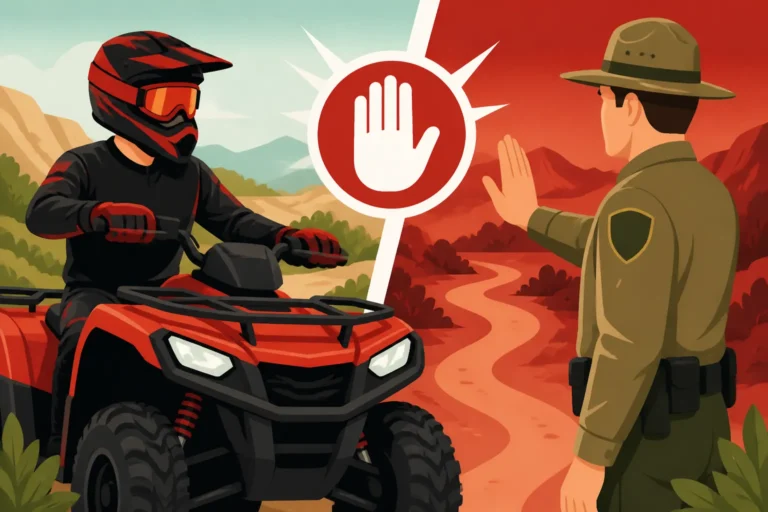
Even if an arroyo lies entirely on public land, such as Bureau of Land Management (BLM) or National Forest land, that doesn't automatically mean it's open for OHV travel. Federal agencies like the BLM and U.S. Forest Service manage their lands under what's called "travel management plans." These plans designate specific routes – trails, roads, and open areas – where OHV use is permitted. Everywhere else is typically closed to motorized travel. Many arroyos, by their very nature, are not designated routes. They are natural drainage features, not intentionally built trails.
Riding off a designated route, even unintentionally, can result in significant fines and penalties. This is covered in [New Mexico Rules for Riding Off a Route]. The environmental impact of riding in undesignated areas is also a major concern, leading to erosion, damage to fragile desert ecosystems, and disturbance of wildlife habitats. It's crucial to carry current maps – preferably GPS-enabled – that clearly show designated OHV routes. Don't assume that because a path exists naturally, it's open to your machine. Always look for signage and consult official maps before venturing into an arroyo.
Here's a quick overview of land types and general arroyo access:
| Land Type | Typical Access Rule for Arroyos | Key Considerations |
|---|---|---|
| Private Land | Strictly Prohibited without explicit, written permission from the landowner. | Trespassing: Legal consequences, fines, potential vehicle impoundment. Always verify boundaries. Often overlaps with ranching operations. |
| State Trust Land | Prohibited without a valid Recreational Access Permit from the New Mexico State Land Office. Permits have specific rules. | Permit Required: Check specific permit conditions for OHV use. Fines for non-compliance. |
| Tribal Land | Strictly Prohibited without explicit, direct permission from the tribal government. | Sovereign Nation: Each tribe has its own laws and regulations. Assume no access unless you have direct, written permission. |
| BLM Land | Generally Prohibited unless the arroyo is specifically part of a designated OHV route on an official travel management map. | Designated Routes Only: Refer to current BLM travel management maps. Fines for riding off-route. Environmental impact concerns. [New Mexico Rules for Riding BLM Land] are key here. |
| National Forest Land | Generally Prohibited unless the arroyo is specifically part of a designated OHV route on an official Forest Service map. | Designated Routes Only: Similar to BLM, follow Forest Service Motor Vehicle Use Maps (MVUMs). Seasonal closures may also apply, particularly at higher elevations. [New Mexico Riding Seasons by Elevation] can impact access. |
The Very Real Dangers of Arroyo Riding
Beyond the legal headaches, riding in arroyos presents a host of physical dangers that are unique to these environments. These aren't just minor inconveniences; they can be life-threatening and cause significant damage to your machine. The wild appeal of an arroyo can quickly turn into a harrowing ordeal if you're not prepared.
Flash Floods: The Silent Killer
This is, without a doubt, the most significant and insidious danger when riding arroyos. What appears to be a dry, dusty track can transform into a raging torrent in minutes, even if the sky directly above you is clear and blue. The reason? [Why an Arroyo Runs After a Desert Storm] explains that the rain causing the flood might have fallen miles upstream, in a distant mountain range or desert plateau. The water travels quickly through the hard-baked desert soil, building momentum and picking up debris as it funnels into the arroyo system.
These flash floods are incredibly powerful, carrying large rocks, tree trunks, and other debris that can easily sweep away an ATV or UTV – and its occupants. The water arrives with little to no warning, often as a sudden roar followed by a wall of muddy water. During [Flash Flood Season in the Southeast] and other parts of New Mexico, typically from July through September, the risk is especially high, but significant rain can happen at any time of year. Always check weather forecasts for the entire watershed upstream, not just your immediate location. If you see dark clouds in the distance, hear thunder, or notice the water starting to rise or change color, get out of the arroyo immediately and seek higher ground. Your life is not worth the risk of trying to outrun a flash flood.
Navigational Hazards and Vehicle Damage
Even when dry, arroyos are not smooth, predictable trails. They are natural, dynamic environments constantly reshaped by the last flood. This means you'll encounter a myriad of navigational hazards that can easily damage your vehicle or lead to an accident. Hidden rocks, often partially buried in sand, can rip open tires or bend rims. Deep, loose sand can bog down even powerful machines, leading to getting stuck, overheating, or rollovers if you're not careful with your throttle and steering inputs.
Sudden drops, washouts, and undercut banks are common features, created by the erosive power of water. You might be cruising along only to find a sharp, unexpected drop-off or a section where the bank gives way. This kind of unpredictable terrain demands constant vigilance and a slower pace. The remoteness of many arroyos also means that if you do break down or get stuck, help can be a long time coming. [Breaking Down Far From a Road] is a serious concern, as cell service is often non-existent. Having robust aftermarket protection, like heavy-duty skid plates, A-arms, and rock sliders from a reputable brand like SuperATV, can provide some peace of mind against impacts, but they are not a guarantee against all damage. Always inspect the terrain ahead and proceed with caution.
Trespass, Environmental Impact, and Fines
As mentioned earlier, riding where you shouldn't, whether on private land or off-designated routes on public land, carries legal repercussions. [New Mexico Fines for an OHV Violation] can be substantial, often hundreds of dollars, and repeated offenses can lead to even more severe penalties, including vehicle impoundment. Officers can and do patrol remote areas, and landowners are often vigilant about unauthorized vehicles on their property.
Beyond the legal aspects, there's a significant environmental impact. Arroyos are often home to sensitive flora and fauna, and their banks can be fragile. Riding off-trail can contribute to erosion, destroy vegetation, pollute water sources (if they do run), and disturb wildlife. Responsible OHV recreation means minimizing your footprint and respecting the environment you're enjoying. Ignoring land ownership and designated route rules not only puts you at risk of fines but also harms the very environment you came to experience and can lead to further restrictions for all riders.
Safer Alternatives and Responsible Riding
The allure of New Mexico's wild landscapes is undeniable, and your ATV or UTV is the perfect tool to explore them. But that exploration must be done safely, legally, and responsibly. While the appeal of an untamed arroyo might call to you, there are much better, and far safer, ways to experience the thrill of off-road riding in the Land of Enchantment.
Stick to Designated OHV Areas and Trails
The best and most responsible way to enjoy off-highway vehicle riding in New Mexico is to stick to designated OHV areas and marked trails. These areas are specifically managed for motorized recreation, meaning the land managers have considered safety, environmental impact, and user experience. They often have maps available, clear signage, and are usually easier to access and navigate. [Where to Ride an ATV in New Mexico] provides a great starting point for discovering these fantastic locations.
Places like the Red Sands OHV Area near Alamogordo, Glade Run Recreation Area in Farmington, or Haystack Mountain near Roswell offer diverse terrains, from sand dunes and washes to rocky trails, all within a legal and managed framework. Even within these areas, you might find arroyo-like features that are part of the established trail system, giving you that wild feeling without the legal and safety risks of uncharted territory. By choosing designated trails, you're not only protecting yourself and your machine but also contributing to the sustainability of OHV recreation for everyone.
Essential Gear and Preparedness for Any Off-Road Adventure
No matter where you choose to ride in New Mexico, preparedness is key. The desert can be unforgiving, and even on designated trails, conditions can change rapidly.
First, navigation is paramount. Don't rely solely on your phone; cell service is notoriously spotty in many remote areas. Carry a dedicated GPS device loaded with detailed topographical maps, or use an app that allows for offline map downloads. Always have a physical map and a compass as a backup. Knowing your route and where you are at all times can prevent you from inadvertently straying onto private land or into a hazardous situation.
Emergency supplies are non-negotiable. This includes plenty of water – far more than you think you'll need, especially during [Carrying Water in the Southern Desert] temperatures. A well-stocked first-aid kit, a fire extinguisher, and basic tools for minor repairs are also essential. Consider carrying a satellite messenger or personal locator beacon (PLB) for emergencies, as these can transmit your location even without cell service.
For your vehicle, ensure it's in top mechanical condition before every ride. Check tires, fluids, and brakes. If you're venturing into rougher terrain, consider upgrading critical components. For example, robust skid plates and heavy-duty suspension components, perhaps from a brand like SuperATV, can offer added protection against impacts from rocks and debris. Carry a tire repair kit and a portable air compressor to adjust tire pressure for different terrains (lower pressure for sand, higher for rocky trails) or fix a flat. Recovery gear, such as a winch, tow strap, and shovel, is crucial if you get stuck, especially in soft sand.
Finally, always inform someone of your planned route and estimated return time. Ride with a buddy if possible, especially when exploring new or challenging areas. By taking these precautions and sticking to legal, designated riding areas, you can have incredible, safe, and responsible adventures across the stunning landscapes of New Mexico.
Disclaimer
This article is for general informational purposes only and does not constitute professional advice. Laws, prices and regulations vary by location and change over time. Consult a qualified professional for guidance on your specific situation.