New Mexico Rules for Crossing a Highway
It's incredibly frustrating when you're out enjoying the vast, open spaces New Mexico has to offer on your ATV or UTV, only to find your adventure interrupted by a stretch of paved highway. You just want to get to the next trailhead, or perhaps connect two incredible riding areas, but that ribbon of asphalt feels like an impenetrable barrier. This guide is here to unravel the often-confusing rules surrounding highway crossings in the Land of Enchantment, ensuring you can navigate these necessary transitions safely and legally.
Understanding the Legal Landscape of Highway Crossings in New Mexico
Navigating the rules for riding your off-highway vehicle (OHV) in New Mexico can feel like deciphering a secret code, especially when it comes to paved roads. You’ve got this powerful machine built for dirt, rocks, and dunes, and then suddenly, you hit asphalt. It’s natural to feel a bit lost or even annoyed, wondering why you can’t just cruise down the road for a moment to reach the next dirt path.
Why Highways Are Different from County Roads
One of the biggest sources of confusion for OHV riders is understanding that not all paved roads are created equal in the eyes of New Mexico law. When we talk about "highways" in the context of OHVs, we're generally referring to state-maintained paved roads, often identified by numerical designations like US-70, NM-38, or I-25. These are the major arteries that crisscross our beautiful state, connecting towns and cities. The New Mexico statutes have specific provisions for these types of roads that are much stricter than for local county roads or city streets.
The general rule of thumb is that OHVs are strictly prohibited from riding on these state highways and especially interstates. This isn't just a matter of preference; it's a critical safety regulation designed to protect both OHV riders and other motorists. OHVs are typically slower, less visible, and handle very differently on pavement compared to cars and trucks, making them a hazard in high-speed traffic environments. This distinction is paramount, and understanding it is the first step in legally navigating the state’s road network.
This can be a real pain point for riders. You might be just a stone's throw from a fantastic riding area, but if a state highway lies between you and it, you can't just hop on the shoulder and ride down. It forces you to find alternative routes, often involving trailering your machine for short distances, which can feel like an unnecessary hassle when all you want to do is ride. But these rules are in place for serious reasons, primarily public safety.
The "Perpendicular Crossing" Rule
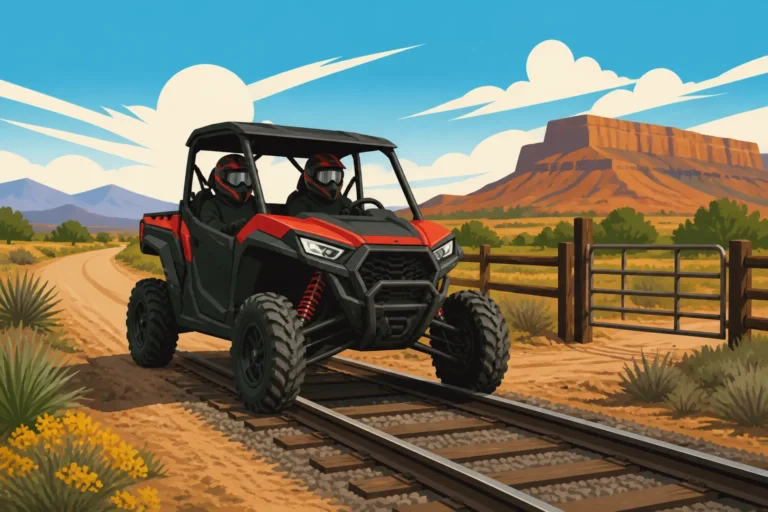
So, if you can't ride on a state highway, how do you get across it to reach trails on the other side? This is where the "perpendicular crossing" rule comes into play, and it's absolutely crucial for any New Mexico OHV enthusiast to understand. This rule is your lifeline for legally connecting riding areas separated by state roads. It explicitly permits an OHV to cross a paved public road or highway, provided the crossing is done at a ninety-degree angle to the road.
What does "perpendicular" mean in practical terms? It means you approach the paved road, stop, and then drive your machine straight across to the other side, making your path as close to a right angle with the highway as possible. You're minimizing your time and exposure on the paved surface, treating it like a temporary obstacle rather than a thoroughfare. Think of it as drawing a straight line from one side of the road to the other, without veering or traveling down the road itself. This regulation is designed to get you across the busiest and most dangerous parts of the road quickly and predictably.
The reasoning behind this specific rule is pure safety. By requiring a perpendicular crossing, the law aims to reduce the risk of collisions. It makes your movements more predictable to other drivers and minimizes the duration your OHV is exposed to high-speed traffic. Before you even think about initiating that crossing, it’s imperative to come to a complete stop and yield to all traffic, just as you would at a stop sign or a railroad crossing. You can learn more about this by checking out [Stopping Before You Enter a New Mexico Roadway]. This isn't a suggestion; it's a requirement to ensure everyone's safety on the road.
Essential Requirements for a Legal Highway Crossing
Even though you’re only on the pavement for a brief moment, New Mexico law doesn’t just let you free-for-all it. There are specific requirements your machine and you, the operator, must meet to make that crossing legal and, more importantly, safe. It’s not just about getting across; it’s about doing it responsibly and in compliance with the rules designed to prevent accidents.
Equipment Mandates for Paved Road Interaction
When your OHV touches pavement, even for a quick perpendicular crossing, it needs to meet certain basic equipment standards. These aren't just arbitrary rules; they're about making sure your machine is visible and controllable in an environment it wasn't primarily designed for. First and foremost, you'll need functional headlights and taillights. Your headlight must be capable of illuminating objects at least 150 feet ahead, and your taillight needs to be visible from at least 200 feet to the rear. This ensures that approaching and departing vehicles can see you, especially during dawn, dusk, or in less-than-ideal weather conditions. You can read up on [New Mexico Headlight and Taillight Rules] and [New Mexico Taillight Rules] for more detailed information.
Beyond lighting, your OHV must be equipped with working brakes – a no-brainer for any vehicle, but particularly critical when you might need to stop suddenly for highway traffic. A proper muffler with a spark arrester is also mandatory. While this is crucial for riding on public lands to prevent wildfires, it also helps keep your machine within acceptable noise limits when interacting with public roads. For details, see [New Mexico Spark Arrester Requirement]. While not strictly mandated for just a crossing, having mirrors can significantly enhance your awareness of traffic approaching from behind, and many riders find them invaluable. Many of SuperATV's aftermarket accessories, like their robust lighting kits and rearview mirrors, can help you meet or exceed these equipment requirements, giving you extra peace of mind and safety during those brief moments on asphalt.
Think of it this way: you’re temporarily entering a shared space with vehicles that are much larger and faster than your OHV. Ensuring your machine is highly visible and completely controllable is non-negotiable. It's not just about avoiding a ticket; it's about avoiding a catastrophic accident. Investing in quality lighting or making sure your existing system is up to snuff is a small price to pay for that safety.
Driver and Machine Eligibility
It’s not just your machine that needs to be ready; you, the operator, also have certain responsibilities and requirements. First, your off-highway vehicle must be properly registered with the New Mexico Motor Vehicle Division (MVD). This means having a current OHV decal displayed on your machine. For any interaction with paved roads, including crossings, you'll specifically need the green decal, which signifies your machine is authorized for both off-highway and limited on-highway use (like crossings). Without this, your machine is simply not legally allowed on any paved public road. Learn more about [New Mexico's Green On and Off-Highway Decal].
Next, you absolutely must carry proof of financial responsibility, which generally means liability insurance. Just like operating a car on New Mexico roads, you need to be able to cover damages in case of an accident. While you might not think of insurance for a quick crossing, any time you're on a public road, it's required. Your personal auto insurance policy might extend to your OHV, or you might need a separate policy. Either way, have that proof with you. [New Mexico's Mandatory Financial Responsibility Act] provides the legal basis for this requirement.
Finally, and this often surprises some riders, you must possess a valid driver's license to operate your OHV on any paved public road in New Mexico, even for a brief crossing. This isn't a learner's permit; it's a full, unexpired driver's license. This ensures you have a basic understanding of traffic laws and safe driving practices. While there are age rules for riding off-road, the moment you touch pavement, the driver's license requirement kicks in. For information on who can operate an OHV on a road, check out [New Mexico Minimum Age to Ride Off-Road] and [A Driver's License on a New Mexico Paved Road]. These requirements aren't there to make your life harder, but to ensure that anyone operating a vehicle on a public road has a baseline level of competence and responsibility.
The Act of Crossing: Step-by-Step and Safety Considerations
Crossing a highway, even under the legal "perpendicular" rule, is perhaps the riskiest part of any OHV journey that involves interaction with paved roads. It requires your full attention, precise execution, and an unwavering commitment to safety. You're merging (briefly) into traffic moving at potentially high speeds, and your machine is not designed for this environment. So, let's break down how to execute this maneuver properly.
Executing a Safe and Legal Crossing
The moment you approach a paved state highway that you need to cross, your mindset needs to shift. Leave the throttle-happy trail riding behind for a few minutes. First, slow way down as you get to the edge of the pavement. Before any part of your OHV touches the asphalt, you must come to a complete and undeniable stop. This isn't a rolling stop; it's a full pause, just as if you were pulling out onto a busy street from a private driveway. This step is mandated by law and critical for your safety. You can learn more about this by referring to [Stopping Fully Before You Cross the Asphalt].
Once stopped, it’s time to activate your senses. Look both ways, repeatedly, for oncoming traffic. Don't just glance; actively scan the road for vehicles. Remember, cars and trucks on a highway are often traveling at 55 MPH or more, meaning they cover ground incredibly fast. Estimate their speed and distance carefully. If you have turn signals (some SuperATV kits include street-legal signal setups), use them to indicate your direction of travel. If not, consider clear and assertive hand signals if it's safe to do so. Once you have a clear, safe window, cross in a single, continuous motion, maintaining that ninety-degree angle. Accelerate smoothly but briskly to minimize your time on the pavement. Your goal is to get from dirt on one side to dirt on the other in the most direct way possible.
It's also essential to keep your OHV in a stable and predictable manner during the crossing. Avoid sudden swerving, braking, or accelerating. Your machine’s tires might have less grip on pavement than dirt, so smooth inputs are key. Ensure your tires are in good condition and at an appropriate pressure; SuperATV offers a variety of tires and suspension components that can enhance stability and control across diverse terrains, which is beneficial even for brief paved interactions. This whole process might only take a few seconds, but those seconds require your absolute focus and careful execution to ensure a safe transition.
Prohibited Actions and Common Pitfalls
While the perpendicular crossing rule provides a legal pathway, it's equally important to understand what is not allowed. Any deviation from the strict perpendicular crossing is illegal and incredibly dangerous. You absolutely cannot ride along the highway, even for a short distance on the shoulder or breakdown lane, to find a better crossing point or to avoid an obstacle. The moment you begin traveling parallel to the highway, you're in violation of the law and at severe risk. This also means no U-turns or any maneuvers that keep you on the pavement longer than necessary to traverse the width of the road.
Another major pitfall is attempting to cross an interstate freeway. This is unequivocally prohibited. Interstates are high-speed, limited-access highways, and OHVs are expressly forbidden from operating on or even crossing them. This is a non-negotiable rule that you must adhere to for your own safety and legal compliance. Make sure to consult [Which Freeways You May Not Even Cross] for clarity on this. Furthermore, never assume that highway traffic will yield to you. OHVs are not granted the right-of-way on state highways, so you must always yield to all oncoming traffic. Rushing, misjudging distances, or failing to stop completely are common mistakes that can lead to severe consequences, including significant fines and potential accidents. [New Mexico Fines for an OHV Violation] outlines some of the penalties you could face for non-compliance.
The temptation to quickly ride down the shoulder for "just a little bit" can be strong, especially if your desired exit point is just around a bend. Resist this urge. The law is clear, and enforcement is strict. These rules are in place because OHVs and fast-moving highway traffic are a perilous combination. Staying disciplined in your crossing technique is paramount to a safe and enjoyable riding experience in New Mexico.
Local Ordinances and Paved Road Plates
The legal landscape for OHVs on paved roads in New Mexico is a bit like a patchwork quilt. While state highways have very strict, uniform rules, local roads can be a different story. This means you need to be aware of what’s happening at the county and city level, because those local decisions can significantly impact where and how you can ride.
The Role of Local Ordinances in Road Access
While state highways generally remain off-limits for anything beyond a perpendicular crossing, many New Mexico counties and some cities have the authority to open their own roads to OHV use through local ordinances. This is a game-changer for riders because it means certain paved county roads or city streets might actually be legal for OHV travel. This allows for connections between trail systems, access to fuel, or even just scenic drives. It's important to understand that these ordinances vary widely from one jurisdiction to another. What's legal in Sierra County might be illegal in Otero County, and what's allowed in Red River might be prohibited in Taos.
This variability can be incredibly frustrating for riders who travel across the state. You might be legally riding on a county road, only to find yourself abruptly on a prohibited street when you cross an invisible jurisdictional line. This is why doing your homework before you ride in a new area is so critical. Always check with the local county sheriff's office or city hall to understand their specific OHV ordinances. You can find more generalized information on [New Mexico Rules for Riding a County Road] and [New Mexico Rules for Riding a City Street]. It's also worth noting that even if a county road is open, a state highway crossing to reach it still requires strict adherence to the perpendicular crossing rule.
This is where a good GPS or mapping system becomes invaluable. Many modern OHVs come with integrated navigation, or you can add aftermarket units. SuperATV offers various mounts and accessories for these systems, helping you keep track of where you are and, ideally, alerting you to known jurisdictional boundaries. Knowing which roads are open and which are closed can prevent tickets and keep you on the right side of the law, making your adventures much smoother.
When a Paved Road Plate Comes into Play (and When It Doesn't for Crossing)
New Mexico offers a "Paved Road Plate" for OHVs, which can add another layer of complexity to understanding road access. This plate, distinct from your regular OHV decal, allows your machine to be operated on certain paved public roads, specifically those city or county streets that have been opened by local ordinance. It’s a fantastic option for riders who want to take full advantage of those locally designated routes, like cruising through Red River or exploring the open roads of Sierra County. You can learn more about this plate in [New Mexico's Paved Road Plate].
However, here’s the critical distinction: having a Paved Road Plate does not grant you permission to ride on state highways, nor does it alter the perpendicular crossing rule for state highways. Even with a Paved Road Plate, if you encounter a state highway, you must still come to a complete stop and cross it at a ninety-degree angle, just as any other OHV would. The plate is for use on those specific local paved roads, not for transforming a state highway into an open route for your OHV. It’s important not to confuse the limited privileges of the Paved Road Plate with a blanket allowance to ride on all paved roads.
So, while the Paved Road Plate significantly expands your riding options on local streets, it doesn't change the fundamental rules for interacting with state highways. You still need to be registered with a green decal, have insurance, and possess a valid driver's license for any paved road interaction. For those machines equipped with a Paved Road Plate, ensuring your OHV is robust enough for increased paved-road use is key. SuperATV provides a wide range of products, from stronger axles to enhanced suspension, that can improve your machine's durability and comfort for extended riding on varied surfaces, including those paved local roads.
| Aspect of Road Use | State Highway (Crossing) | Opened County/City Road (With Green Decal) | Opened County/City Road (With Paved Road Plate) |
|---|---|---|---|
| Action Permitted | Perpendicular crossing ONLY | Limited travel, usually at lower speeds | Extended travel, adhering to local rules |
| Registration Required | Green OHV Decal | Green OHV Decal | Green OHV Decal AND Paved Road Plate |
| Driver's License | Mandatory | Mandatory | Mandatory |
| Insurance | Mandatory | Mandatory | Mandatory |
| Equipment | Headlights, taillights, brakes, muffler | Same as crossing | Same as crossing, plus potential local additions |
| Speed Limit | As quick as safely possible while crossing | Adhere to posted local limits | Adhere to posted local limits |
| Duration of Use | Brief, single motion | Limited, to access trails/amenities | Extended, as allowed by ordinance |
| Yield to Traffic | ALWAYS yield to highway traffic | Yield as per normal road rules | Yield as per normal road rules |
Disclaimer
This article is for general informational purposes only and does not constitute professional advice. Laws, prices and regulations vary by location and change over time. Consult a qualified professional for guidance on your specific situation.