New Mexico’s Perpendicular Crossing Rule
Many New Mexico ATV and UTV riders dream of endless trails and wide-open spaces, but the reality often involves encountering paved roads when trying to link up different riding areas or simply access a trailhead. Navigating these asphalt stretches with an off-highway vehicle can be a source of real anxiety and confusion, especially with the fear of receiving a costly citation or, worse, being involved in an accident. This guide is designed to demystify New Mexico's specific "perpendicular crossing rule," helping you understand exactly what it means, why it's so important, and how to execute it perfectly every time, transforming a potentially stressful situation into a smooth, legal, and safe part of your adventure.
What Exactly is New Mexico's Perpendicular Crossing Rule?
The idea of riding an OHV on a paved road in New Mexico often conjures up images of strict prohibitions, and for good reason. Our machines aren't really built for high-speed asphalt, and mixing them with traditional traffic can be genuinely hazardous. However, the law does recognize that sometimes you just have to get across a paved road to reach another section of trail or access public land. That's where the perpendicular crossing rule comes into play, offering a narrow, carefully defined window for these necessary transitions.
Defining the "Perpendicular Crossing"
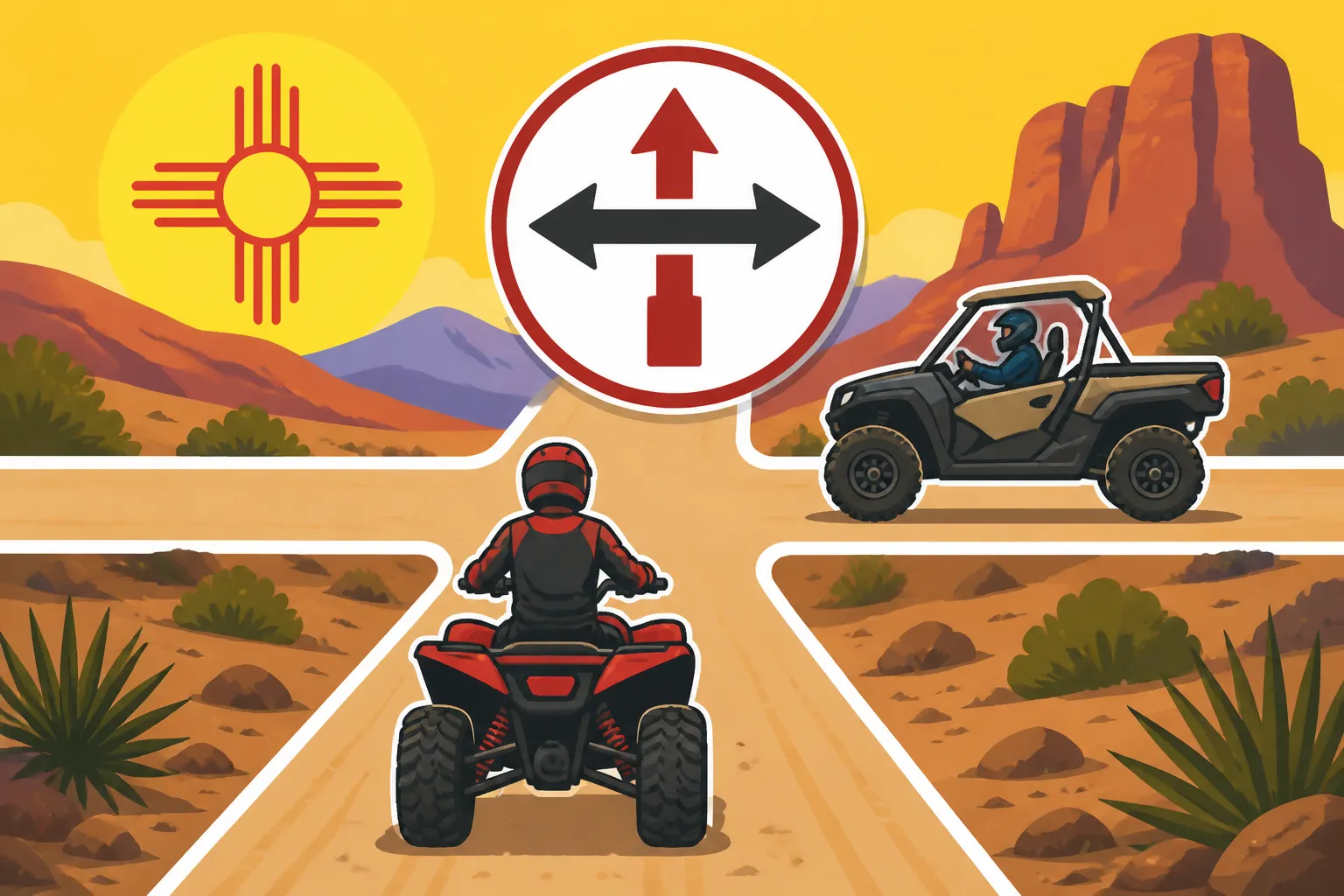
At its heart, a "perpendicular crossing" means taking the shortest, most direct route possible across a paved roadway. Think of it like drawing a straight line from where you enter the pavement to where you exit it on the opposite side. This isn't about turning onto the road and riding along it, even for a short distance; it's about minimizing your time on that surface as much as humanly possible. The aim is to reduce the exposure of your off-highway vehicle to fast-moving traffic and to maintain the safety of everyone sharing the road.
Imagine you're on a dirt track that dead-ends into a two-lane paved county road, with another trail picking up directly on the other side. You're not meant to turn left or right on that paved road, even if the trail entrance on the opposite side is a little to your left or right. Your responsibility is to cross straight over, like the short leg of a right-angle triangle. This might feel a bit counterintuitive, especially if you've seen riders in other states casually cruise down shoulders, but in New Mexico, that direct, straight path is the defining characteristic of a legal crossing. It's a precise maneuver designed to get you off the pavement as quickly as you got on it.
Distinguishing Crossing from Riding on a Paved Road
This is where many riders inadvertently get into trouble. There's a fundamental difference between crossing a paved road and riding on a paved road. The perpendicular crossing rule is exclusively for the former. It grants you permission for a brief, direct traversal of the roadway, nothing more. It doesn't give you license to travel down the shoulder, even if you're only going 100 feet to reach a better entry point for the next trail. That 100 feet, to law enforcement, constitutes "riding on" the paved road, which typically requires a special green "on and off-highway" decal and specific local ordinances allowing such use. You can read more about what's required to legally travel on pavement in [New Mexico's Green On and Off-Highway Decal].
Consider a scenario: you've successfully crossed a highway and on the other side, you see the continuation of your trail about 50 yards to your left. You might think, "Well, I'm already here, I'll just drive down the paved shoulder a little bit." Resist that urge! That short drive on the pavement is a violation. The perpendicular crossing rule implicitly means you must cross to a point where you can immediately exit the paved surface and resume off-highway travel. The intent is to keep OHVs on designated off-road trails and minimize their interaction with conventional traffic, only allowing the briefest, most necessary intersections.
Which Roads Does This Rule Apply To?
New Mexico's perpendicular crossing rule generally applies to all paved public roads, including state highways, most county roads, and city streets, unless there's a specific local ordinance stating otherwise. It's a broad brush stroke to ensure consistency and safety across the state's diverse road network. You might be in a remote part of the Lincoln National Forest, encountering a quiet two-lane county road that sees little traffic, or perhaps you're on the outskirts of a small town where a paved street connects two dirt routes. In almost all these instances, the perpendicular crossing rule is what governs your interaction with that paved surface.
It's a common misconception that less-trafficked, rural paved roads are somehow exempt from these rules. Unfortunately, that's not typically the case without explicit local government action. Many counties in New Mexico have not opted to open their roads to general OHV use, and therefore, even those quiet paved stretches are subject to the crossing rule. It's crucial not to assume a road is open just because it looks like a suitable path. Always assume the most restrictive interpretation of the law (crossing only) unless you have confirmed that a specific road or jurisdiction has adopted an "opt-in" ordinance. This is why it's so important to understand [Why New Mexico Counties Open Only Their Own Streets] and to know when [New Mexico's Paved Street Opt-In] might apply.
Why New Mexico Emphasizes Perpendicular Crossings
The state's insistence on perpendicular crossings isn't about making your life harder; it's deeply rooted in safety and practical considerations. When you understand the "why" behind the rule, it often makes more sense and encourages compliance. These regulations are designed to protect you, other drivers, and even the infrastructure itself from the unique challenges posed by mixing off-highway vehicles with paved roads.
Enhancing Safety for OHV Riders
One of the primary reasons for the perpendicular crossing rule is the inherent safety risk to OHV riders themselves when on paved roads. Off-highway vehicles, whether an ATV, UTV, or dirt bike, are engineered for dirt, rock, sand, and mud. Their knobby tires provide excellent traction off-road but can become unstable and offer poor grip on smooth asphalt, especially during turns or emergency braking. The suspension systems are designed for absorbing bumps and jumps, not for the stable, low-profile handling required on pavement.
Imagine you're riding a UTV equipped with aggressive mud tires. If you were to turn onto a paved road and attempt to accelerate or brake suddenly, those tires would have significantly less contact patch and grip than a road vehicle's tires, potentially leading to a skid, loss of control, or even a rollover. The risk is even higher for ATVs, which require active body english to maintain stability, a technique that becomes precarious on pavement. By limiting your time on the paved surface to the absolute minimum—a straight, direct crossing—the state dramatically reduces your exposure to these inherent design limitations and the potential for a severe accident. This rule directly works to protect you from the very real dangers of operating your machine outside its intended environment.
Protecting Other Motorists
Beyond rider safety, the perpendicular crossing rule also serves to protect other motorists who are using the paved roads. Predictability is a cornerstone of road safety. Drivers of cars and trucks expect to share the road with other vehicles that behave in a certain way: maintaining lane discipline, signaling turns, and stopping efficiently. OHVs, by their very nature, can be unpredictable on pavement. They are often slower, handle differently, and can be harder for other drivers to see, especially if they're not expecting them.
Picture a situation where an ATV suddenly enters a paved highway at an angle, or attempts to ride along the shoulder. A driver in a car traveling at highway speeds might not anticipate this maneuver. The OHV's slower acceleration and braking capabilities mean it stays in the traffic flow (or near it) for a longer period, creating a moving hazard. This can force other drivers to brake hard, swerve, or take evasive action, increasing the risk of multi-vehicle collisions. By requiring a perpendicular crossing, New Mexico aims to make OHV-paved road interactions as brief and predictable as possible. A straight crossing minimizes the time an OHV is an active participant in the traffic flow, reducing surprise elements and allowing other drivers to react more safely to a known, quick maneuver rather than an extended, unfamiliar presence.
Minimizing Pavement Wear and Tear
While perhaps a less immediate concern than safety, the impact of OHV tires on paved road surfaces is another factor in the perpendicular crossing rule. The aggressive, knobby treads of off-highway tires are designed to dig into loose terrain, providing grip where smooth tires would slip. On asphalt, however, these same treads can act like tiny chisels or grinding tools. When an OHV rides along a paved road, especially if it's turning or accelerating forcefully, those knobby tires can contribute to accelerated wear and tear on the road surface.
Over time, frequent or extended OHV use on pavement, particularly in high-traffic crossing areas, can lead to rutting, premature deterioration of the asphalt, and increased maintenance costs for state and local road departments. While a single perpendicular crossing is unlikely to cause significant damage, widespread non-compliance where OHVs frequently ride along shoulders or make long, angled entries could cumulatively degrade road conditions. The rule, therefore, helps to preserve the integrity of New Mexico's road infrastructure, ensuring that tax dollars designated for road maintenance are used efficiently on damage caused by vehicles designed for paved roads, rather than machines with aggressive treads that are better suited for the dirt.
Executing a Legal Perpendicular Crossing: A Step-by-Step Guide
Executing a perpendicular crossing properly isn't just about avoiding a ticket; it's about safeguarding your life and the lives of others. It requires a deliberate, focused approach. Rushing this critical maneuver is a recipe for disaster. Let's break down the process into actionable steps to ensure you navigate paved roads safely and legally every time.
Approaching the Roadway Safely
The first step in any successful perpendicular crossing begins well before you even reach the edge of the pavement. As you approach a paved road from a trail, your mindset needs to shift immediately from off-road adventuring to extreme caution. Slow your vehicle down significantly. You should be traveling at a speed that allows you to stop safely and completely before reaching the road's edge. This slow approach gives you ample time to scan the area for traffic coming from both directions, as well as any potential hazards on the road or the shoulders.
Look for a clear, direct path across the road to where the trail continues on the other side. This might sound obvious, but sometimes a trail will meet a road at an odd angle, or the continuation on the other side isn't directly opposite. Your goal is to identify the shortest, straightest line. Also, be mindful of visibility. If there are blind curves or hills just before the crossing, exercise even greater caution. If your machine is equipped with mirrors, like those often available from SuperATV for added utility and safety, use them to check your flanks as you slow down and prepare to stop. Every piece of information helps you make a safer decision.
Stopping, Looking, and Yielding to Traffic
Once you've safely approached and identified your crossing point, you must come to a complete and absolute stop. This isn't a rolling stop, nor is it a slow crawl as you look both ways. It's a full, wheels-still, engine-idling stop right at the edge of the pavement or before any white stop line, if present. This is a non-negotiable step that gives you the best opportunity to thoroughly assess traffic conditions. You can find more detail on this critical step in [Stopping Before You Enter a New Mexico Roadway].
From your stopped position, look left, then right, then left again, perhaps even a second full scan. Pay close attention to the speed and distance of any oncoming vehicles. Remember, cars and trucks on paved roads often travel much faster than you anticipate, especially in rural areas where speed limits might be higher. Your OHV's acceleration isn't comparable to a car's, so you need a significantly larger gap in traffic to cross safely. Yield to all oncoming traffic, regardless of how far away it seems. If there's any doubt about having enough time to cross completely before a vehicle reaches you, simply wait. Patience is your most powerful tool in this moment.
Crossing the Roadway Directly and Efficiently
When you are absolutely certain the path is clear and you have sufficient time, engage your vehicle and cross the roadway directly. Maintain a straight line, going from one side of the pavement to the other in the most efficient manner possible. This isn't the time for fancy maneuvers, sudden turns, or testing your machine's top speed. The objective is to cover the paved distance as quickly and smoothly as possible while maintaining full control of your vehicle.
Accelerate smoothly and consistently. Avoid any abrupt movements that could cause your knobby tires to lose traction on the asphalt or destabilize your machine. Your focus should be entirely on getting across to the off-road surface on the other side without deviation. Remember, the law specifies a perpendicular crossing, which means as close to a 90-degree angle as the situation allows, getting you off the asphalt in the shortest possible distance. For additional guidance on this specific maneuver, refer to [Crossing as Close to Square as You Can].
Continuing Your Ride Off-Road
Congratulations, you've successfully navigated the paved road! The final, but equally important, step is to immediately continue your ride off-road once you've crossed. As soon as all four (or more) wheels of your OHV are off the paved surface and onto the dirt, gravel, or designated trail, your focus should shift back to the off-highway environment. There should be no lingering on the shoulder, no short jaunts down the paved road to reposition, and absolutely no riding along the asphalt.
The moment you've cleared the pavement, you are back in an off-highway zone. This means adhering to all off-road rules and regulations. The purpose of the crossing was solely to transition between off-road areas, not to temporarily use the paved road for travel. Maintaining this strict boundary not only keeps you compliant with the law but also reinforces safe riding habits and minimizes any potential for misinterpretation by law enforcement or other road users. Always be mindful of the rules for [New Mexico Rules for Crossing a Highway].
Common Mistakes and How to Avoid Them
Even with the best intentions, it's easy to fall into common traps when crossing paved roads with an OHV. These mistakes, often born of convenience or a lack of understanding, can quickly turn a quick transition into a costly citation or, far worse, a dangerous incident. Being aware of these pitfalls is the first step in avoiding them and ensuring your ride remains safe and legal.
Attempting Diagonal or Angled Crossings
One of the most frequent mistakes riders make is attempting to cross a paved road at an angle rather than perpendicularly. This usually happens when the trail on the opposite side isn't directly lined up with where you're entering the road, or if a rider tries to cut a corner. A diagonal crossing means your OHV spends more time on the paved surface, increasing your exposure to traffic and the risk of an accident. It also looks less deliberate and more like you're simply riding on the road.
Imagine a scenario where you're approaching a paved road, and you see the continuation of your dirt trail about 75 feet down the road to your left. Instead of crossing straight over to the shoulder and then navigating to the trail entrance, a rider might try to angle their machine across the road directly to that point. While this might seem more efficient from a riding perspective, it's a clear violation of the perpendicular rule. You're meant to cross directly to the opposite side, minimizing your time on the pavement. If the trail doesn't line up, you must cross straight, get off the pavement, and then off-road maneuver to your desired entry point, even if it's a bit of a scramble or means backtracking slightly on dirt.
Failing to Come to a Complete Stop
Another incredibly common, and dangerous, mistake is the "rolling stop." We all do it occasionally in our cars at stop signs, but it's completely unacceptable and illegal when crossing a paved road on an OHV. A rolling stop means you slow down significantly, glance both ways, and then proceed without bringing your vehicle to a full, momentary halt. This momentary halt is crucial because it allows you to fully disengage from the forward motion of your machine and devote 100% of your attention to scanning for traffic and assessing the safety of your crossing.
Consider this: you're approaching a paved road, and you slow down to about 5 MPH. You look, see no immediate traffic, and proceed. But what if a vehicle suddenly appears from behind a slight bend, or a patch of gravel on the shoulder causes your knobby tires to slip when you try to accelerate? If you haven't come to a complete stop, your reaction time is compromised, and you might not have the stability to adjust. An officer observing this will almost certainly issue a citation for failing to stop, and rightly so. The state wants you to be as stable and aware as possible before entering any paved roadway, and that starts with a full, definitive stop.
Riding Along the Pavement After Crossing
Even if you execute a perfect perpendicular crossing, the job isn't done until you're completely off the paved surface and stay off. A mistake many riders make is crossing the road and then riding along the shoulder, or even in the lane, for a short distance before re-entering an off-highway trail. This is not considered part of the crossing; it's considered riding on the paved road, and it's generally illegal without the proper decals and local allowances.
Let's say you cross a two-lane road perfectly, but the dirt access point on the other side is about 30 feet to your right. If you turn right on the pavement (even the shoulder) to reach that access point, you are now in violation. The expectation is that you cross directly to a point where you can immediately exit the paved surface. If the dirt trail on the other side doesn't directly line up, you may need to find a different crossing point, or be prepared to navigate a short distance off-road (e.g., through brush or uneven terrain) once you've crossed, to get to where you need to be. The pavement is literally a "no-go" zone for travel, only for crossing.
Group Crossings: Safety in Numbers (or Not)
Riding in a group is one of the joys of OHV recreation, but it can introduce unique hazards, especially during paved road crossings. The "safety in numbers" mentality can sometimes lead to a relaxation of individual vigilance. When the lead rider in a group crosses, there's a natural tendency for subsequent riders to follow quickly, assuming the path is still clear. This can be a grave error.
Imagine a group of four UTVs. The lead driver performs a perfect stop, looks, and crosses. The second driver, eager to stay close, quickly follows, barely stopping, assuming the road is still clear because the first driver just went. However, in the brief seconds it took for the first machine to cross, a car might have appeared around a bend. The second rider, relying on the leader's assessment rather than their own, is now in immediate danger. Every single rider in a group is individually responsible for performing their own complete stop, their own thorough scan for traffic, and their own safe, perpendicular crossing. Don't rely on the person in front of you. Encourage communication within your group about traffic, and ensure everyone understands that individual safety checks are paramount.
Consequences of Violating the Perpendicular Crossing Rule
Ignoring New Mexico's perpendicular crossing rule isn't just a minor oversight; it carries real and significant consequences that can quickly ruin your day, your wallet, or even your health. Understanding these potential repercussions is a strong motivator for adhering to the regulations.
Understanding Potential Fines and Penalties
The most immediate and tangible consequence of violating the perpendicular crossing rule is receiving a citation. Law enforcement officers, whether state police, county sheriffs, or even game and fish rangers, are aware of these rules and often patrol areas where OHVs commonly encounter paved roads. If an officer observes you making an illegal angled crossing, failing to stop, or riding along the pavement, they have the authority to pull you over and issue a ticket.
These fines are not trivial. A single violation can easily result in a citation costing hundreds of dollars, depending on the specific infraction and the jurisdiction. In some cases, if the violation is deemed particularly egregious or if you're engaging in other unsafe behaviors, you could even face impoundment of your vehicle, though this is less common for a simple crossing infraction. Beyond the monetary cost, a citation means a mark on your record, and potentially having your riding day cut short. You can learn more about general penalties in [New Mexico Fines for an OHV Violation]. It's a hefty price to pay for a moment of impatience or misunderstanding, far outweighing any perceived convenience of bending the rules.
Increased Risk of Accidents and Injuries
While fines are a significant deterrent, the far more severe consequence of violating the perpendicular crossing rule is the dramatically increased risk of an accident. Paved roads, especially those with higher speed limits, are inherently dangerous environments for OHVs. As we've discussed, these machines are not designed for road use, and their characteristics (knobby tires, high center of gravity, different braking dynamics) make them more susceptible to loss of control on asphalt.
If you make an angled crossing, fail to stop, or ride along the pavement, you are significantly increasing the chances of a collision with a car or truck. Other drivers are simply not expecting an OHV to be maneuvering in that way, and their reaction time might be insufficient to avoid impact. The results of such a collision can be catastrophic, leading to severe injuries or even fatalities for the OHV rider and potentially occupants of the other vehicle. It's not just about getting a ticket; it's about life and limb. A moment of disregard for the rule can lead to lifelong physical consequences, not to mention the emotional and financial burden of medical bills, vehicle damage, and potential legal action.
Officer Discretion and Enforcement Variability
It's important to remember that while the law is clear, the application of enforcement can sometimes involve officer discretion. A state trooper might issue a warning for a minor, first-time infraction in a very remote area, especially if you are cooperative and respectful. However, this is by no means a guarantee. In busier areas, or if the officer perceives your actions as overtly reckless, or if there have been previous issues with OHVs in that specific location, they are much more likely to issue a full citation without hesitation.
Do not gamble on an officer's leniency. Always assume that the letter of the law will be strictly enforced. The variability in enforcement should not be interpreted as an invitation to push the boundaries of the rule. Instead, it should reinforce the idea that compliance is your best and safest strategy. It's better to ride cautiously and legally than to hope for a break from a law enforcement officer, especially when your safety and the safety of others are at stake.
Beyond the Crossing: Other Paved Road Rules for New Mexico OHVs
While the perpendicular crossing rule is a critical piece of the puzzle, it's just one aspect of New Mexico's broader regulations regarding OHVs and paved roads. If you're looking to do more than just cross a road – perhaps ride on a specifically designated open county road – there are additional requirements you absolutely must know and follow.
| Action / Requirement | Purpose | Legality for OHV on Pavement | Notes |
|---|---|---|---|
| Perpendicular Crossing | Safely link off-road sections | Legal (with full stop and yield) | Minimal time on pavement, straight path only. |
| Riding on Paved Road | Travel along designated roads | Legal ONLY with specific decal & local ordinance | Requires Green "On & Off-Highway" decal and an opened road. |
| Full Stop Before Pavement | Assess traffic & ensure safety | Mandatory for any crossing or entry | No "rolling stops." |
| Yield to All Traffic | Prevent collisions | Mandatory for any crossing or entry | Vehicles on pavement have right-of-way. |
| Helmet (Under 18) | Head protection for young riders | Mandatory on any public land/road | Always a good idea for all riders. |
| Eye Protection (Any Age) | Protect eyes from debris & glare | Mandatory on pavement | Goggles or face shield required. |
| Liability Insurance | Financial responsibility for accidents | Mandatory for any pavement use | Required for green decal; carries proof. |
| Mirrors, Headlights, Taillights | Visibility & road compliance | Mandatory for pavement travel | Check [New Mexico Equipment Rules for Road Use] for specifics. |
| Spark Arrester | Prevent wildfires | Mandatory on public land (on/off-road) | All OHVs require a USFS-approved spark arrester. |
The Importance of Decals and Plates for Road Use
Let's be clear: the perpendicular crossing rule applies even if your OHV only has the yellow "off-highway" decal. However, if your aspirations go beyond merely crossing and you want to actually travel along certain paved roads, you'll need to step up your game. New Mexico offers a green "on and off-highway" decal (and sometimes, historically, a paved road plate, though the rules evolve). This green decal specifically permits your registered OHV to be operated on paved roads that have been designated as open to OHV use by a specific county or city ordinance.
This isn't a one-size-fits-all solution; having the green decal doesn't automatically mean you can ride on any paved road. You still need to verify local regulations. But if you're planning to ride in an area like Sierra County, which has opened many of its county roads, this decal is absolutely essential. It signifies that your machine is compliant with the additional requirements for road use, which often include proof of liability insurance. You can dive deeper into these requirements with [New Mexico's Green On and Off-Highway Decal]. For those looking to equip their machines for such versatile use, companies like SuperATV offer a wide range of accessories, from turn signal kits to DOT-approved tires, that can help your OHV meet the more stringent demands of shared road environments, even if they don't sell the decals themselves.
Helmet, Eye Protection, and Insurance Requirements
Operating an OHV on any paved surface, whether crossing or traveling on an open road, brings with it a heightened set of safety and legal responsibilities. New Mexico has specific regulations concerning helmets and eye protection, particularly for younger riders, and mandates financial responsibility (liability insurance) for any OHV using public roads.
For instance, all riders under the age of 18 are required to wear a helmet when operating an OHV on public land or roads. Even if you're just making a brief, perpendicular crossing, if you're under 18 and not wearing a helmet, you're in violation. Additionally, eye protection is required for all riders, regardless of age, when operating an OHV on a paved surface. Goggles or a helmet with a face shield are essential to protect your vision from dust, debris, and glare that you're more likely to encounter at road speeds. Furthermore, New Mexico's Mandatory Financial Responsibility Act applies to OHVs operating on paved roads, meaning you must carry proof of liability insurance. This protects you and others in case of an accident. Ignoring these requirements can lead to additional fines and, more critically, leaves you vulnerable to serious injury or financial ruin in the event of a collision. Make sure you understand [New Mexico Helmet Law for ATV Riders] and [New Mexico ATV Insurance Requirement].
Designated Open Roads vs. General Paved Roads
This distinction is perhaps one of the most confusing aspects for OHV riders in New Mexico, and it's critical to understand. The perpendicular crossing rule applies to all paved roads. However, the ability to travel along a paved road is much more restrictive. It is generally only permitted on roads that have been explicitly designated as open to OHV use by a specific local (county or city) ordinance or resolution. These are often referred to as "opt-in" roads.
Many counties and municipalities in New Mexico have not passed such ordinances, meaning their paved roads remain closed to OHV travel. Simply seeing a county road sign does not grant you permission to ride your UTV down it. You must do your homework and confirm which specific roads, if any, are open in the area you plan to ride. Riding on a paved road that hasn't been officially opened, even with a green decal, can lead to a citation. This is why resources like [New Mexico's Paved Street Opt-In] are so important. For those committed to utilizing these open roads, ensuring your machine has the necessary safety and visibility equipment, such as proper lighting, turn signals, and mirrors—items often available from brands like SuperATV—becomes just as vital as having the right decals and insurance. It's about being prepared for both the legal and practical demands of sharing the road.
Disclaimer
This article is for general informational purposes only and does not constitute professional advice. Laws, prices and regulations vary by location and change over time. Consult a qualified professional for guidance on your specific situation.