Registering a Hunting Quad in New Mexico
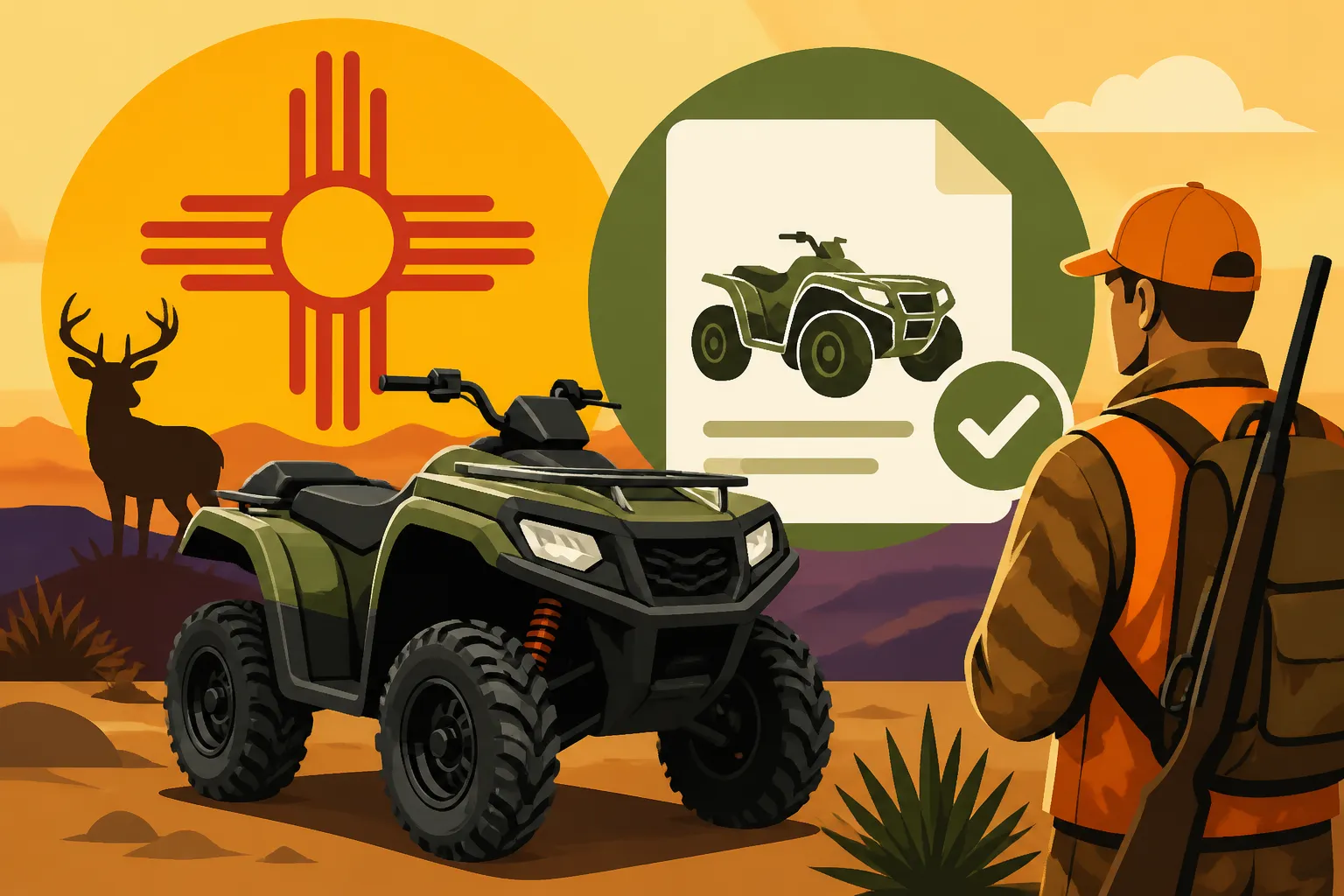
There's nothing quite like the freedom of using your quad to access those remote hunting spots in New Mexico. You've got your gear, your tags, and your trusty machine, but one thing can quickly turn a hopeful morning into a frustrating encounter: improper registration. This guide will walk you through everything you need to know about registering your hunting quad in New Mexico, ensuring your focus stays on the hunt, not on legal headaches.
Understanding New Mexico's OHV Registration for Hunters
When you're planning a hunting trip, the last thing you want to worry about is whether your off-highway vehicle (OHV) is legal to operate. Many hunters assume that if they're only using their quad on private land or designated trails for hunting access, registration might not be necessary. However, New Mexico law is pretty clear on this, and it’s important to understand the requirements to avoid fines and interruptions to your hunting season.
Why Your Hunting Quad Needs Registration
Even if your primary use for a quad is to haul gear, scout locations, or retrieve game during hunting season, it falls under the same OHV registration requirements as any machine used for recreational trail riding. New Mexico statutes define an OHV broadly, encompassing ATVs, UTVs, dirt bikes, and even some dune buggies. If you plan to operate your hunting quad on any public land – and that includes designated routes within National Forests, BLM lands, or State Trust Lands where hunting often occurs – it absolutely needs to be registered. This isn't just a bureaucratic hurdle; it’s about funding the trails and programs that benefit all OHV users, including hunters. Without proper registration, you risk a citation from a New Mexico Game and Fish officer, a Forest Service ranger, or a BLM law enforcement officer, which can certainly put a damper on your hunting trip. It also contributes to ensuring that there’s a system in place to identify machines, which can be crucial in cases of theft or accidents.
Moreover, if you ever need to cross a paved public road, even just to get from one section of hunting land to another, or to reach a gas station in a small town near your hunting grounds, proper registration (and often a specific type of decal) becomes even more critical. Think of registration as your machine's passport to the vast landscapes New Mexico offers, ensuring you can navigate them legally and responsibly. It’s part of being a good steward of the land and a responsible hunter.
The Difference Between Off-Highway and On-Highway Decals for Hunters
New Mexico has two primary types of OHV decals, and understanding the distinction is vital for hunters, especially those who might encounter paved roads. The most common decal is the yellow "off-highway only" decal. This signifies that your quad is registered for use strictly on designated off-highway trails and routes. For many hunters operating deep in the backcountry or entirely on private property with no public road crossings, this yellow decal is sufficient. It allows you to access your hunting spots via dirt roads, two-tracks, and trails across federal or state lands, as long as those routes are designated for OHV use.
However, if your hunting strategy involves crossing any paved public road, even a small county road between parcels of public land, or riding for a short distance on an open-to-OHV city street, you'll need the green "on and off-highway" decal. This green decal allows for limited paved road use as permitted by local ordinances and state law. This is a crucial distinction for hunters. Imagine needing to cross a state highway that divides two sections of a game management unit. Without the green decal and adherence to specific road use rules, that simple crossing could lead to a significant fine. [Why the Yellow Decal Keeps You Off Pavement] explains why the yellow decal won't cut it for these situations, and [Why the Green Decal Lets You Onto Pavement] goes into more detail about the privileges the green decal provides. Many hunters find the green decal offers greater flexibility and peace of mind, knowing they're prepared for any unexpected road crossings or access needs.
The Registration Process for a Hunting Quad
Registering your hunting quad isn't overly complicated, but it does require careful attention to detail and a trip to the Motor Vehicle Division (MVD). Knowing what to expect and what documents to bring will make the process much smoother, allowing you to get back to planning your next hunting adventure.
Essential Documents You'll Need at the MVD
To successfully register your hunting quad at a New Mexico MVD office, you'll need to gather several key pieces of paperwork. Missing even one document can mean a wasted trip, so it’s always best to double-check everything before you head out. First and foremost, you'll need proof of ownership. For a new machine, this will typically be the Manufacturer's Statement of Origin (MSO). If you're registering a used quad, you'll need the current title, properly signed over to you by the previous owner. It's imperative that the title is free of any errors or missing signatures. [Titling an Off-Highway Vehicle in New Mexico] provides a deeper dive into the titling process itself.
In addition to the MSO or title, you'll need proof of your identity, such as a valid driver's license or state ID. The MVD will also require a Vehicle Identification Number (VIN) inspection, which can often be done on-site at the MVD or by a law enforcement officer. This ensures the machine's identity matches its paperwork and helps prevent stolen vehicles from being registered. If you bought your quad from a private seller, having a robust bill of sale is highly recommended, even if the title is available. A bill of sale, especially one from a reputable source like LawDepot, can provide a clear record of the transaction, including the sale price, date, and signatures of both buyer and seller. This document can be critical if there are any discrepancies or questions about the ownership transfer, and it often serves as essential support for the MVD. A well-crafted bill of sale helps establish the chain of ownership and protects both parties in the transaction. You might also need an odometer disclosure statement, though this is less common for purely off-highway machines. Finally, be prepared to pay the registration fees, which are typically a biennial cost. [New Mexico OHV Registration Paperwork] offers a complete checklist for your MVD visit.
Navigating the MVD for Your Hunting Quad's Registration
Once you have all your documents in order, the next step is to visit a New Mexico MVD office. While some MVD services can be handled online or through authorized third-party providers, initial OHV registration usually requires an in-person visit, especially for the VIN inspection. When you arrive, be prepared for potential wait times, especially during peak hours. It’s often a good idea to check if your local MVD office offers appointments or has specific hours for OHV services.
At the counter, a clerk will review your documents, verify your identity, and process the application. They will also collect the required registration fees. The cost for a New Mexico OHV registration is generally a biennial fee, meaning it covers a two-year period. While prices can vary and should always be confirmed with the MVD, the cost often includes both the registration and the issuance of your decal. If you opt for the green on/off-highway decal, there might be additional requirements or costs, such as proof of liability insurance, as [New Mexico OHV Registration and Insurance Proof] highlights. The MVD agent will explain the decal placement rules specific to your type of machine (ATV, UTV, dirt bike) and provide you with the appropriate decal to affix to your quad. Successfully completing this process means your hunting quad is now legally registered for use on New Mexico’s vast network of public lands, giving you one less thing to stress about when you're out chasing game. [New Mexico OHV Registration Cost] delves into the fees you can expect.
Key Considerations for Hunters and Their Registered OHVs
Getting your hunting quad registered is a significant step, but there are a few other important details that hunters should keep in mind to ensure full compliance and a smooth experience in the field. These considerations often relate to how you display your registration and how you operate your machine on public land, especially if paved roads are involved.
Decal Placement and What It Means for Your Hunt
Proper decal placement isn't just a suggestion; it's a legal requirement that helps law enforcement quickly identify registered machines. The placement rules vary slightly depending on the type of OHV you own. For ATVs (quads), the decal is typically required to be affixed to the left-rear fender or quarter panel. This location ensures it's easily visible to an officer approaching from the rear or side. For UTVs or side-by-sides, the decal usually goes on the left-rear quarter panel. Dirt bikes, with their different body styles, typically have the decal placed on the left fork leg. The key is visibility and adherence to the specific guidelines provided by the MVD.
Why does this matter for your hunt? Imagine you're deep in the wilderness, scouting a new area, and a Game and Fish officer approaches to check your registration. If your decal isn't in the correct, visible location, it could lead to delays, questions, or even a citation for non-compliance. It's a small detail that can save you a lot of hassle. Ensuring your decal is properly affixed and legible means fewer interruptions to your hunting time and a smoother interaction with authorities. [New Mexico OHV Decal Placement Rules] provides comprehensive details for various machine types, including [Where the Decal Goes on an ATV's Left Rear] and [Where the Decal Goes on an ROV Quarter Panel].
Riding Your Hunting Quad Legally on New Mexico Roads
One of the most common points of confusion for hunters is the use of OHVs on paved roads. New Mexico is not a "street legal ATV" state in the traditional sense, but it does allow for limited on-highway use under specific conditions, especially if you have that green on/off-highway decal. This limited use primarily applies to crossing paved roads, riding for short distances on certain county roads or city streets that have been explicitly opened to OHV traffic by local ordinance, and accessing trailheads. State highways and interstates are generally off-limits, even for crossing.
If you possess the green decal, you can often cross paved roads at a perpendicular angle, after coming to a complete stop, and only when safe to do so. Some counties and towns have also opened certain roads to OHV traffic. For instance, you might be able to ride a designated county road for a short stretch to get to a different section of public land. However, you must always yield to conventional vehicles and be aware of any local curfews or specific restrictions. Understanding these rules is critical for hunters who need to connect different sections of their hunting grounds. Violating road-use laws can result in significant fines and potentially endanger yourself and others. Always check local regulations before planning a route that involves paved roads. [New Mexico Rules for Crossing a Highway] and [New Mexico Rules for Riding a County Road] offer specific guidance.
Insurance Requirements and Why They Matter (Even for Hunters)
For most off-highway use with a yellow decal, New Mexico does not mandate liability insurance for your OHV. However, this changes drastically if you obtain the green "on and off-highway" decal and intend to use your hunting quad on any paved public roads, even for just a brief crossing. In these scenarios, New Mexico law requires you to carry proof of financial responsibility, which typically means liability insurance. This insurance must meet the state's minimum coverage requirements, similar to what's required for conventional vehicles.
Even if you primarily ride off-road, having liability insurance is a smart decision for any OHV owner. Accidents can happen, and the costs of property damage or injuries to others can be substantial. For hunters, in particular, who might be operating in remote areas, having some form of coverage offers an additional layer of protection. If you frequently cross paved roads to access hunting areas or ride in areas where local ordinances permit limited street use, ensuring you have the proper insurance coverage is not just a legal obligation but a responsible choice. It safeguards your assets and provides peace of mind, allowing you to focus on the thrill of the hunt. You should always carry proof of insurance with you when operating your machine on any road open to the public. You can often find insurance providers that specialize in OHV coverage or add it to an existing auto or recreational vehicle policy. [New Mexico ATV Insurance Requirement] provides additional context on this topic.
Registering your hunting quad correctly in New Mexico ensures that your passion for the outdoors and the pursuit of game remains unimpeded by avoidable legal issues. By understanding the decal types, navigating the MVD process with the right paperwork (perhaps aided by a document like a LawDepot bill of sale), and respecting road-use and insurance requirements, you can enjoy New Mexico's incredible hunting opportunities with the full confidence that you're riding legally and responsibly. This preparation ensures that when you finally spot that trophy buck or hear the gobble of a distant turkey, your mind is entirely on the moment, not on whether your quad is up to code.
Disclaimer
This article is for general informational purposes only and does not constitute professional advice. Laws, prices and regulations vary by location and change over time. Consult a qualified professional for guidance on your specific situation.