Riding a Grazing Allotment Politely
Riding across a grazing allotment can put you on the same range as cattle, ranch operations, and public-land users. The hard part is knowing where access is allowed and how to avoid disturbing livestock or damaging working infrastructure. A few careful choices before and during a ride help you stay on route, handle gates correctly, and leave the range usable for everyone.
What a grazing allotment means for ATV and UTV riders
A grazing allotment is an area where livestock use is authorized under a land-management arrangement. In New Mexico, an allotment may cover public land, but that does not mean every road or track across it is open to recreational riding. Land ownership, the land manager’s travel rules, seasonal closures, and the status of the route all matter.
A grazing permit and an OHV permit serve different purposes. A grazing authorization concerns livestock use; it does not by itself give a rider permission to travel anywhere in the allotment. Likewise, an OHV registration or permit does not create access to a closed route, private parcel, or restricted area. Check the land manager’s route information before setting out, and confirm that your planned route is open to motorized use. For route basics, see New Mexico Rules for Riding a Designated Route.
Allotments can include a mix of public and private land, and boundaries may not be obvious from the seat of a machine. A two-track that looks like a public road might cross private property, while a route shown on a map may have restrictions that are not apparent on the ground. Do not assume that an open-looking gate or tire tracks mean you are authorized to continue. If access is unclear, stop and verify it rather than guessing.
| What you see | What it may mean | A careful response |
|---|---|---|
| Cattle beside a marked route | Livestock are using the range near an authorized travel corridor | Slow down, give them room, and continue only if the route is open |
| An open gate | Someone may have opened it for livestock or another authorized user | Check signs and route status; do not treat it as permission to leave the route |
| A closed gate | The barrier is controlling livestock or access | Stop, close it behind you if you pass through, and do not leave it open |
| A water tank, trough, or pipeline | Working range infrastructure | Keep machines and gear clear; do not touch, move, or drive over it |
| A track with no sign or route marker | It may be an unauthorized trail, a ranch track, or an old route | Confirm its status before using it |
| A fence or private-land sign | A boundary or access restriction may be present | Do not cross unless you have clear authorization |
The right starting point is the land manager’s current information, not an assumption based on the allotment name or the presence of a road. For public-land travel, review New Mexico Rules for Riding BLM Land or the relevant forest travel information for your area. State trust land has its own access requirements; an OHV permit alone may not be enough, so check State Trust Land and Its Own Permit when your route crosses trust land.
Before you ride: confirm access, permits, and conditions
Plan the route before loading the ATV or UTV. Identify the roads and trails you intend to use, check whether motorized travel is allowed, and look for temporary closures or seasonal restrictions. A route can be legal in one section and closed in another, or it can pass from public land onto private land. Use a current travel map or land-manager information, and do not rely solely on an old GPS track or a line drawn on a general map.
A grazing allotment may be shared by multiple users, and ranch work can change from day to day. A gate may be open during one visit and closed during the next. Livestock may be moved between pastures, or workers may be using a road to service water or fencing. If a sign gives instructions or identifies a closure, follow it. If a closure is temporary and its status is uncertain, contact the responsible land manager before riding through.
Check your machine’s paperwork
New Mexico’s rules for residents and visitors are not identical in every situation. Before the trip, check whether your machine needs registration or a nonresident permit, and confirm whether a valid out-of-state registration is recognized for your ride. Reciprocity depends on the state and the applicable requirements; do not assume that a plate or sticker from home automatically covers every New Mexico ride. New Mexico’s Broad OHV Reciprocity explains why visitors should check their home-state status rather than treating all registrations the same.
Also check whether the rider needs a safety permit, especially if a minor will be riding. Keep required documents available during the trip. These requirements apply separately from route access: having the correct paperwork does not make an otherwise closed road legal to use.
Prepare for a working landscape
A grazing allotment is not just scenery. Fences, gates, troughs, pipelines, salt or mineral stations, and ranch roads are part of an active operation. Plan to avoid stopping where a vehicle could block a ranch road, access to a water point, or a gate. Carry enough water, fuel, and basic repair supplies for the route, and tell someone where you plan to ride if you will be far from reliable cell service.
Before starting, agree on simple group rules: ride single file near livestock, keep a steady pace, stop in a place that does not block the route, and regroup only when the whole party can pull well clear. A UTV group should leave enough space that a rider behind can see dust, cattle, and obstacles rather than being forced to follow a cloud of it.
How to ride around livestock without creating trouble
The safest approach is to make your machine predictable. Sudden acceleration, tight turns, repeated passes, and loud revving can startle cattle and make them run. Running livestock wastes their energy, can separate calves from cows, and may push animals into fences or onto a road. Even if the animals appear calm, give them room and avoid trying to move them for a better view.
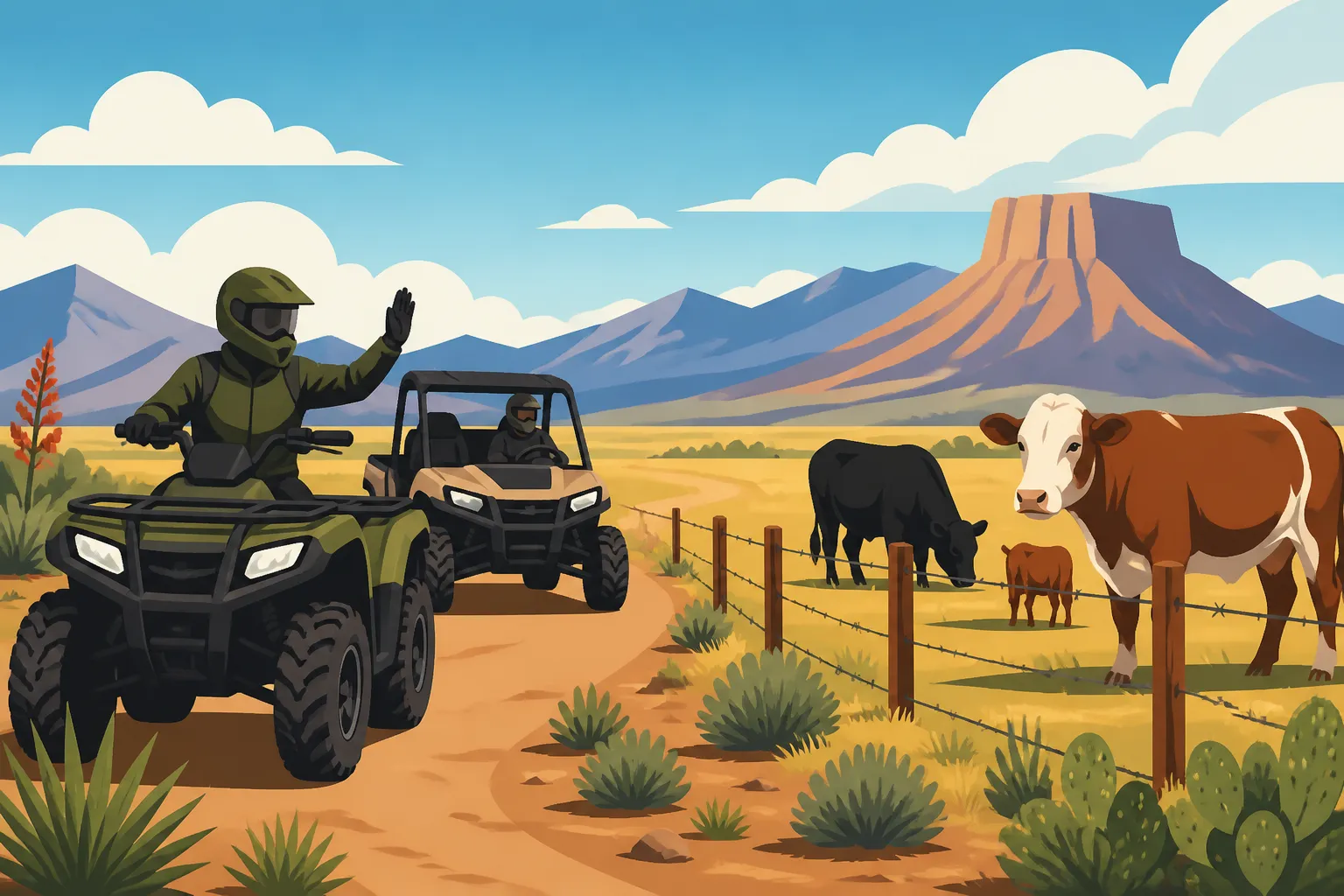
When you see livestock ahead, reduce speed early and keep your line steady. Do not charge toward a group and brake at the last moment. Give animals a wide berth where the terrain permits, and avoid cutting between a cow and calf. If cattle are blocking a narrow section, stop at a safe distance and wait for them to move on their own. A patient pause is usually better than trying to squeeze through or make the herd scatter.
Dust is another reason to slow down. Fine dust can irritate people and animals, obscure the route, and reduce visibility for riders behind you. On a dry road, leave more space between machines and avoid accelerating hard near livestock, ranch workers, or other trail users. If dust is hanging in the air, pause until you can see clearly rather than continuing by guesswork.
Use these habits when passing animals:
- Ease off the throttle before you reach the herd.
- Keep your machine pointed in a steady direction and avoid abrupt noise or movement.
- Leave ample space and do not ride through the middle of the animals.
- Wait if the animals are on the route and there is no safe, authorized way around them.
- Resume at a controlled pace after the herd has moved clear.
- Check that animals have not become separated or trapped near a fence before continuing.
Do not honk, chase, circle, or use the machine to herd cattle. Do not feed livestock or leave food scraps behind. Feeding can draw animals toward roads and create problems for the rancher and future visitors. Keep dogs under control; an excited dog can pressure cattle even when the riders are trying to pass quietly.
Riding politely also means noticing people at work. If you encounter a rancher, range worker, or livestock trailer, slow down and follow any directions given. Pull over only where it is safe and where you will not block a gate, driveway, or narrow road. A brief, courteous exchange can clarify whether a route is temporarily occupied or whether you should wait.
Gates, water points, and what to do when access is unclear
Gates deserve special attention because they control livestock movement. A gate left open can allow animals to wander into the wrong pasture or onto a road; one left closed can prevent them from reaching forage or water. Follow any signs and instructions at the gate. If you pass through a gate that you find closed, close it after you, and make sure it latches as it was intended to. If you find it open, do not automatically change its position: it may have been left that way deliberately. Follow posted directions or contact the land manager or responsible party if you cannot tell what to do. See Why You Close Every Gate Behind You for more on this basic but important habit.
Never climb over a fence with an ATV or UTV, push through wires, or use a machine to move a gate. Do not drive around a gate to bypass a closure. Those actions can damage property, let livestock escape, and turn a navigational mistake into a serious access problem. If a gate is locked or a sign says the route is closed, turn around and find a route that is clearly open.
Water infrastructure is equally important in dry country. Tanks, troughs, valves, pipes, and windmills may be the only dependable water source for livestock over a broad area. Keep machines away from these structures, do not park beside them, and never use a trough as a wash station or play area. Avoid riding over hoses or visible pipelines, and do not climb on equipment for a photograph. Even damage that looks minor can interrupt water delivery.
If you encounter a damaged fence, broken gate, leaking tank, or livestock in distress, do not attempt repairs unless you have authorization and know what you are doing. Note the location as accurately as you can, take a photo from a respectful distance if it is safe, and report the issue to the land manager or the appropriate contact for the property. Do not post sensitive access details in a way that could encourage others to enter a restricted area.
When you are unsure whether a track is open, use this decision process:
- Stop before entering the uncertain section.
- Read signs and check your map or route information for the land manager and route status.
- Look for clues that the route crosses a boundary, but do not treat tracks or an open gate as proof of access.
- If access remains uncertain, turn around or contact the responsible office before proceeding.
- Record the point where you turned back so you can choose a confirmed route next time.
A courteous ride is one that leaves no extra work for the people managing the range. Stay on authorized routes, avoid disturbing livestock, respect gates and water systems, and pack out everything you brought in. These choices protect the range and help keep riding access compatible with grazing and other public-land uses.
Disclaimer
This article is for general informational purposes only and does not constitute professional advice. Laws, prices and regulations vary by location and change over time. Consult a qualified professional for guidance on your specific situation.