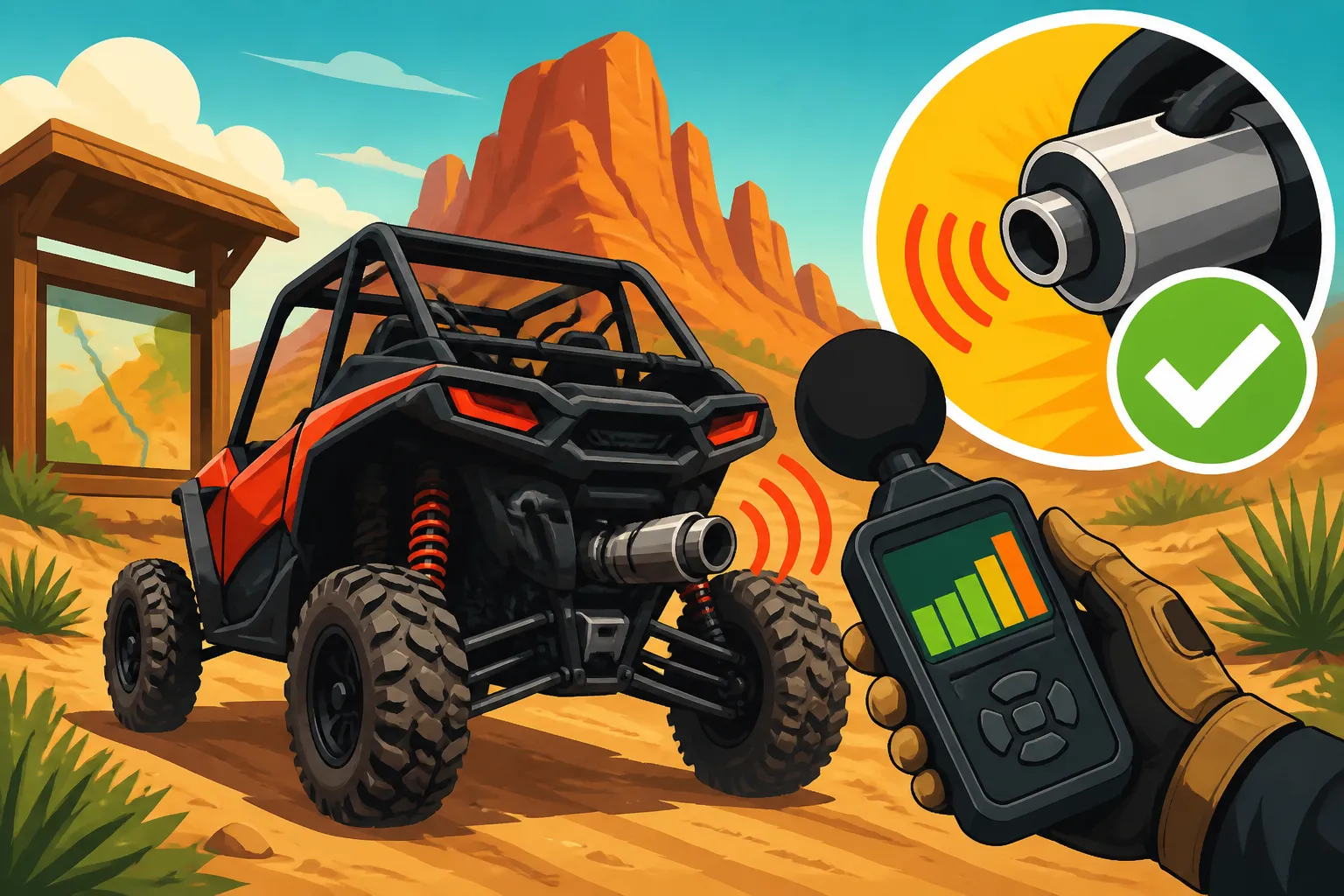
Passing New Mexico’s 96 Decibel Check at a Trailhead
A trailhead noise check can be stressful when you are not sure what the tester measures or how your ATV or UTV will sound under inspection. New Mexico sets a clear ceiling, but a reading can depend on the test setup and the machine’s condition. Here’s how to prepare sensibly, understand the result, and decide what to do if your machine is too loud.
What New Mexico’s noise limit means
New Mexico’s Motor Vehicle Division NM says off-highway motor vehicles must not produce noise that exceeds 96 decibels. The practical point is that the limit applies to the noise the vehicle produces, not simply to whether a muffler is installed or whether the machine sounds quiet while idling.
A modified exhaust, damaged silencer, loose heat shield, or exhaust leak can make a machine noticeably louder. But sound judged by ear is only a rough clue. Riders and bystanders can perceive noise differently, and the sound at a trailhead may not match what you hear from the seat. A machine that seems acceptable to you is not automatically within the limit.
The available rule identifies the maximum noise level but does not establish a particular test method here. That matters because readings can depend on the meter, its position, the engine speed, the surrounding environment, and how the test is conducted. Do not assume a reading from a phone app, driveway check, or informal comparison is equivalent to an official measurement.
If staff conduct a check, ask them to explain the procedure and how they interpret the reading. A clear, consistent test gives you more useful information than an unexplained number. If you are unsure whether your exhaust setup is appropriate, contact the relevant land manager or testing authority before your ride rather than relying on a sound estimate.
The rule is part of a broader set of public-land requirements. The New Mexico Department of Wildlife says the state’s OHV program supports off-highway recreation while balancing cultural, historic, resource, and public-safety values. A sound check is one way a trailhead may address responsible use, but passing it does not replace other applicable requirements. For related requirements, see New Mexico Sound Limit for ATVs and [New Mexico Rules for Riding a National Forest].
Prepare your machine before reaching the trailhead
The most useful preparation is mechanical, not a last-minute attempt to alter the sound. Inspect the exhaust system while the engine is off and cool. Look for obvious damage, missing parts, loose fittings, signs of leakage, and anything that appears to have been removed or changed. If you find a problem, have it checked before riding.
A machine can become louder over time even without a deliberate exhaust modification. Packing in a silencer may wear, fasteners can loosen, and a previously repaired component may no longer fit or seal properly. If your machine has an aftermarket exhaust, confirm that it is intended for your vehicle and is in good condition. A product description or a seller’s assurance is not a substitute for meeting New Mexico’s noise limit.
It can also help to keep documentation for replacement or modified exhaust components. Documentation does not prove that a machine meets the sound limit, but it may help you identify the parts fitted to the vehicle and explain its setup during a discussion. Keep expectations realistic: the measurement, rather than a receipt or label alone, is what addresses the noise question.
A consumer sound meter may help you spot a change from your machine’s usual sound, but treat it as a screening tool, not a certification. Readings from a phone app or consumer meter may differ from a trailhead test because of the device, its calibration, the environment, or the method used. If you shop on Amazon or elsewhere for a meter, check what it measures and how it is intended to be used; buying one does not establish that your ATV or UTV will pass.
| Before the ride | What to check | What it can and cannot tell you |
|---|---|---|
| Exhaust condition | Look for damage, looseness, missing parts, or an apparent leak | Helps identify faults, but does not establish a decibel reading |
| Exhaust changes | Confirm what components are fitted and whether they are in good condition | Helps you understand the setup, but does not prove compliance |
| Sound meter | Use it only as an informal comparison under consistent conditions | Can flag a change; it may not match the trailhead test |
| Trailhead procedure | Ask how the check is conducted and how results are handled | Clarifies the local process; it does not change the state limit |
If you want to learn more about a separate equipment requirement, read Checking Your Spark Arrester Before Public Land and Which Spark Arresters Pass on Federal Land. The Motor Vehicle Division NM also requires off-highway motor vehicles to have a spark arrester approved by the United States Forest Service. A spark arrester and an exhaust-noise check address different equipment concerns; having one does not mean the other requirement is satisfied.
Before travelling, check for current access conditions and any local instructions that apply to the riding area. A trailhead may have procedures or temporary restrictions riders need to know about. New Mexico Trail Closures to Check First can help you plan around access changes, while the staff or land manager for the specific location is the right place to ask about its testing process.
What to do if your ATV or UTV is too loud
If a test indicates that your machine exceeds the limit, stay calm and get clear information before deciding what to do. Ask whether the reading can be repeated and whether the equipment and procedure are working as intended. You can also ask what part of the setup appears to be causing the concern. A useful explanation helps distinguish a mechanical fault from a disagreement about how the test was performed.
Do not try to argue from how the machine sounds to you, or assume that a different reading from a phone app settles the matter. Those comparisons may help you investigate later, but they do not necessarily duplicate the trailhead procedure. Ask what options are available at that location. Depending on the site’s instructions, you may need to stop riding, make a repair, or leave and have the machine inspected before returning.
Avoid quick fixes that compromise the exhaust system or create another problem. Removing parts, opening a leak, or making an improvised change can make the machine louder or less safe. If the exhaust needs repair or replacement, consult a qualified mechanic or the manufacturer’s service information. Once work is complete, have the machine checked using a suitable method before planning another ride.
It is sensible to keep a record of any inspection or repair, especially if you have had a recurring noise issue. Note what was repaired and retain relevant service paperwork. That record can help a mechanic diagnose a repeat problem, although it is not a guarantee of passing a later measurement.
Riders should also keep the interaction practical and respectful. Trailhead staff may be applying site procedures, while you may need clarification about the reading or next steps. Ask concise questions, listen to the answer, and avoid continuing to operate a machine that has been directed not to ride. If you believe the test was handled incorrectly, ask about the location’s process for reviewing or raising that concern rather than trying to resolve it by riding away.
Keep the noise check in context
A quiet exhaust is only one part of being ready for public land. The New Mexico Department of Wildlife says users must register an OHV or obtain a permit when using it on public land. The appropriate option can depend on the rider and vehicle, so check the requirements that apply to your situation before leaving home. New Mexico Permits Explained provides a broader overview of the permit topic.
Equipment and rider rules also matter. According to the Motor Vehicle Division NM, operators under the age of 18 must possess an off-highway motor vehicle safety permit, and people under that age must wear eye protection and a securely fastened safety helmet when operating or riding an OHV. The same agency says riders under 18 may not carry a passenger while operating an off-highway motor vehicle. These requirements are separate from the noise limit.
A useful pre-ride routine is to:
- Inspect the exhaust and address damage or looseness before the trip.
- Avoid assuming an aftermarket part, consumer meter, or quiet idle guarantees a passing result.
- Ask the specific trailhead or land manager about the test setup and what happens if a reading is over the limit.
- Confirm the registration or permit requirements for public-land use.
- Check applicable equipment, rider, and access rules before setting out.
That approach cannot promise a particular measurement, because the trailhead procedure and the condition of the machine both matter. It can reduce surprises, help you identify a mechanical issue early, and make it easier to respond constructively if your ATV or UTV is flagged as too loud.
Sources
- Motor Vehicle Division NM — Chapter 16 – Off-Highway Motor Vehicles | Motor Vehicle Division NM (checked November 3, 2026)
Disclaimer
This article is for general informational purposes only and does not constitute professional advice. Laws, prices and regulations vary by location and change over time. Consult a qualified professional for guidance on your specific situation.