New Mexico OHV Registration After a Move
Moving to a new state brings a whole host of logistical puzzles, and for those of us who love hitting the trails, figuring out how to get your beloved off-highway vehicle (OHV) legal in your new home can feel like a daunting extra chore. You've got enough on your plate unpacking boxes and finding the best green chile cheeseburger – the last thing you need is to navigate confusing MVD rules for your ATV or UTV. This guide is here to simplify the process of registering your out-of-state OHV in New Mexico, ensuring you understand exactly what you need to do to get your machine ready for the Land of Enchantment's incredible landscapes.
Understanding New Mexico's OHV Registration Basics for New Residents
First things first, welcome to New Mexico! We're thrilled to have you and your OHV here. Whether you're coming from a state with super strict OHV laws or one that was pretty laid-back, New Mexico has its own way of doing things, and it's essential to get up to speed. Our state requires all OHVs operated on public lands or approved roads to be registered and display specific decals. This isn't just a formality; it's how New Mexico helps maintain our trails and keeps riders safe.
When you move here, your out-of-state registration typically won't transfer directly. Think of it like your driver's license – you eventually need a New Mexico one. The same generally goes for your OHV. You'll be going through what's essentially a "first registration" process, even if you've owned your machine for years in another state. This means you'll need to satisfy all the requirements for a brand-new registration in New Mexico, which includes proving ownership and paying the necessary fees. It's a fresh start for your machine in a new desert playground. You might find it helpful to review [New Mexico's First OHV Registration] to get a general overview, as many of those steps will apply to you.
Why New Mexico Requires Re-Registration
It might seem redundant to register a machine you've already registered elsewhere, but New Mexico has specific reasons for this. Each state has its own system for tracking vehicle ownership, collecting fees, and managing off-highway vehicle programs. New Mexico's fees directly contribute to funding safety programs, trail maintenance, and enforcement efforts right here in our state. By requiring you to register your OHV here, the state ensures that your machine is officially recognized within its system and that you're contributing to the local OHV community.
Moreover, New Mexico's registration process helps confirm that your vehicle meets local operating standards and that you, as the owner, are aware of the state's rules regarding OHV use. This includes things like where decals need to be placed, what equipment is required for road use, and any safety regulations. It’s all about integrating your machine into New Mexico's regulatory framework to ensure safe and responsible riding for everyone.
Key Documents You'll Need to Gather
The MVD loves paperwork, especially when you're establishing new residency and bringing in an out-of-state vehicle. The most critical document you'll need is proof of ownership. For most OHVs, this means the original title. If your previous state didn't issue titles for OHVs (which some states don't, especially for older models or dirt bikes), you'll need to provide alternative proof of ownership, such as a bill of sale, previous registration documents, or a notarized affidavit. It's wise to have several forms of proof ready, just in case.
You'll also need proof of your New Mexico residency, like a utility bill, a New Mexico driver's license, or a lease agreement. Additionally, you'll need your vehicle's identification number (VIN) for the application. If you have any questions about specific forms or what constitutes acceptable proof of ownership in a unique situation, calling your local MVD office before you go can save you a lot of time and frustration. Sometimes, if previous ownership documents are a bit murky, a professionally drafted bill of sale or affidavit, perhaps obtained through a service like LawDepot, might be considered to help solidify your claim, though the MVD ultimately dictates acceptable documents.
Step-by-Step Guide to Registering Your Out-of-State OHV
Alright, let's break down the actual process into manageable steps. This isn't something you can usually do online when you're bringing an OHV from another state because the MVD needs to verify your documentation and the vehicle itself. So, prepare for a trip to your local New Mexico MVD office.
1. Locate Your Documents and Vehicle Information
Before you even think about leaving the house, gather every single piece of paper related to your OHV's ownership and previous registration. This includes:
- Original Title: This is the gold standard. Make sure it's in your name and free of any liens, or you'll need lien release documentation. If your state was a non-titling state for OHVs, gather every piece of previous registration and sale paperwork you have.
- Bill of Sale: If you purchased the OHV, even in your previous state, having the bill of sale can be very helpful, especially if the title isn't immediately available or if the MVD requires additional proof of the transaction. Services like LawDepot can provide customizable bill of sale templates if you need to create one for a future sale, but for your current ownership, you're looking for the original document.
- Previous Registration Cards: These show continuous ownership and can be crucial if you don't have a title.
- Proof of Residency: Your new New Mexico driver's license, a utility bill, or a lease agreement are good examples.
- Identification: Your current driver's license or state ID.
Double-check your OHV for its VIN. Write it down clearly. You'll need it for the application forms. Sometimes, an MVD agent might want to visually inspect the VIN on the machine itself, so be prepared for that possibility.
2. Complete the New Mexico OHV Registration Application
You'll need to fill out the New Mexico OHV registration application form. This form collects basic information about you and your OHV. You can often download this form from the New Mexico MVD website in advance, which can save you time at the office. Take your time filling it out, ensuring all information matches your supporting documents. Pay close attention to sections asking about previous state registration or title information.
When it comes to [New Mexico OHV Registration Paperwork], accuracy is key. Any discrepancies between your application and your ownership documents could lead to delays. If you're unsure about a particular section, it's better to leave it blank and ask the MVD agent when you're there. They can guide you through it.
3. Present Proof of Ownership and Residency
This is where your meticulously gathered documents come into play. When you get to the MVD counter, you'll present your completed application, your original title (or equivalent proof), and your proof of New Mexico residency. The MVD agent will review these documents to verify ownership and ensure everything is in order.
If you're coming from a state that doesn't title OHVs, this step can sometimes be a bit more involved. The MVD will have specific guidelines for how to establish ownership without a traditional title. This might involve additional affidavits or forms, possibly similar to those you could create using a platform like LawDepot if you needed to formalize a statement of ownership. Don't be discouraged; the MVD agents are used to these situations and can guide you. The key is to have as much historical documentation as possible.
4. Pay Fees and Receive Your Decals
Once your paperwork is approved, you'll pay the required registration fees. New Mexico charges a biennial (two-year) registration fee. For new registrations, there may be an initial registration fee, which might differ slightly from a renewal. You can learn more about [New Mexico OHV Registration Cost] to get an idea of the expense. The MVD accepts various forms of payment, but it's always a good idea to check their website or call ahead for accepted payment methods.
After payment, you'll receive your New Mexico OHV decals. These are crucial! You'll typically get a yellow decal for off-highway use. If you plan to ride on paved county or municipal roads where permitted, you'll also need to opt for a green decal, which allows you to ride on and off-highway. Make sure you understand the difference and get the correct decals for your riding plans. Don't forget that [New Mexico's Green On and Off-Highway Decal] has specific requirements.
5. Proper Decal Placement
Proper placement of your new decals is not just a suggestion; it's a requirement. Each type of OHV has a specific designated spot for the decal to be visible.
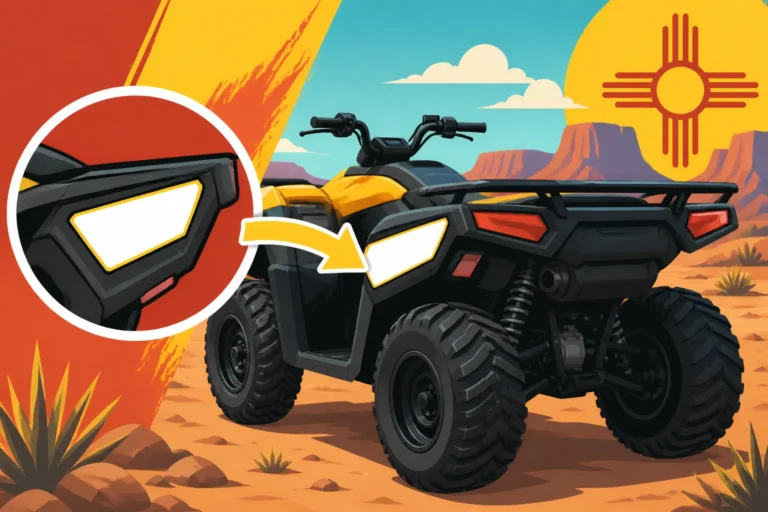
- ATVs (Quads): The decal typically goes on the left-rear fender. For more details, see [Where a Quad's Decal Goes].
- ROVs (Side-by-Sides, UTVs): The decal is usually placed on the left-rear quarter panel. You can find specifics at [Where an ROV Quarter Panel Decal Goes].
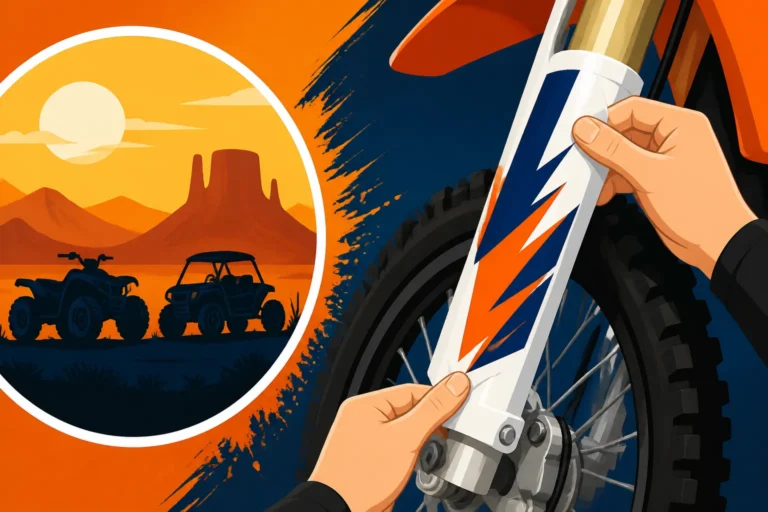
- Dirt Bikes/Off-Highway Motorcycles: The decal is affixed to the left fork leg. Check out [Sticking the Decal on a Dirt Bike's Fork Leg] for exact instructions.
Failure to properly display your decals can result in a citation, which is definitely not how you want to start your New Mexico riding adventures. Ensure you clean the surface thoroughly before applying the decal for good adhesion, as the desert sun can be harsh on adhesives.
Important Considerations and Common Pitfalls
Moving and dealing with vehicle registration can have its unique challenges. Being prepared for these can save you a lot of headache.
Titling Your OHV in New Mexico
Even if you had a title from your previous state, the MVD will likely process a new New Mexico title for your OHV during this registration process. This ensures your vehicle is fully integrated into the state's titling system. It's a key part of establishing your ownership officially in New Mexico. If your OHV previously didn't have a title (from a non-titling state), the MVD will issue one for the first time in New Mexico, based on the proof of ownership you provide. This process is covered in more detail in [Titling an Off-Highway Vehicle in New Mexico].
It's important to understand the sequence: you generally need to title your OHV first or concurrently with the registration. The title is the ultimate proof of ownership. Make sure all your information, including your name and address, is accurate on the new title.
The Role of a Bill of Sale
While the title is primary, a bill of sale is still a very important document, especially if you ever plan to sell your OHV in New Mexico. It serves as a record of the transaction and can protect both the buyer and seller. If you brought your OHV from a state that only issued a bill of sale and no title, that bill of sale becomes your crucial primary document for establishing ownership with the MVD here.
For future transactions, if you find yourself needing to create a clear and legally sound bill of sale for an OHV you're selling, resources like LawDepot can be helpful in drafting such documents. This ensures you have proper documentation in place for any subsequent private sales here in New Mexico.
Reciprocity and Nonresident Permits vs. New Resident Registration
It's common for new residents to confuse "nonresident permits" with the requirement for new resident registration. New Mexico does offer nonresident OHV permits for visitors from certain states, and it honors registrations from many other states through reciprocity. However, once you establish residency in New Mexico, these rules generally no longer apply to you. Your intent is to become a permanent New Mexico rider, not a visitor.
Therefore, you'll go through the full New Mexico registration process, not simply buy a temporary nonresident permit. This ensures you receive a permanent New Mexico registration and decals, and that your machine is properly tracked within the state. Understanding the difference is critical to avoiding missteps. If you're curious about the visitor rules, you can look into [New Mexico's Nonresident OHV Permit] to see what applies to visitors, but remember, once you live here, you're a resident!
Insurance Requirements for Road Use
If you plan to use your OHV on paved county or municipal roads, getting that green decal isn't the only step. New Mexico law requires that any OHV operated on a paved public road must have liability insurance, just like a regular car. This isn't usually required for purely off-highway use, but it's absolutely mandatory for road riding.
Make sure your insurance policy meets New Mexico's minimum liability coverage requirements. You'll need to carry proof of this insurance with you whenever you're riding on paved roads. If you're pulled over without it, you could face significant fines. It's best to sort this out with your insurance provider before you venture onto any paved surfaces. Getting [New Mexico OHV Registration and Liability Insurance] squared away is a smart move.
| Document Type | Purpose | Requirement for New Residents | Notes |
|---|---|---|---|
| Original Title | Primary proof of ownership from previous state. | Highly Recommended | Essential for establishing clear ownership. If missing, be prepared with robust alternative proofs. |
| Bill of Sale | Proof of transaction if the title is new or if from a non-titling state. | Recommended | Crucial if you don't have a title, or if the MVD requires additional proof of how you acquired the OHV. |
| Previous Reg. Cards | Show continuous ownership history. | Recommended (if no title) | Can help establish ownership lineage, especially useful if your prior state didn't issue titles for OHVs. |
| Proof of NM Residency | Confirms you live in New Mexico. | Required | Valid driver's license, utility bill, lease agreement, etc. |
| Photo ID | Verifies your identity. | Required | Your driver's license or state ID. |
| OHV Application Form | Official New Mexico MVD form. | Required | Can often be downloaded online and filled out prior to your visit to save time. |
| VIN Inspection (Potential) | Verification of your vehicle's identification number. | Possible | An MVD agent may visually inspect the VIN on your machine. Ensure it's accessible and readable. |
Navigating the MVD as a new resident can feel a bit like a scavenger hunt, but with this guide and all your documents in hand, you'll be well-prepared. Take a deep breath, gather your paperwork, and soon enough, you'll have those New Mexico decals proudly displayed on your OHV, ready to explore our beautiful state!
Disclaimer
This article is for general informational purposes only and does not constitute professional advice. Laws, prices and regulations vary by location and change over time. Consult a qualified professional for guidance on your specific situation.