Why You Close Every Gate Behind You
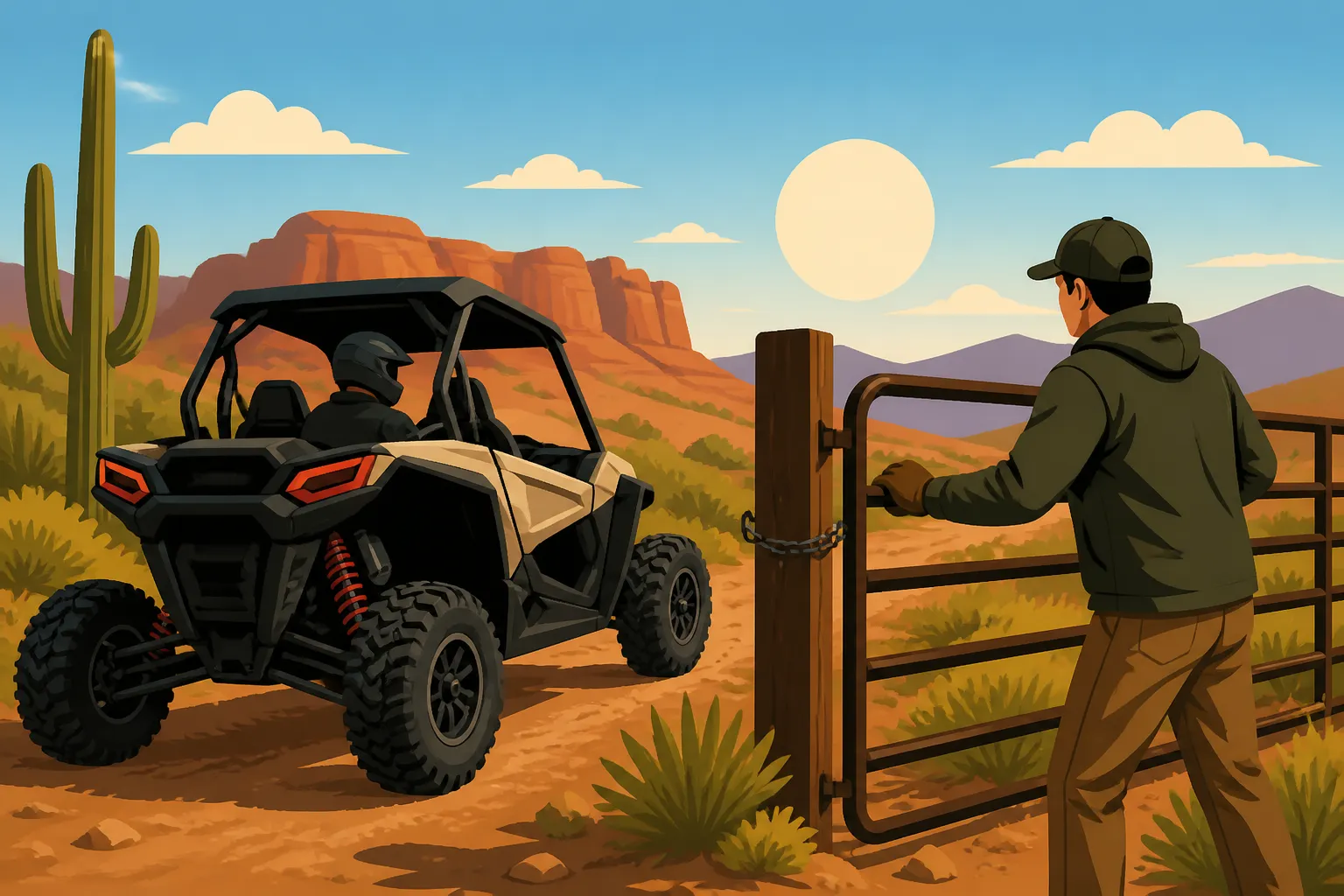
A gate on a New Mexico trail can mark a working ranch boundary, a grazing allotment, or a route where livestock need to stay contained. The practical rule is simple but important: leave the gate as you found it, follow any posted instructions, and never treat an open gate as permission to ride. Here’s how to pass through without putting animals, access, or your ride at risk.
Why gates matter on New Mexico rides
Gates help landowners and land managers control livestock movement, protect crops and property, and separate areas with different access rules. A gate across a road or trail does not, by itself, tell you who owns the land or whether OHV travel is allowed. It does tell you to slow down and pay attention.
In New Mexico, a ride may pass through a patchwork of private property, public land, and grazing allotments. An allotment is an area where livestock grazing is authorized; it may include public land, private land, or both. A gate along a route might be there to manage livestock even when the road beyond it is open to authorized travel. Conversely, a gate that happens to be open does not establish that you have permission to enter.
Your registration, nonresident permit, or other riding paperwork is separate from permission to use a particular route. A permit may meet a riding requirement without granting access across private property or overriding a closure. For an overview of the access rules that apply to allotments, see New Mexico Rules for Riding a Grazing Allotment. For private land, permission is a separate matter; Permission From a Ranch Owner explains why a visible road or open gate is not a substitute for consent.
A gate can also be part of a route that is closed to motorized travel. Confirm that the road or trail is open before setting out, rather than using the gate as your only clue. On federal land, check the relevant travel information and stay on routes open to your vehicle type. Travel Management Maps on Federal Ground and New Mexico Rules for Riding BLM Land are useful starting points; forest roads have their own access conditions, covered in [New Mexico Rules for Riding a National Forest].
| What you find | Practical response |
|---|---|
| Gate closed and latched | Stop, check for signs and route restrictions, then open it only if you are authorized to continue. Close and latch it behind you. |
| Gate open | Do not assume the route is open to OHVs. If travel is permitted, generally leave the gate in the position you found it unless a sign or manager says otherwise. |
| Gate chained or locked | Do not force, climb, cut, or go around it. Find another authorized route. |
| Sign says to leave the gate open or closed | Follow the posted direction, even if the gate’s position differs from what you expected. |
| Livestock are near the gate | Pause, give them room to move, and avoid driving through the herd. |
| You cannot tell what to do | Do not guess. Check with the landowner or managing agency before proceeding. |
The table is a practical rule of thumb, not a substitute for signs, landowner instructions, or current route restrictions. If specific instructions are posted, follow them. If you cannot confirm that you are allowed to continue, turn back rather than risk trespass or an access problem.
How to pass through a gate responsibly
A little coordination makes a gate crossing safer, especially when a group is riding. Before moving, choose one person to handle the gate and make sure the rest of the group knows to stop. Keep machines far enough back to avoid crowding the gate, livestock, or the person operating it.
Use this sequence when the gate is closed and the route is open to your machine:
- Stop before the gate. Pull off the travel line only where it is safe and permitted. Watch for traffic, loose footing, livestock, and signs.
- Check the instructions. Look for posted directions, a lock, a chain, or a warning that the road is closed. Do not interpret an unlocked gate as an invitation.
- Confirm the group is stopped. Keep riders and machines clear of the gate’s swing. If you are riding alone, secure your machine safely before handling the gate.
- Open the gate without forcing it. Use the latch as intended. Do not cut a chain, move a barrier, or damage a fence to get through.
- Move through carefully. Ride at walking pace if livestock or other users are nearby. Keep your machine under control and leave enough space for animals to move away.
- Close and latch the gate. Return it to the required position. Check that the latch has engaged so the gate cannot swing open or let livestock through.
- Let the group reform safely. Avoid bunching up on a narrow road or blocking the gate while everyone catches up.
The gate handler should not be expected to hold it open while several machines rush through. That can leave it unsecured, startle livestock, or put the person at risk. A better plan is for one rider to operate the gate while the others wait, then close it after the last machine passes. If someone needs to reposition a vehicle, do that without leaving the gate unattended in the wrong position.
Not every gate should be moved. A locked gate, a posted closure, or a barrier that clearly prevents access is a stop sign in practical terms. Do not try to bypass it by riding around the end of the fence, crossing a field, or following a faint track. Those choices may take you onto private land, damage vegetation, or put you on a route that is not open to motorized travel.
If there is no clear way to pass without damaging property or leaving the gate unsecured, turn around. A detour is frustrating; a damaged fence or escaped livestock can create a much larger problem for the landowner and future riders.
What to do when a gate is open, damaged, or hard to manage
An open gate calls for judgment, not an automatic decision to leave it open or close it. First, look for posted directions. A sign may explain that the gate must remain open or closed, or it may warn that the route is restricted. Follow that instruction. If there is no sign, the general courtesy rule is to leave the gate as you found it, but only proceed if you are already authorized to use the route.
An open gate is not proof of public access. It may have been left open temporarily by a ranch worker, land manager, or another authorized user. The route could also be closed to OHVs even if a truck or another type of vehicle is allowed. Check the route’s status before riding; Matching a Route Number on a Forest Sign can help when you are following a numbered forest route, but a route sign does not replace checking its current restrictions.
A damaged gate or fence should not be repaired by improvising with wire, rope, or a strap unless the landowner or land manager specifically directs you to do so. A quick fix can injure an animal, fail under pressure, or make the enclosure less secure. If you can safely do so, note the location and report the damage to the responsible owner or agency. Do not leave the gate open simply because it will not latch; that can allow livestock to escape. If you cannot secure it without causing further damage, stay nearby only if it is safe, and contact the responsible party.
Some gates are heavy, awkward, or difficult to open while wearing riding gear. Do not put your hands or body where the gate could swing, pinch, or fall. Avoid leaning a machine against a fence or leaving it on unstable ground while you work. If a rider cannot safely handle the gate alone, ask another adult in the group to help rather than forcing the hardware.
If you are riding with children or inexperienced riders, set expectations before reaching the barrier: stop on approach, wait for instructions, and do not ride ahead while someone is opening or closing it. A child should not be left to operate a heavy gate without appropriate help and supervision.
When several machines are traveling together, count them through. The gate should not be considered handled until the last rider has passed and the latch is secured. A quick verbal check prevents a common mistake: the lead rider closes the gate, but the last person assumes someone else will do it.
Livestock need space
Cattle, horses, and other animals may react unpredictably to engine noise or a moving vehicle. Stop at a distance and allow them to clear the route on their own. Do not honk, rev the engine, chase them, or squeeze between animals and a fence. If they are blocking the gate or road, wait for them to move or turn back if they do not.
Keep dogs under control and away from livestock. A dog that bolts after an animal can cause injuries or push animals through an open gate. If the group cannot pass without pressuring the herd, do not force the crossing. For more on considerate riding around livestock, see Riding a Grazing Allotment Politely.
Planning ahead and handling common mistakes
Before a ride, identify the routes you plan to use and confirm that motorized travel is allowed there. Check signs and current information from the land manager, and ask the owner when a route crosses private land or access is unclear. Keep an alternate route in mind so a locked gate or closure does not tempt the group to cut across an unauthorized area.
For a grazing allotment, do not assume that a road is open because it appears on a map, has tire tracks, or is used by another kind of vehicle. Rules may depend on the land, the route, the vehicle, and the permission granted. New Mexico Rules for Riding a Grazing Allotment provides more context on the distinction between riding an authorized route and entering land without the required access.
If you realize you left a gate open, go back and secure it if you can do so safely and without creating another access or traffic hazard. If you are already far away, contact the landowner or managing agency and explain what happened and where. Do not hide the mistake or assume someone else will notice.
If a gate is closed behind you and you discover that the route is not open, do not continue deeper into the property looking for another exit. Turn back by the route you used, provided it is safe and lawful to do so, and contact the appropriate owner or manager if you need help. Do not climb a fence or create a new opening.
When a group is approaching a gate on a narrow road, prevent the crossing from becoming a traffic hazard. Stop where there is room, keep the road clear when possible, and do not block another user’s passage. On a steep, loose, or exposed section, choose a safe place to stop before anyone gets off a machine. If the terrain makes opening the gate unsafe, find a safer authorized approach or turn around.
The best gate habit is consistent: follow the instructions, use the route only when you are allowed to, and leave the barrier in the required condition. That protects livestock and property, reduces conflict with landowners, and helps keep riding access open for others.
Disclaimer
This article is for general informational purposes only and does not constitute professional advice. Laws, prices and regulations vary by location and change over time. Consult a qualified professional for guidance on your specific situation.