New Mexico Rules on National Forest Land
New Mexico’s National Forest roads and trails can look open while still being closed to a particular kind of machine—or to all motorized use. Before you unload, you need to sort out state registration or permit requirements, the Forest Service’s route rules, and any local closure. Here’s how to check those pieces so you can plan a ride without treating every dirt road as an open OHV route.
State requirements still apply on National Forest land
National Forest land is federal land, but that does not erase New Mexico’s state requirements for operating an off-highway vehicle (OHV). Before a ride, check both whether the machine has the required New Mexico registration or nonresident permit and whether the specific route is open to it.
New Mexico residents generally need to register their OHV through the state process. Visitors may be able to ride under a valid registration from another state, depending on that state’s rules. If the machine is from a state without a qualifying OHV registration program, a New Mexico nonresident permit may be required. The details can depend on the machine and where it is registered, so check before heading to the forest. New Mexico OHV Reciprocity Rules
A registration or permit does not give you permission to ride anywhere on public land. It shows that you have met a state requirement; the Forest Service’s travel rules decide which roads, trails, and areas you may use. You can think of these as two separate checks:
- State authorization: Is the machine registered or covered by the required permit?
- Route authorization: Is this particular road, trail, or area open to the machine?
You need both. A valid registration cannot make a closed road legal, and an open route does not excuse a missing registration or permit.
| Rider or machine situation | State step to check | What it does not authorize |
|---|---|---|
| New Mexico resident | Current New Mexico OHV registration requirements | Riding on a route that is closed or not designated for the machine |
| Visitor with an out-of-state registration | Whether the registration qualifies for reciprocity in New Mexico | Use of every Forest Service road or trail |
| Visitor from a state without a qualifying OHV registration program | Whether a New Mexico nonresident permit is required | Riding outside the Forest Service’s designated routes |
| Rider under 18 | State safety-permit and supervision requirements, as well as age-related rules | Riding a route that is restricted or closed |
The permit question is easy to overlook when a ride is planned around a forest trailhead rather than a town. But the state’s OHV rules can apply on federal public land. For a breakdown of the different visitor situations, see New Mexico’s Nonresident OHV Permit and [New Mexico OHV Safety Permit Requirements]. Requirements can change, so confirm the current process and acceptable proof before traveling.
Keep the registration or permit information accessible during the ride. A phone may be useful for storing a photo or digital copy if the program accepts it, but do not rely on a saved image as a substitute for anything the rules require you to carry. If you are unsure whether a digital copy is accepted, check first and bring the required physical document or permit card.
The Forest Service decides which routes are open
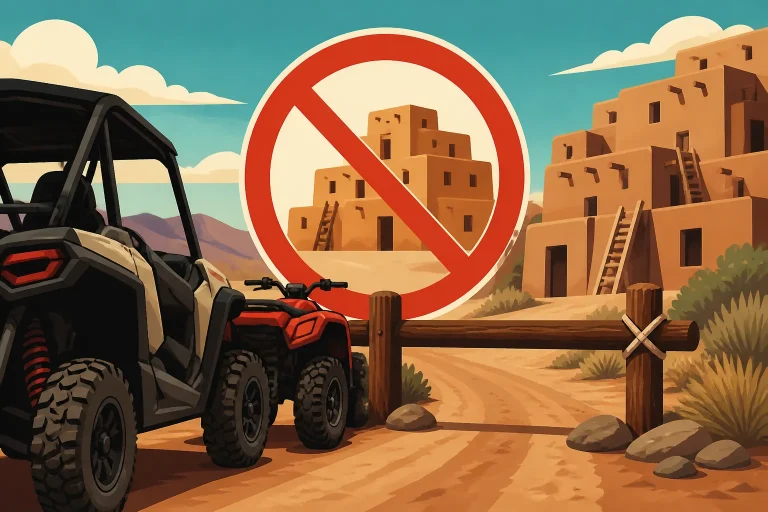
The most important rule for riding in a National Forest is that a road’s appearance does not tell you whether motorized use is allowed. A dirt road may look like a normal way through the forest and still be closed to OHVs, restricted to certain vehicles, or open only during part of the year.
In general, ride only on routes or in areas designated for your type of machine. Do not assume that an existing track, old map line, tire rut, or path made by another rider is an authorized route. A route can be closed even if it is physically passable, and an open road for a full-size highway vehicle is not automatically open to an OHV.
The Forest Service’s Motor Vehicle Use Map, commonly called an MVUM, is a key planning tool. It shows which roads and trails are open to motorized travel and may include restrictions such as vehicle class, season, or route designation. Use the map for the relevant forest and district, not a general map that simply shows roads. Travel Management Maps on Federal Ground
Match the route to your machine
A route may be open to some vehicles and not others. For example, a trail suitable for a narrow ATV or dirt bike may not be suitable or legal for a wide side-by-side. Check the route’s designation and any width or vehicle-class restrictions before setting out. Don’t rely on the machine’s ability to squeeze through a space as proof that it is permitted there.
Also check how the MVUM defines the route. A line on the map may represent a road or trail with a specific designation, not an invitation to explore the surrounding ground. Route signs, barriers, and posted notices matter too. If a sign at the trailhead conflicts with an old screenshot or a map saved on your phone, stop and find out which information is current before proceeding.
A useful planning sequence is:
- Identify the forest and ranger district where you plan to ride.
- Get that area’s current Motor Vehicle Use Map.
- Mark the routes designated for your machine.
- Check seasonal restrictions, closures, and route conditions.
- At the staging area, compare the signs with your plan.
- Stay on the designated route and turn back if you encounter a closure or restriction.
For help interpreting signs and route designations, see [New Mexico Rules for Riding a Designated Route] and Matching a Route Number on a Forest Sign. If a route is marked closed, do not ride past the sign because the road looks clear or because another rider has gone through. Riding Past a Closed Route Sign
Do not use an old track to create a new route
Riding off a designated road or trail can damage soil and vegetation, widen a route, and create an unauthorized track that other riders may follow. It may also take you onto land with a different owner or manager. Stay on the authorized route even when a shorter line across an open-looking area seems convenient.
This is especially important near route junctions, trailheads, and forest boundaries. A trail can meet private land, state trust land, tribal land, or another restricted area. A National Forest boundary is not a general-access boundary for every kind of motorized travel. Check land ownership and access rules before crossing it. New Mexico Rules for Riding Federal Land
Seasonal closures, weather, and fire restrictions
A route that is open on the map may still be closed temporarily. Forest roads can be restricted for seasonal conditions, road damage, maintenance, fire danger, or other management needs. Restrictions vary by forest and district; do not assume that a road is open simply because you rode it in another season.
In some parts of New Mexico, high-elevation roads can be affected by snow, thawing ground, or seasonal closures. Lower-elevation routes may face different conditions, including summer storms, washouts, dust, and fire restrictions. A forest-wide assumption such as “the roads are open now” is not a substitute for checking the district’s current notices and the particular route you want to use. New Mexico Riding Seasons by Elevation
Check for closures shortly before departure
Check the relevant Forest Service office or official forest information shortly before your trip, especially after a storm, during fire season, or when a road has been closed in the past. A map is useful for planning, but it may not show a short-term closure issued after the map was produced.
Pay attention to restrictions that apply to only part of a route or to a particular vehicle type. A closure sign at a junction may apply beyond that point even if the road remains open for other uses. If the notice is unclear, turn around and ask the forest office rather than guessing.
Fire restrictions deserve particular attention. A restriction may affect campfires, stoves, or other activities as well as motorized access. Depending on conditions, managers may close roads or areas to reduce risk. Check the applicable restriction before lighting any fire or planning a stop that depends on one.
Treat changing weather as a route issue
A dry forest road can change quickly after rain or snow. Water may run through low spots and arroyos, and soft or damaged surfaces can become unsafe for a vehicle. Avoid driving into flowing water or crossing a wash when you cannot judge its depth, current, or bottom. A route that was manageable on the way in may be difficult on the way back.
At higher elevations, weather can shift during the day. Carry clothing for changing conditions, leave room in your schedule to turn around, and do not let a planned destination pressure you into continuing onto a closed, damaged, or unsafe route. A satellite messenger or another way to call for help can be useful where cell service is unreliable, but it does not make an unsafe route safe.
If your plan depends on reaching a particular campsite or overlook by motor vehicle, confirm that the access route is open and legal for your machine. A campground or destination being open to visitors does not automatically mean every OHV route leading to it is open.
Equipment, age rules, and responsible riding
State OHV rules and Forest Service restrictions both matter on a National Forest ride. Check requirements for the rider as well as the vehicle. Riders under 18 may have additional safety-permit, supervision, helmet, or passenger requirements. Do not assume an adult’s paperwork or experience covers a young rider; confirm what each rider needs before leaving home. New Mexico Safety Permit for a Minor
The machine also needs to meet applicable requirements for public-land riding. New Mexico has rules involving sound and spark arresters, and the Forest Service may enforce requirements intended to reduce noise and fire risk. Check the current rules for the machine and the land you plan to ride. New Mexico Sound Limits on Public Land [New Mexico Spark Arrester Rules]
A loud exhaust or an unsuitable spark arrester can turn a routine trailhead check into a problem, but compliance is also part of protecting the area and keeping access available. Before the trip, inspect the equipment rather than waiting to discover an issue at the staging area. Make sure the machine is in working order, particularly its brakes, tires, lights, and steering.
Prepare for the route, not just the ride
A forest ride can move from open country into steep, rocky, shaded, or high-elevation terrain. Match the machine and riders to the route, and avoid pushing a vehicle beyond its capability. A route that is legal for your machine may still be a poor choice for a novice rider or an overloaded vehicle.
Carry enough water, food, layers, and basic tools for the length and difficulty of the ride. Bring a map or an offline navigation option and make sure everyone knows the route plan. A waterproof map sleeve or a reliable phone mount can help keep navigation usable in changing weather; if shopping through Amazon, check that the item fits your machine and can withstand vibration, dust, and rain. Do not make a phone your only navigation method if you expect to lose service or power.
Plan fuel conservatively. Forest routes can take longer than expected, and a short distance on a map may involve slow travel, elevation changes, or detours around a closure. Leave enough fuel to return to the staging area without depending on an unverified shortcut.
Share the forest with other users
National Forest roads and trails may be shared by OHV riders, hikers, cyclists, horseback riders, loggers, and other motorists. Slow down when visibility is limited, at blind corners, near trailheads, and when passing other users. Give others room and avoid spraying them with dust or gravel.
Stay alert for wildlife and livestock. Do not chase or crowd animals, and reduce speed when approaching them. Close gates if you opened them, and leave a gate as you found it if you did not open it. A gate may be controlling livestock movement, not marking an invitation to leave the route.
Pack out trash and avoid damaging vegetation when parking or staging. Do not block a road, gate, or access point. Keep noise reasonable, and remember that a group’s behavior can affect the experience of visitors who came to the forest for quiet as well as those traveling by vehicle.
A practical pre-ride checklist
A short checklist can prevent the most common problems: missing paperwork, a closed route, or a machine that is not allowed where you planned to ride. Complete these checks before loading the vehicle, then check for last-minute changes before departure.
- Confirm the machine’s state status. Verify that a New Mexico registration or the correct nonresident permit applies. If relying on an out-of-state registration, confirm that it qualifies for reciprocity.
- Check rider requirements. Look up age-related safety permit, supervision, helmet, and passenger rules for everyone in the group.
- Choose the forest and district. A general search for “National Forest trails” is not specific enough; route rules can differ between districts.
- Use the current Motor Vehicle Use Map. Mark routes open to the machine, not just roads visible on a general map.
- Check temporary and seasonal closures. Look for fire restrictions, road damage, weather closures, and posted notices.
- Inspect the vehicle. Check required equipment, brakes, tires, lights, fuel, and any sound or spark-arrester requirements.
- Plan for limited service. Carry navigation that works offline, tell someone your route and expected return, and bring supplies suitable for the ride.
- Follow the route on the ground. Obey signs and barriers, stay on the designated route, and turn back when a closure or unsafe condition changes the plan.
If you ride more than one New Mexico forest, repeat the route and closure checks for each area. A map for one district may not cover another district, and a route that is open on one side of a boundary may not remain open after you cross it.
The basic rule is straightforward: state registration or a permit covers the state requirement, while the Forest Service map and current notices determine where you may ride. Check both before every trip. For related details on route access and federal land, see [New Mexico Rules for Riding a National Forest] and New Mexico Rules for Riding Federal Land.
Frequently Asked Questions
Does a New Mexico OHV registration let me ride anywhere in a National Forest?
No. It addresses a state requirement but does not open every road, trail, or area. Follow the current Motor Vehicle Use Map, posted signs, and any temporary closure notices.
Can I ride any dirt road in a National Forest?
No. A dirt surface is not proof that OHV use is allowed. Ride only on routes designated for your type of machine, and check any restrictions shown on the map or signs.
Does an out-of-state registration always work in New Mexico?
Not necessarily. Reciprocity depends on the other state’s OHV registration rules. Check whether your machine’s registration qualifies; some visitors may need a New Mexico nonresident permit.
Are National Forest routes open all year?
Not always. Seasonal access, weather, road conditions, fire restrictions, and temporary closures can affect a route. Check current information for the forest and district before leaving.
Disclaimer
This article is for general informational purposes only and does not constitute professional advice. Laws, prices and regulations vary by location and change over time. Consult a qualified professional for guidance on your specific situation.